

 Ankita ShrivastavAnkita Shrivastav says she did a stand-up comedy piece on her experience to raise awareness
"Hello ma'am, I'm calling from FedEx. We've been alerted by police that a courier you sent to Iraq contains drugs."
This is what a man on the other end of the phone told Ankita Shrivastav, a stand-up comedian based in Mumbai city, one afternoon in October 2024. What followed was one of the most harrowing experiences of her life, Shrivastav says, but she never spoke about it publicly until this April, when she performed a comedy sketch based on the experience.
In the almost 30-minute video uploaded on her YouTube channel, Shrivastav narrates how the person on the phone asked her to make a video call and connected her with two men in police uniform who placed her under "digital arrest" until they could verify her identity and confirm that she wasn't the person who had sent the courier.
For the next eight hours, the "policemen" monitored Shrivastav via a video calling app on her laptop. She wasn't allowed to switch off her camera, leave the house or meet or speak to anyone.
They asked her numerous questions, including about her bank accounts and transaction history, all the while reminding her how grave the case was and how much trouble she could be in.
"The pressure was intense and after a while, I felt confused and psychologically exhausted. I just wanted the ordeal to end," Shrivastav told the BBC.
She went on to approve transactions worth 900,000 rupees ($9,300; £6,700) at the behest of the so-called policemen, only to realise later that the entire operation was a scam and that she had lost her money.
"'You're educated, how did you get scammed?' - this is what anyone I spoke to about my experience told me," Shrivastav says. "And that's also a question I have repeatedly asked myself."
 Getty ImagesIndians lost more than 200bn rupees to digital scams in 2024
Shrivastav isn't alone.
According to the latest National Crime Records Bureau (NCRB) report, for the year 2023-2024, there was a nearly 18% increase in cybercrimes year-on-year with Indians losing more than 220bn rupees to digital fraud.
In 2024, 101,928 cybercrimes were registered, an almost 50% increase from 2021.
"Digital arrests" - where criminals impersonate law enforcement or government officials to falsely accuse victims of a crime and intimidate them into staying on a video call to extort money - are among the most frequently reported scams in the country.
- You are under digital arrest': Inside a scam looting millions from Indians
- Duped of millions in 'digital arrest', Indian woman seeks answers from banks
Scammers also use fake investment apps, deceptive emails or text messages to steal or trick people into sharing sensitive information such as one-time passcodes (OTPs) and passwords. They also use AI to clone voices and impersonate people or send emotional pleas to extort money.
Experts say that while the increase in cases could reflect better reporting of cybercrimes, it also underscores the changing nature of criminal activity.
An editorial in The Telegraph newspaper said that the NCRB report mapped the "emerging anxieties of a society that is being reshaped by technology, urbanisation and economic change", and added that newer forms of criminality are challenging India's criminal justice system.
Shrivastav agrees. She says making several trips to various law enforcement agencies to help recover her money from the scammers yielded no results.
"The scammers were one step ahead of the police and bank authorities," she says.
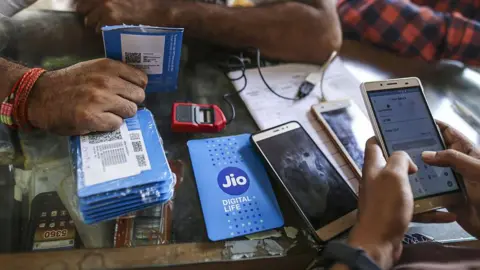 Getty ImagesExperts say that digital literacy hasn't kept pace with the internet boom in India
According to the latest NCRB report, by the end of 2024 around 100,000 cybercrime cases were pending investigation and about 75,000 were yet to be tried in court.
But that's not to say that India hasn't been trying to combat the issue on a war footing. In 2020, the federal government launched the Indian Cybercrime Coordination Centre (I4C), which collaborates with Indian and international agencies to tackle cybercrime nationwide.
The government has also launched a helpline - 1930 - and a portal to report and block cyber fraud, implemented public awareness campaigns and new technology and data protection laws to tackle deepfakes and AI-voice scams.
Recently, India's Home Minister Amit Shah announced that I4C was collaborating with Reserve Bank Innovation Hub to use AI to detect and cull hidden mule accounts - bank accounts or digital wallets used by cybercriminals to receive, transfer and launder illegally obtained funds while hiding their true origin. India's central bank is also mulling measures to tackle digital scammers.
But data suggests that cybercrime isn't letting up.
Soumya Gupta, a journalist and author of the book Bharat Bluff: Inside the cons of India's internet revolution, says that the boom in internet connections and smartphones has put people at increased risk of falling prey to digital scams. According to government data, over 86% of households are now connected to the internet.
Digital literacy hasn't kept pace, Gupta says, but adds that things are slowly changing due to public awareness campaigns and reporting in the media.
"But at the end of the day, the art of scamming is psychological rather than technological," Gupta says.
 Getty ImagesAccording to government data, about 86% of Indian households are connected to the internet
She writes in her book that scams play on our fear, greed or beliefs and ideology and that once we're sucked into a scam, we either don't know how to extricate ourselves, are too ashamed to say anything or trudge on due to sunk-cost fallacy.
Gupta also says that scammers closely track people's online behaviour and use the information to select victims and devise scams that will get them to take the bait.
Shrivastav says that it was her fear of the police that was exploited by the scammers and perhaps, her popularity as a stand-up comedian.
"From a young age, we're taught to be afraid of the police and to obey authority. That ingrained fear overrode the alarm bells that were ringing in my brain," she says, adding that she was also eager to prevent any incident that would spoil her reputation among fans.
Performing a comedy routine based on her experience was unnerving, she says, as she was scared to be vulnerable about her mistakes and risk being called a fool by the audience.
"But I wanted people to know that if I - an educated, urban woman who considers herself to be street-smart - could get scammed, it could happen to anyone," Shrivastav says.
Gupta says that it is crucial for people to be cautious about what they're sharing online and to take adequate measures to safeguard their data.
"But along with this, the golden rule is - if it's too good to be true, it's probably not true and if something doesn't feel right, stop and ask for help."
Follow BBC News India on Instagram, YouTube, X and Facebook.
IndiaAsiaCyber-crimeArtificial intelligence


