The focus to this point has been on risers, but some of the old guard needs to be adjusted down
 By Scott White Apr 30, 2026 at 10:05 am ET • 6 min read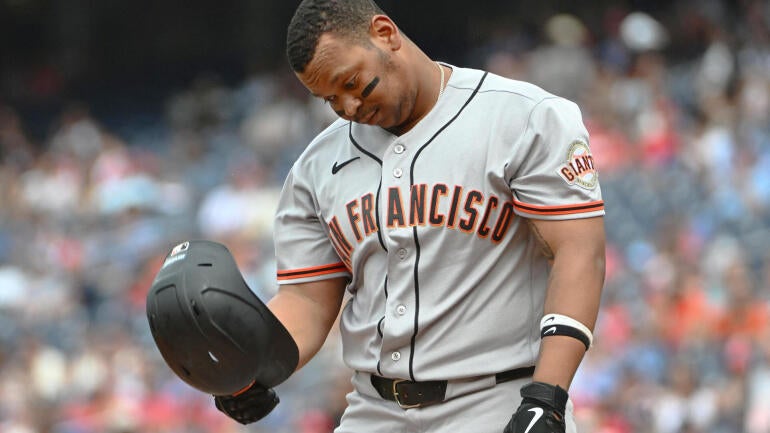
Most every week, Scott White will highlight some of the more notable changes to his rest-of-season rankings. You'll find said rankings here and are urged to bookmark them if you haven't already. There's no better resource for gauging player value throughout the long season.
I've stressed before the need for caution with any rankings adjustment this early in the season. If you go down far enough that the investment level is minimal, sure, sweeping changes are justifiable, but the genuine tried-and-trues are practically untouchable. Why? Almost anything can happen to any player in just a month's time, so if you take that first month as a cue for how the rest of that player's season will go, you're liable to look foolish.
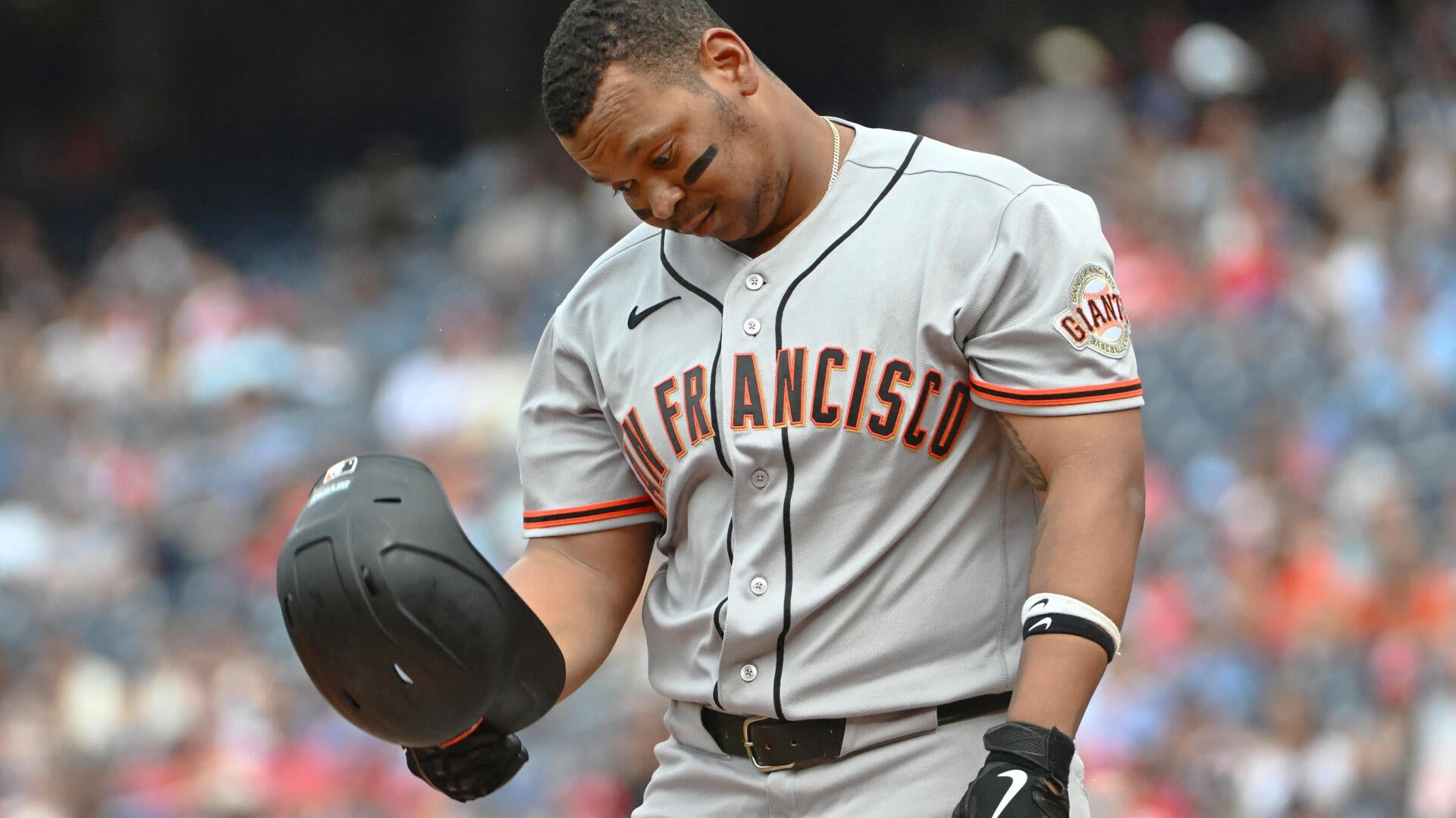
It's with great fear and trembling, then, that I tell you I'm ready to make a move with Rafael Devers. I mocked that very idea in this same space just a week ago, but I've seen the light and it is dark indeed.
Bolstering the case is that there were already warnings signs coming into the season, which makes my sudden willingness to act a sort of confirmation bias, you could say. But if I'm responding to a continuing trend rather than a brand new development for 2026, I'm not basing my assessment on just a month's time, now am I?
The 10 biggest rankings moves for this week
- OK, before you get too excited, Devers is still in my top 10 at first base, which may not qualify as a "big move" to you. But for a player who has been an early-round mainstay since he first broke into the league 10 years ago and who remains in his prime at age 29, it's a significant tumble. It's well deserved, though, given that the contact issues that first came to light a year ago have only intensified. Of particular concern are his struggles against fastballs, which have him swinging and missing more than 20 percent of the time. Those contact issues are accompanied by a continued decline in bat speed, which first took a tumble last year. Devers isn't old, but he looks it at the plate, and he wouldn't be the first perennial All-Star to drop off a cliff around age 30. I'm not saying that's happening -- still ranking him 10th, after all -- but I'm losing confidence he can return to being the four-category threat he was for most of his time in Boston. That's enough to drop him behind not just Sal Stewart and Ben Rice, but also Josh Naylor, who himself is off to a poor start but in a way that doesn't concern me as much.
- With every week comes a new Sal Stewart adjustment, but this one is in a different vein. He's now eligible at third base in CBS Sports leagues, to the cheers of the worshipful masses. Likewise, in what is perhaps an even greater miracle, Fernando Tatis Jr is now eligible at second base. It won't surprise you to learn, given how high I rank Stewart at first base, that he immediately slots into my top five at third base, behind only Jose Ramirez, Junior Caminero, Jazz Chisholm and Manny Machado. It may surprise you to learn that Tatis is my new No. 1 at second base, though it really shouldn't. He was drafted ahead of Jazz Chisholm and Ketel Marte, after all.
- For as massive and volatile as starting pitcher is, this week's changes were mostly confined to outside of the top 60, which appears to be the dividing line for the pitchers that absolutely need to be rostered and the ones that I could take or leave. Climbing into that first group, ahead of injury cases Sonny Gray and Nick Pivetta, are Kyle Harrison, Spencer Arrighetti and Chase Dollander, three pitchers who are suddenly showing massive strikeout upside. Falling a little behind them at 66 is JR Ritchie, whose strikeout potential isn't as evident and whose claim to a rotation spot isn't as clear.
- Louie Varland was only anointed to the closer role about a week ago -- and not even officially -- but already, he's in my top 12 at relief pitcher. This is partly an indictment of the position itself, which has already seen so much turnover due to injury and poor performance, and partly a comment on Varland's actual production, which has been better than anyone could have even imagined from Jeff Hoffman. In 15 appearances, Varland has a 0.56 ERA, 1.00 WHIP and 14.6 K/9.
- Travis Bazzana, formerly the No. 1 pick in the 2024 draft and newly appointed as the Guardians second baseman, debuts at 13th for me at that talent-poor position. I want to stress that last part so that no one misconstrues the high ranking as irrational exuberance for Bazzana, who has his talents but didn't wreck the minor leagues in the way you'd expect of a No. 1 pick. It's just that I'd rather purchase that lottery ticket than continue to cross my fingers on Matt McLain, Marcus Semien and Ceddanne Rafaela.
- On the other hand, I can only rank Bazzana 13th at second base because the league has blessed us with 12 quality options there, which was hardly a given coming into the year. One of those who appeared to be on the bubble was Ozzie Albies after a couple of disappointing seasons, but I was of the opinion that health (or a lack thereof) was largely to blame for those disappointments. His performance to begin this year would seem to validate that thinking and has pushed him into my top five at second base, ahead of early disappointments Jose Altuve and Luke Keaschall.
- Though he debuted last year with 21 homers in 71 games, which paces out to 48 in 162, Colson Montgomery was largely an afterthought in drafts because the whole profile seemed too volatile. It hinged entirely on those home runs, which were backed up by moderate exit velocities and a poor contact rate. He offered a profile of extremes with a narrow path to success, and yet ... he's doing the exact same thing this year. It's honestly stunning how close his Statcast readings are to a year ago, for as unrepeatable as it all seemed, which justifies a move up into the seemingly impenetrable range of the shortstop rankings. He's now at 16th, ahead of Trevor Story (quite the tumble for him), Dansby Swanson and Willy Adames.
- Ozzie Albies is back, so why not Michael Harris? There's a reason why the Braves have the best record in baseball, after all. The 25-year-old is hitting the ball as hard as anybody, with his Baseball Savant page depicting a bunch of 98s and 99s (for the uninitiated, those are percentile rankings), and he's once again looking like the five-category threat he was in 2022 and 2023, batting average and all. With that, Harris has climbed back into my top 20 in Rotisserie, ahead of Jackson Merrill, Tyler Soderstom and Wyatt Langford.
- Enough is enough. I've gone ahead and buried Aaron Nola, moving him from 58th at starting pitcher to 90th. Even at his best, he had a narrow margin for error, relying more on impeccable command than pure stuff, and after a year in which he contributed a 6.01 ERA, I've seen no evidence that he's figured out what went wrong. Luis Castillo is right there with him at 89th, his multi-year decline having also seemingly come to a head.
- Perhaps you've noticed that Carlos Cortes, a 5-foot-7 outfielder playing more days than not for the Athletics, is slashing .400/.473/.692 with four home runs in 24 games. What you may not have noticed is that he ranks in the 99th percentile or better in xBA, xSLG and xwOBA, which means he's earned everything he's gotten so far. You may also not have noticed that he slashed .322/.414/.603 with 17 homers in 71 minor league games this year. He's not exactly a prospect, being just a couple months shy of his 29th birthday, and he hasn't made himself indispensable against lefties yet. Still, is 56th too low in the outfield? It doesn't properly capture my enthusiasm, but there are enough possible drawbacks here to keep Cortes behind Steven Kwan, Sal Frelick and Kerry Carpenter for now.