

 Harriet Whitehead
 BBC
BBCDrivers lean on their horns as a group of protesters stand along the roadside. One white-chalk sign reads: "Beep if you want to save our green spaces". Another, decorated with hand drawn foxgloves, hedgehogs and birds, declares: "We need homes too!". The demonstration is organised by Protect Enderby and Narborough Green Spaces, a local group fighting a proposal to build up to 800 homes, partly on Enderby Golf Course.
The development forms part of Blaby District Council's emerging Local Plan, the document that will shape where future housing can be built. But the proposals have triggered a backlash: thousands of people have signed a petition urging the council to rethink.
This local protest was one of many held on Saturday - with what organisers from the Community Planning Alliance claimed were around 170 organisations taking part nationwide as part of a day of action aimed at highlighting concerns over the loss of green spaces across the UK.
For some of the people who use Enderby Golf Course in Leicestershire, its loss would be keenly felt. "It's only a nine hole little course, which is why a lot of people love it here, because it's like half a golf course," explains Chris D'Araujo, who manages the site. "It is perfect for a new golfer or retired people that don't really want the big long up and down hills, like a proper private course. We do serve a very good purpose for the community."
"It'd be sad to see it go… I think this would be the very, very last site you would pick if you had to," Chris says.
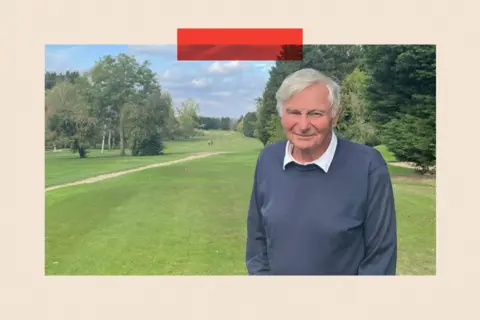
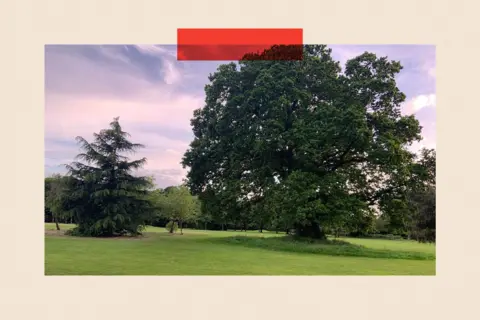 Chris D'AraujoEnderby Golf Club has become one of the many courses earmarked as a potential site for new housing
Blaby District Council has said the area of land it has proposed for development, including the golf course, could help it meets it planning obligation of delivering 654 new homes a year up to 2042. The site offers an opportunity to create a "sustainable community" with public green space open to all and "much-needed affordable housing" it said.
The site still needs to go through the relevant planning stages, and the need for new homes will be balanced "against public amenity", the council added.
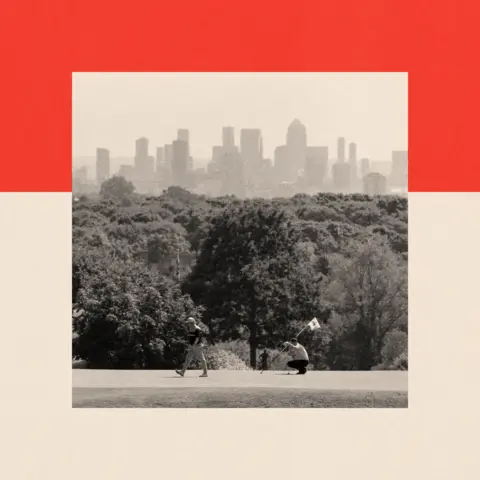
The UK hosts around a quarter of Europe's golf courses at a time when the government is pushing hard to increase housing supply - aiming for 1.5 million new homes in England over five years, or roughly 300,000 to 370,000 a year. In England alone, golf courses occupy an estimated 270,000 hectares, around 2% of the country's total land area - roughly the same amount used for domestic buildings, by some estimates.
Gavin Anderson, from England Golf, the governing body for amateur golf, says the organisation has seen a significant rise in planning proposals involving partial or full loss of golf provision, particularly over the last two to three years - likely because golf courses often sit on large, well‑located pieces of land at a time when councils are trying to find space for new homes.
And Custodian Golf consultancy reports that nearly 20% of clubs are financially at risk, a factor that could influence decisions to release land for housing.
It is against this backdrop a debate has sharpened over how this land should be used: are golf courses the right places to build housing, or are they simply a soft target?
Public good
Golf has long carried a reputation as a pastime reserved for the privileged - with the average age of a golfer in many traditional club settings in the 50s. But many argue the landscape has shifted.
Chris has played at Enderby Golf Course for about 35 years. He says before Covid-19 the average age of a golfer there was around 60, but is now much younger with many players in their 20s or younger. "The difference in demographic is incredible," he says.
The course is municipal, meaning it is owned by the local council and open to the general public, while private golf clubs tend to be members-only and have annual fees. Enderby costs an adult £12 for a nine hole round on a weekend.
"[The course] is massive for youngsters now," Chris says. "They can't really access the private golf courses, because they're too expensive." Membership costs vary greatly - one annual survey of 79 members' clubs across ten regions in the UK found costs ranged from £200 to £3,870.
But Anderson says that golf is becoming more welcoming. "The myth that golf is exclusive or inaccessible is not the reality on the ground," he argues, though he notes barriers still exist - including cost and perception.
Total membership at English golf clubs rose from 730,602 in 2024 to 750,071 in 2025 – with junior membership growing by more than 34% in 2025, rising from 46,028 to 61,483. Meanwhile, 20% of adult golfers on full-length courses in the UK and Ireland were female in 2022 compared to 15% in 2019.
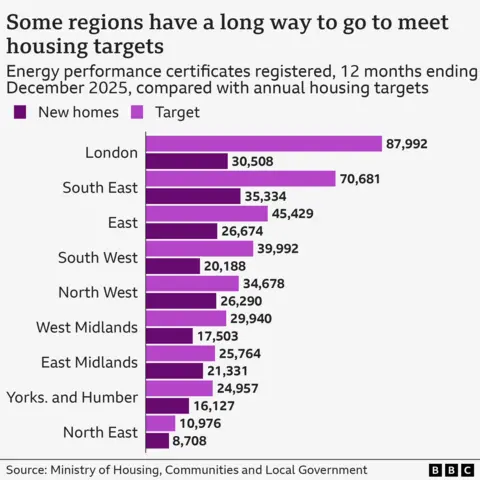
Yet this growth happens at a time when house building is falling well short of government targets. Ant Breach, director of policy and research at the Centre for Cities think tank, says too few homes are being built, contributing to "exceptionally expensive" housing.
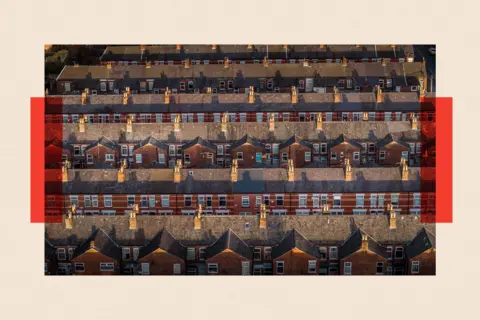 Getty ImagesToo few homes are being built, contributing to "exceptionally expensive" housing, argues Ant Breach
Ben Cooper, head of the Fabian Housing Centre, a left-leaning think tank, argues golf courses are often a waste of land, which could instead be used for house building. Amidst a housing crisis, and with many people in temporary accommodation, he suggests "using substantial acres of land for golf courses, compared to actually building on those golf courses, is probably the wrong priority".
Russell Curtis, director at RCKa architects, also believes some golf courses could be turned into housing. He began looking at courses in London as a lockdown project and calculated that Greater London has more than 90 golf courses - which take up to 17% of all the available green space in London. Combined, they cover an area roughly the size of the entire borough of Brent (43km²).
"There's an argument, I think, to be made to convert these into lots of things. It doesn't have to be just housing," he says.
The green belt debate
The government has set annual housing targets for each local authority in England.
Planning is devolved in the UK, and historically development on green belt land has been discouraged. In July 2024 the government introduced a new "grey belt" policy for England - proposing that if a council's housing targets cannot be met, some existing green belt land will be redesignated as grey belt.
Some think this now makes golf courses a "soft target" for development.
According to Anderson, the overwhelming factor driving cases of golf course redevelopment in England "is the increasing value of land, combined with the escalating pressure on local authorities to identify sites to meet ambitious housing targets." Because golf courses can sit on large areas of open land, often bordering or nearby urban zones, this can mean they are put forward as development options.
A Ministry of Housing, Communities and Local Government spokesperson said: "We inherited a housing crisis which is why we're getting spades in the ground to build the homes people need and restore the dream of homeownership.
"We also recognise the value sports facilities and green spaces can have for local communities, which is why there are appropriate planning protections in place to safeguard these spaces."
And though many golf courses in England are being discussed as potential redevelopment sites, it's not an even picture across Britain. In Wales, the golf governing body says it is aware of very few courses being converted into housing. It suggests this is largely because most Welsh courses sit in out‑of‑town or rural locations, making them less attractive for development. Scottish Golf also say the issue has not emerged as a major concern.
'It has to be well connected'
This all begs the question: are golf courses actually suitable locations for new housing developments?
Nicole Guler, a chartered town planner and director at Urbanist Architecture says choosing a golf course could be suitable but there always has to be a "logic" to it, with access being a key consideration. "It has to be well connected… if it is not, then I would definitely say that it is not appropriate to select that site."
Russell Curtis, who analysed London golf courses during the pandemic, takes a similar view. He notes that while some courses are poorly connected and therefore unsuitable, "there are quite a number of courses that are very close to public transport and it seems reasonable that at least some of those should be turned into housing."
"We should be building homes close to social infrastructure that aren't reliant upon car ownership," he says.
 Getty Images"There are quite a number of courses that are very close to public transport," notes Russell Curtis
But what about golf courses in the green belt, which though perhaps well connected, may have environmental value?
Anderson says golf courses can act as significant green infrastructure supporting biodiversity: "Many courses provide tree cover, habitats for wildlife, pollinator‑friendly environments, and opportunities for ecological improvement that can exceed what is possible on developed land or open fields."
But studies have suggested that golf courses can perform poorly for biodiversity compared to more natural habitats and their maintenance can be resource intensive (though many golf courses are working to improve their environmental footprint).
 R&A via Getty ImagesGolf courses can act as significant green infrastructure supporting biodiversity, says Anderson
 Paul de Zylva, from the environmental group Friends of the Earth, says the debate about building on golf courses should be seen in the context of the "pressure on green spaces".
He says that people will dub golf courses as not particularly biodiverse so as to argue they do not really count as green, and therefore should not be part of the green belt. De Zylva argues this misunderstands the point: "The purpose of the green belt isn't to be green per se, it is to be a buffer to prevent sprawl." So the question is not only whether golf courses are particularly biodiverse, but whether or not it is wise to build on this type of land.
"If golf courses are under pressure to be developed, that's because of the way the system has been set up," he says.
For Cooper, from the Fabian Housing Centre: "The nature versus house building [debate] doesn't necessarily apply in golf courses, because golf courses are not biodiverse… or easily accessible if you want to enjoy nature."
"Whereas what we can do is use that land not only to supply thousands of additional affordable homes, we can use it to increase access to these spaces."
Cooper notes that under the grey belt policy, there are "golden rules" which apply for development. These include things like accessible green space. "So you can get that win-win for affordable housing and for access to nature in communities."
"We can have house building [and] we can have more nature if you build on golf courses."
De Zylva suggests well managed golf courses could play their role in restoring nature in the UK, and says: "I don't think they should be seen as fair game for being covered in concrete, in the same way as quality farmland, woodlands, wetlands, parks, should not be."
Research from the Campaign to Protect Rural England argues there is enough brownfield land to build 1.4 million homes in England, and more than half of these sites already have planning permission.
Curtis accepts the principle of "brownfield first," yet argues that many golf courses effectively meet that definition, describing them as "not biodiverse."
'Planning and health are inextricably linked'
For more than 40 years, David Young was a member of the North Oxford Golf Club. The 70‑acre site closed at the end of 2025 after being earmarked for a development of more than 1,000 homes. The landowners - Oxford University, Merton College and Exeter College - reached an agreement with the club and offered £4.3m for them to vacate the site. A group of golfers called the Greenway Group, of which David is a member, came together in an effort to halt the plans, but ultimately their campaign failed.
An alternative golf course site at Frieze Farm has been proposed as part of Cherwell District Council's local plan. Oxford is one of the least affordable places to live in the country, with average house prices now more than 13 times the average household income.
"Very cross… very sad," is how David sums up his feelings. For him, the club (where monthly fees for a full seven day membership were around £130), was "very much a community-based" place, and its closure has left many locals having "lost a friendship group". A former county planner in Oxfordshire, he argues: "Planning and health are inextricably linked. People need to exercise, they need to have somewhere to walk, go, play, commune. Mental health and physical health are exceedingly undervalued at the moment by planning."
 LDRSFor more than 40 years, David Young was a member of the North Oxford Golf Club
Russell Curtis suggests there's a case for making golf courses smaller without limiting people's ability to play. "If you reshape a course and reduce its size, that releases quite a lot of land for other things, including development and that development might then provide an injection of cash into a club."
Some, however, are concerned about the wider impact on the sport.
Enderby's Chris D'Araujo argues: "You're going to gradually take the accessibility of the sport away, because you're going to find all the private rich clubs, they're going to still be about, but you are making it less affordable, and taking it away from the masses."
Others suggest the debate should not be framed as a binary choice. "It's only relatively recently that the idea of there being a straightforward choice between golf and housing has surfaced, largely driven by the pressure on land [rather] than by any fundamental issue with the sport itself," says Anderson.
"Fundamentally, when framed as golf versus housing, this risks oversimplifying a much more complex challenge and distracts from the reality that housing shortages are driven by systemic planning and infrastructure issues, rather than the presence of one particular sport."
Top picture credit: Getty Images
More from InDepthThere's a solution for e-bike parking chaos - but it's not problem-free
NHS dentistry is rotting. Will the plan to fix it work?
Where responsibility lies when social media inspired mountaineers get into trouble

BBC InDepth is the home on the website and app for the best analysis, with fresh perspectives that challenge assumptions and deep reporting on the biggest issues of the day. Emma Barnett and John Simpson bring their pick of the most thought-provoking deep reads and analysis, every Saturday. Sign up for the newsletter here
HousingUrban planningHousing market