
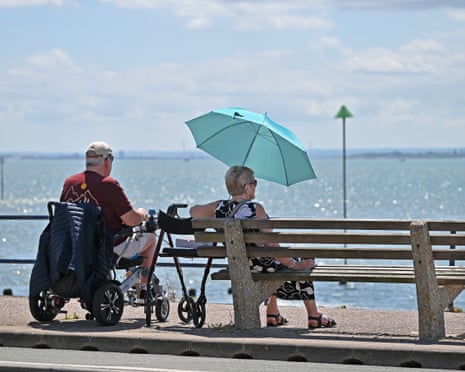
 Extreme heat exposure is a growing threat to human health and older people are particularly vulnerable, the study showed. Photograph: John Keeble/Getty ImagesExtreme heat exposure is a growing threat to human health and older people are particularly vulnerable, the study showed. Photograph: John Keeble/Getty ImagesExtreme heat more dangerous for people 60 and over than previously thought
Study finds older adults could face harmful heat stress at just 1.5C of warming above preindustrial levels
People aged 60 and over face dangers to their health from exposure to heat at much lower temperatures than previously thought, research has found.
Older adults will bear the brunt of increasingly frequent sustained spells of extreme heat globally as the world continues to warm up, according to a study in The Lancet Public Health.
Heatwaves will leave huge and growing numbers of people worldwide of all ages suffering from uncompensable heat stress (UHS) – where the body loses the ability to cool itself – and thus at risk of serious damage to their health, including death.
Heat exposure of older people across world to double by 2050, finds studyRead more“Our results suggest accounting for age stratified vulnerability, intolerable heat will be experienced at much larger scales and for longer durations, affecting far more people than previously thought,” according to the study, which was led by health academics from Stanford University in California.
Older adults are known to be more in danger because of the effects of very high temperatures. They sweat less, their hearts work harder in the heat and their blood vessels are less able to widen, limiting their capacity to stay cool.
However, previous studies did not properly set out the different risks faced by younger people aged 15-39, middle-aged adults (40-59) and older adults (aged 60 or over). That is because they applied thresholds at which people cannot maintain their heat balance – which were accurate for younger people – to all age groups, and so overlooking older people’s greater risk of, for example, heart attacks.
A combination of rising global temperatures and the projected doubling in the world’s population of those aged 60 and over to 2.1bn by 2050 means more people in that age bracket will suffer heat-related health problems, especially in low- and middle-income countries such as India and Pakistan.
“UHS will become increasingly prevalent with global warming across all age groups. Older adults are projected to face far more frequent and widespread UHS than young adults,” the study says.
The UK Health Security Agency said recently that it fears that 2026’s high temperatures in Britain – parts of which have experienced five heatwaves – are likely to mean that the country records its highest ever number of heat-related deaths in a year. The four-day heatwave in May and eight-day heatwave in June together caused 2,877 excess deaths, almost double the 1,504 seen during the summer of 2025.
Dr Simon Williams, an expert in the impact of heat on human health and the resulting inequalities at Swansea University, said: “This is a very significant study, with findings suggesting that heatwaves and extreme heat exposure is going to be a growing threat to human health in the coming years. In particular, it shows that heatwaves have unequal health impacts, with older adults particularly vulnerable.”
He added that the study suggested older adults were “at risk of harmful and potentially fatal heat stress” at just 1.5C of warming above preindustrial levels, compared with 4C for younger adults.
Each additional degree of global heating “exposes roughly one million more people to at least 180 hours of UHS annually”, the study says. This burden falls disproportionately on older adults.
If heating continues to escalate, parts of the tropics and subtropics could become uninhabitable, especially for older people, the authors said.
Caroline Abrahams, the charity director at Age UK, said: “These findings are alarming. This study means there’s now no denying that extreme heat poses a very real health threat to our older population.
“High temperatures can exacerbate certain medical problems that are common among older people and, more generally, ageing bodies find it harder to adapt to more extremes of heat and cold as we age.”
Dr Hilary Williams, the clinical vice-president of the UK’s Royal College of Physicians, said: “Extreme weather, including severe heat, is a patient safety issue.
“We know that heatwaves bring a surge in patients. Older people often arrive with dehydration, having collapsed, or with existing conditions like heart and kidney disease made worse by the heat. Managing multiple health conditions at once is hard enough but doing it when the body’s ability to regulate its own temperature is less efficient makes it harder still.”
One hospital doctor reported the temperature on the geriatric ward where they work reaching 36C during this summer’s extreme heat. “That is not a safe environment for patients or staff,” said Williams.
Explore more on these topicsShareReuse this content

