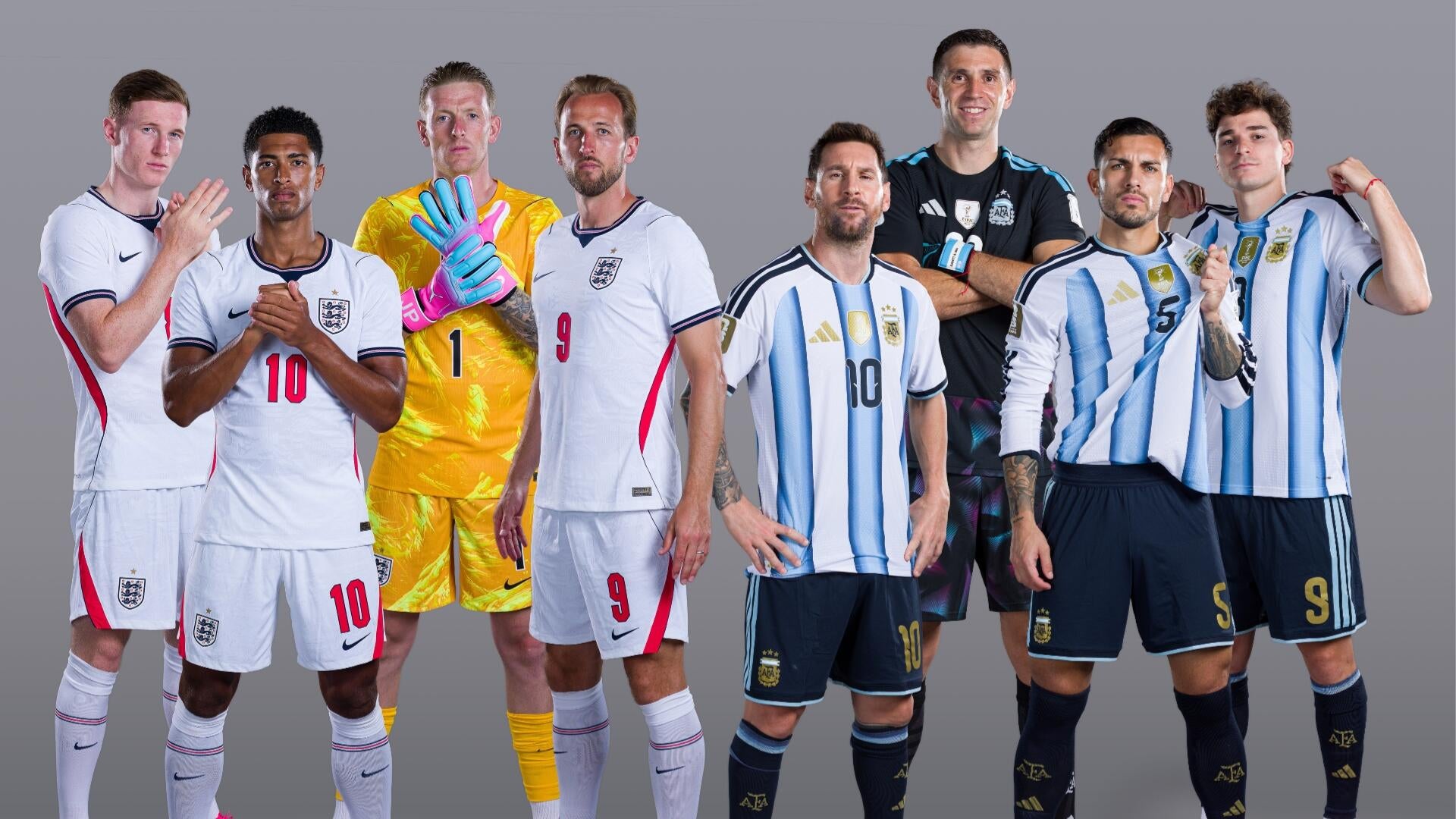
ATLANTA – "We [will] try exactly what is maybe not possible."
England's Thomas Tuchel offered a peek inside the mindset of a head coach in the hours before a World Cup semifinal, his main objective to free his players of any unnecessary fodder bouncing around their brains ahead of a monumental match. In the same breath, though, he shared the great conceit before Wednesday's game – how could anyone possibly ignore the fact that England and Argentina are meeting once again, this time for a spot in Sunday's World Cup final?
This summer's tournament has already delivered one classic semifinal, Spain outdoing a seemingly unbeatable France in their greatest showing at the World Cup yet, while Wednesday's game between England and Argentina is poised to offer another batch of memorable moments. The second semifinal, though, is tinged by a decades-long history between these two teams. The story of how red cards were introduced to soccer runs through these two sides, as do the sport's most infamous goal and the Falklands War – and it was all up for grabs in Tuesday's pre-match remarks from both Tuchel and his Argentina counterpart Lionel Scaloni, who did what they could to downplay things.
"The reality is this is a football match," Scaloni insisted when asked about the Falklands War, which took place over 10 weeks in 1982. "I am not going to mix everything up, especially regarding things that happened so long ago. It was a very sad time in our history and we can't do much about it. This is a football game, that's all."
He is perhaps the only public-facing Argentine this summer attempting (unsuccessfully, to be honest) to distance himself from the war. A chant referencing the Falklands, known as Islas Malvinas in Argentina, Diego Maradona and Lionel Messi has become a common refrain amongst fans and players alike during their latest run to the semifinals – "For the Malvinas, for Diego, for Leo's last World Cup. Argentina, I want to see you win it again."
Scaloni, though, was naturally happy to open up on the biggest on-field controversy in the history of this rivalry – the "hand of god" goal scored by Diego Maradona at the 1986 World Cup. The player scored a brace to ensure Argentina would beat England 2-1 in the quarterfinals that year and admitted post-match that he handled the ball on the second goal, still a source of pride for Argentines from Scaloni's perspective.
"I think everyone remembers that game and they remember Diego Maradona's game, in particular that second goal," he said. "That will be forever in our hearts. It was such a beautiful goal. Anybody who loves football will remember that in the best way possible. It was just a coincidence that it was against England but had it been against anyone else, it would've been just as beautiful. That is the fact of the matter so yes, we have the stories from that time and this all makes it very emotional."
Tuchel, for his part, hopes the players can block out the historic weight of the moment.
"I would say it's irrelevant but I'm not sure about it," he said. "I think the players are very aware – of both countries – what it means to them. If a fixture provides so many iconic moments, I think you cannot just say that it's another football match but as a coach, we do exactly that. Focus on what we can influence. Me and my team, between us, we don't speak about the historic events. We don't speak about the iconic moments. It's in itself iconic enough and the tension is big enough so we try exactly the opposite and try to influence the players in what we want them to do, how we want them to behave in different situations and we try to reduce the information the bigger the stage gets, the bigger the tension grows so hopefully we can simplify the messages enough that they can execute it."
Explaining England vs. Argentina rivalry: Falklands War, 'Hand of God' and the match that changed soccer Francesco Porzio
The context of Wednesday's game in a vacuum is overwhelming in its own right. England are technically one game away from their first World Cup final in 60 years, a slow but steady crescendo after a younger version of the team reached the tournament semifinals eight years ago in Russia. Since, they have played in two European Championship finals and another World Cup quarterfinal, many members of the group at this point are no strangers to big occasions. There is one notable obstacle in their way – the ageless Messi, who remains the joint leader in the golden boot race with eight goals.
"I was thinking about this, if we do a proper old school man-mark [for Messi]," Tuchel said. "I'm not sure if we follow through with this idea but it crossed my mind. I think everyone knows the spaces where he wants to show up. It's just like, you analyze the matches, you feel he just sees stuff earlier than anyone else on the field. It's just like the ball drops to him, he finds the gap, he makes himself the space for his left foot and then executes the solution on the very highest level. I think we found some patterns in their game of course but if we close the patterns he will find a new one or create a new one. It is his super strength, it is just what it is."
Tuchel's side will also aim to improve upon Saturday's quarterfinal win over Norway, needing extra time during a dull showing to advance.
"I think we had too [many] technical errors in our last match, too [many] technical errors that hold us back from finding a rhythm in attack," Tuchel said. "We were, again, a bit rushed in our decision-making. We were not patient enough. We were not disciplined enough in our positions. That cost us the rhythm of attacking. We improved through the tournament a lot in defending, in defending as a team so this is something that we need to, of course, have tomorrow in the highest level but our rhythm, our build-up play and the acceleration of our attacking game, combined with the technical execution, has to be on a higher level and like I said, we haven't peaked in this kind of momentum yet but I think a match, a stage like tomorrow, an opponent like tomorrow, a set-up like tomorrow will bring the best out of us, the best out of my players and we're excited for it."
Then there is Argentina, a formidable foe for their ability to face adversity but a deeply inconsistent semifinalist as far as these things go. A routine batch of games in the group stage gave way for a chaotic series of knockout matches, going to extra time against Cape Verde in the round of 32 and Switzerland in Saturday's quarterfinal while escaping a 2-0 deficit against Egypt in the round of 16. It is perhaps why Scaloni took a measured approach when reflecting on his team's journey to the semifinals, even if the ambition to reach a second straight World Cup final – and a fourth straight final in major competition if you include the Copa America – is still clearly there.
"A month and a half ago, I would've just wanted to be here regardless of how we got there, tired or not tired, it doesn't matter," he said. "We are at a semifinal and a month and a half ago, i would've accepted that. I would've signed off on that. Now, of course, the dream is here. We are very excited. We are very pleased and we're not looking at the condition we're in. We're there and we're playing."
Add CBS Sports on Google Join the Conversation comments