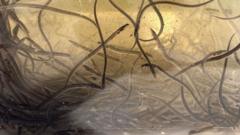

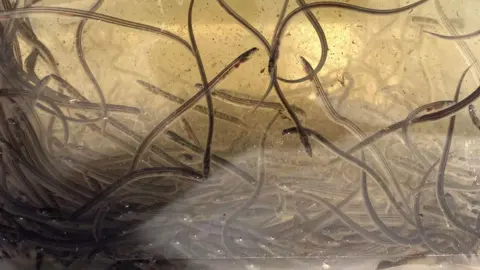
 Tees Rivers TrustEuropean eels start life in the Sargasso Sea before migrating to Europe
Endangered European eel numbers in a former industrial river will be boosted thanks to a new project.
The Eels of Steel scheme, funded by Natural England, aims to accelerate the recovery of the type of fish in the Tees catchment.
Volunteers and workers from the Tees Rivers Trust said they hoped to boost numbers by improving habitat quality and reconnecting people with the overlooked species.
Project manager Ellie Ward said eels were "a critical part of marine, brackish and freshwater ecosystems" but they were often seen as "gross and slimy".
"It is amazing to see how interested people become once they hear about their incredible life cycle," she said.
"Glass eels are mesmerising, almost translucent - an adaptation to oceanic migration."
Glass eels are juvenile eels, aged one to two years, that have just completed their migration across the Atlantic from the Sargasso Sea.
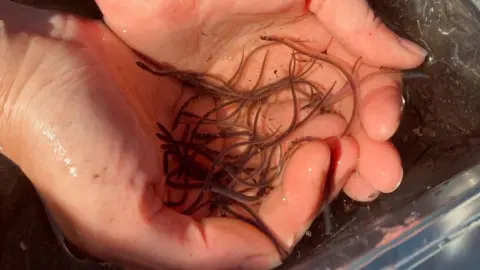 Tees Rivers TrustEuropean eels travel over 3,700 miles (6,000km) when swimming to Europe
The number of eels passing the barrage is being counted and measured every week between April and November.
Since the 1980s the European eel population has declined by up to 98% across all life stages.
The species is now listed as critically endangered on the International Union for Conservation of Nature Red List of Threatened Species.
Their life cycle is complex as they spawn in the Sargasso Sea in the North Atlantic Ocean before travelling to Europe.
They also need to swim freely up and downstream along rivers to find places to hide and food.
Mature eels then make the journey back to sea to breed.
Ward said changing water temperatures, pollutants, loss of habitat, over-exploitation and barriers to migration have led to the population decrease.
"We need eels, they are a critical part of marine, brackish and freshwater ecosystems," she said.
"They provide food for many other organisms including otters and bitterns."
Follow BBC Tees on X, Facebook, Nextdoor and Instagram.
More stories like this