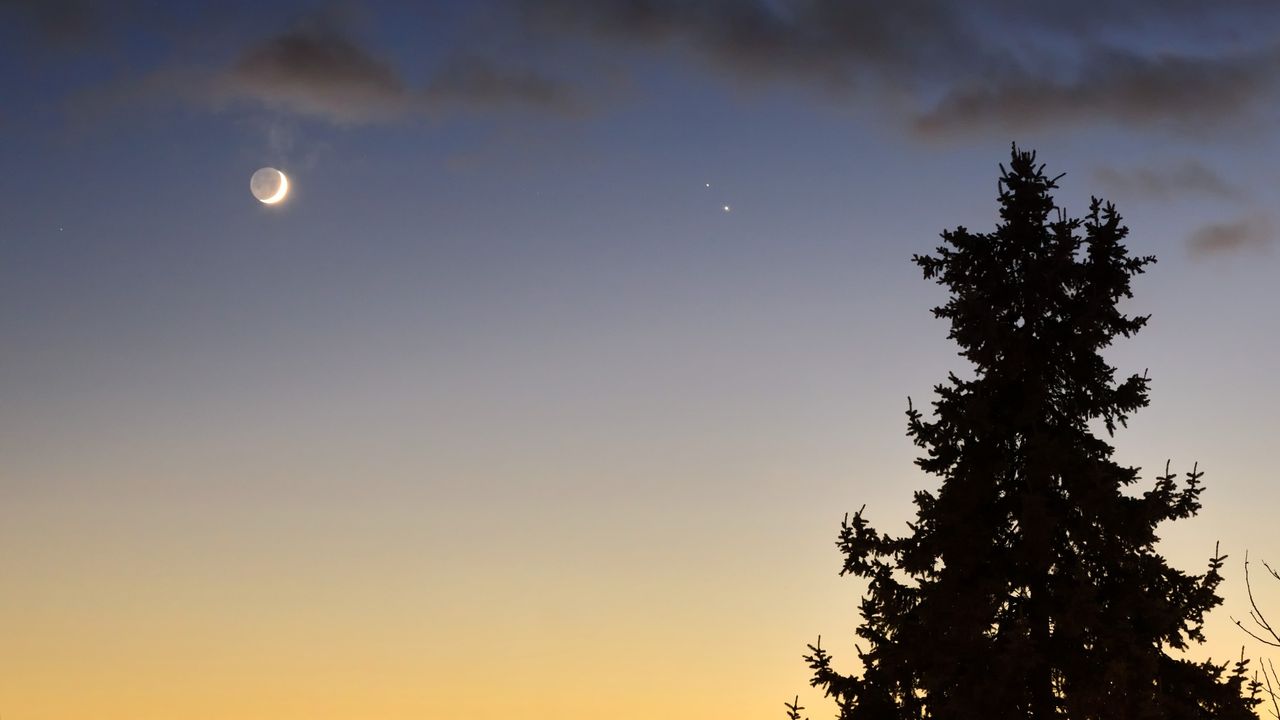
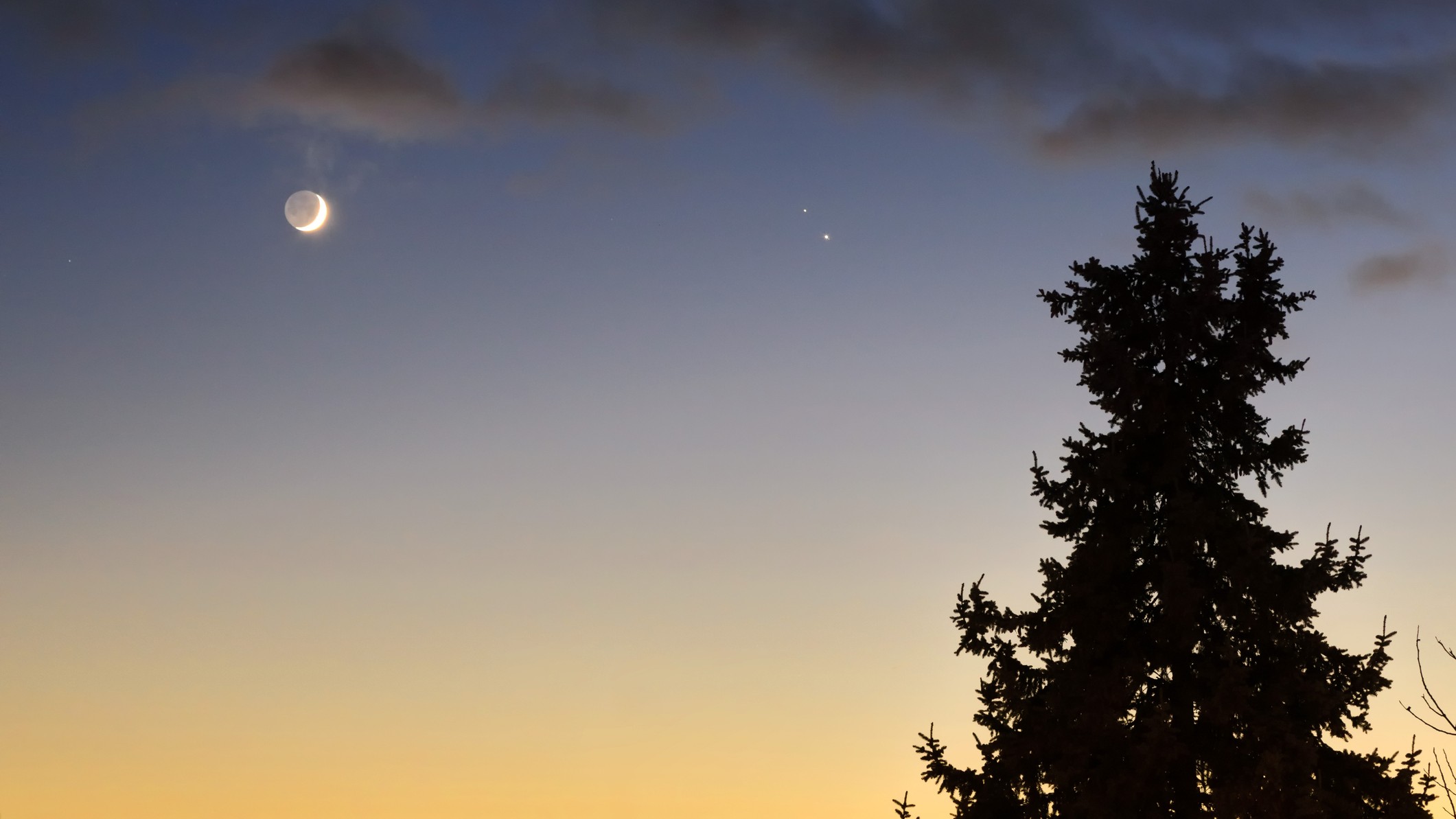
 The early morning sky on June 10 will offer quite the treat with Saturn shining close to the moon. In this photo captured Dec. 17, 2020, the moon shines to the left of Saturn and Jupiter. (Image credit: Christophe Lehenaff viaGetty Images) Share this article 0 Join the conversation Add us as a preferred source on Google Newsletter Subscribe to our newsletter
 Early risers on Wednesday morning (June 10) will be able to partake in an interesting rendezvous between the moon and a bright planet. Set your alarm for 3 a.m. and upon heading outside, look due east. Make sure you don't have any tall obstructions, such as trees or buildings, in your way. You'll first notice a fat waning crescent moon, two days past last quarter phase. At that hour, the moon will stand 10 degrees above the horizon, roughly the equivalent of the width of your fist.
Then, look about 5 degrees (half a fist) to the lower right of the moon and you'll see a rather bright "star" shining with a soft yellowish-white hue. Except that's not a star, but a planet.
The "Lord of the Rings" — Saturn.
If you are unable to see the moon and/or Saturn because trees or buildings are blocking your view, then wait another hour until the eastern sky has begun to light up with the break of dawn. By that time, both objects will have doubled their respective altitudes above the horizon and shifted toward the east-southeast.
Celestial pièce de résistance
For most amateur and professional astronomers, Saturn is the telescopic showpiece of the night sky. No photograph or verbal description can duplicate the thrill of seeing this ringed beauty through a telescope for yourself.
The generally accepted magnification for getting a glimpse of the rings is 30x, however, Murray Paulson, who edits the Planets and Satellites section of the Royal Astronomical Society of Canada's Observer's Handbook comments that "The rings. . . are visible even in steadied (or image-stabilized) high power binoculars and small spotting scopes." Those rings consist of countless billions of particles, the bulk of which are tiny, measuring from about the size of a grain of sand up to car-sized boulders, though the largest boulders are estimated to range anywhere from 30 to 60 feet (9 to 18 meters) across. These particles are made of — or covered by — water ice. This would account for their exceedingly high reflectivity. The reason that "rings" is plural and not singular is that gaps and brightness differences define distinct rings; complex subsystems of rings within rings.
Approximate location of the duo in the predawn hours on June 10. (Image credit: Created in Canva Pro by Daisy Dobrijevic)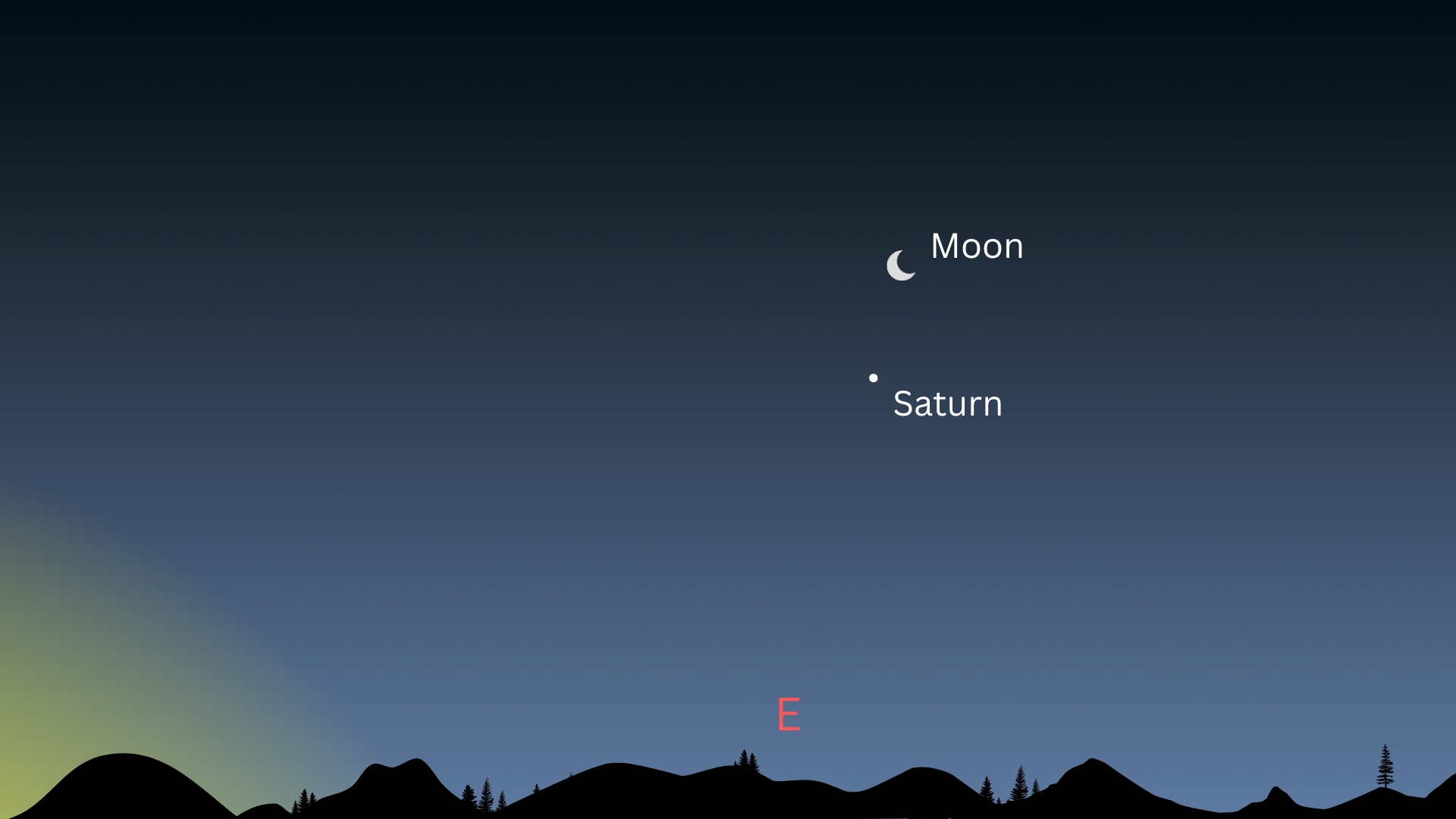
Coming attractions
In the weeks and months to come, Saturn will become increasingly more well-placed to observe in the sky as it rises a little earlier each night. Saturn started June within the boundaries of the non-zodiacal constellation of Cetus the Whale, then crossed into Pisces the Fishes on June 3. It will then come to a halt on June 27, after which it will begin a 4.5-month period of retrograde motion, causing it to move back into Cetus on Sept. 5, where it will remain for the balance of the year. It will arrive at opposition on Oct. 4, rising at sunset and well up in the south-southeast around midnight. It is the only bright star (but not superbright like Venus and Jupiter) in that region of the sky.
From now until 2039 (Jan. 22), the sun will be shining on the south face of the rings. As seen from the perspective of the sun, the rings will smoothly open out to a maximum of 26.96 degrees (widest open) on May 12, 2032, then smoothly close again. But as seen from here on Earth, the inclination angle will vacillate during the year because we (like Saturn) are moving around the sun and so we will view the planet from different angles. When 2026 began, the rings appeared nearly edge-on at an inclination of just 0.9 degrees. During June, the angle widens from 8.3 to 9.0 degrees. They'll reach a maximum of 9.1 degrees on Aug. 1, then will close to 6.1 degrees on Dec. 1.
Joe Rao serves as an instructor and guest lecturer at New York's Hayden Planetarium. He writes about astronomy for Natural History magazine, Sky and Telescope, The Old Farmer's Almanac and other publications.
View MoreYou must confirm your public display name before commenting
Please logout and then login again, you will then be prompted to enter your display name.
Logout Joe RaoSkywatching Columnist
Joe Rao is Space.com's skywatching columnist, as well as a veteran meteorologist and eclipse chaser who also serves as an instructor and guest lecturer at New York's Hayden Planetarium. He writes about astronomy for Natural History magazine, Sky & Telescope and other publications. Joe is an 8-time Emmy-nominated meteorologist who served the Putnam Valley region of New York for over 21 years. You can find him on Twitter and YouTube tracking lunar and solar eclipses, meteor showers and more. To find out Joe's latest project, visit him on Twitter.