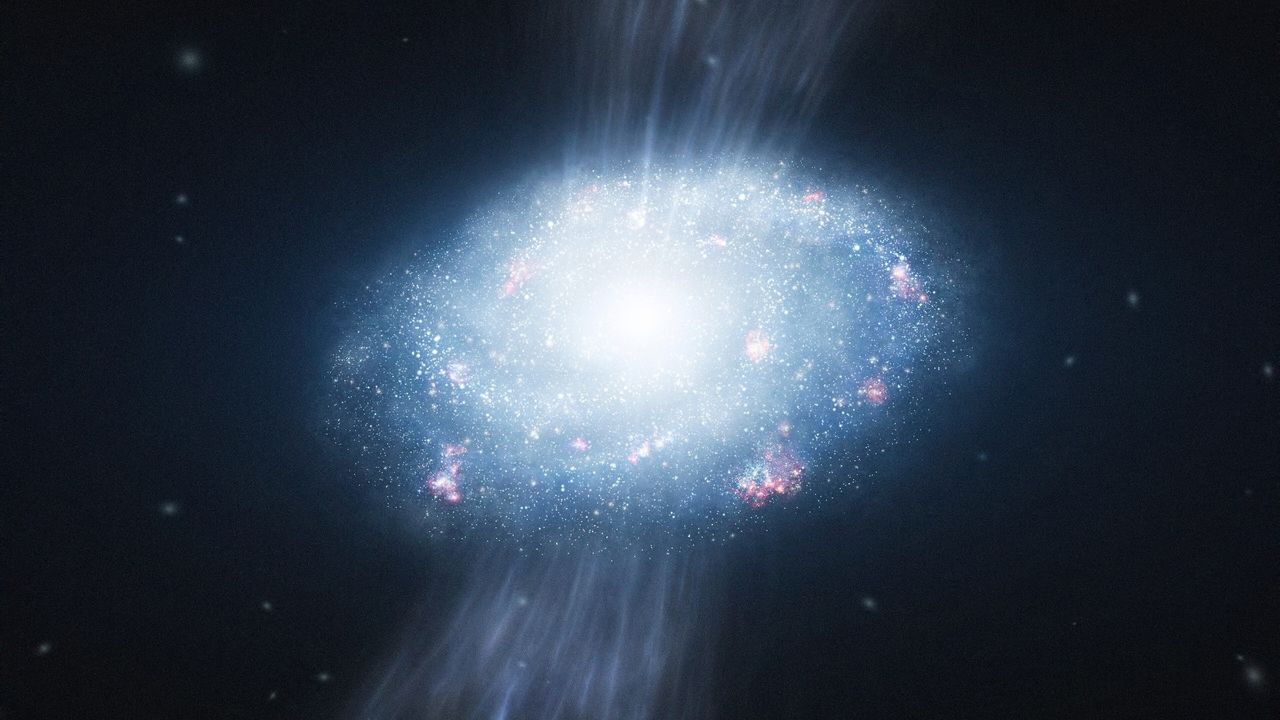
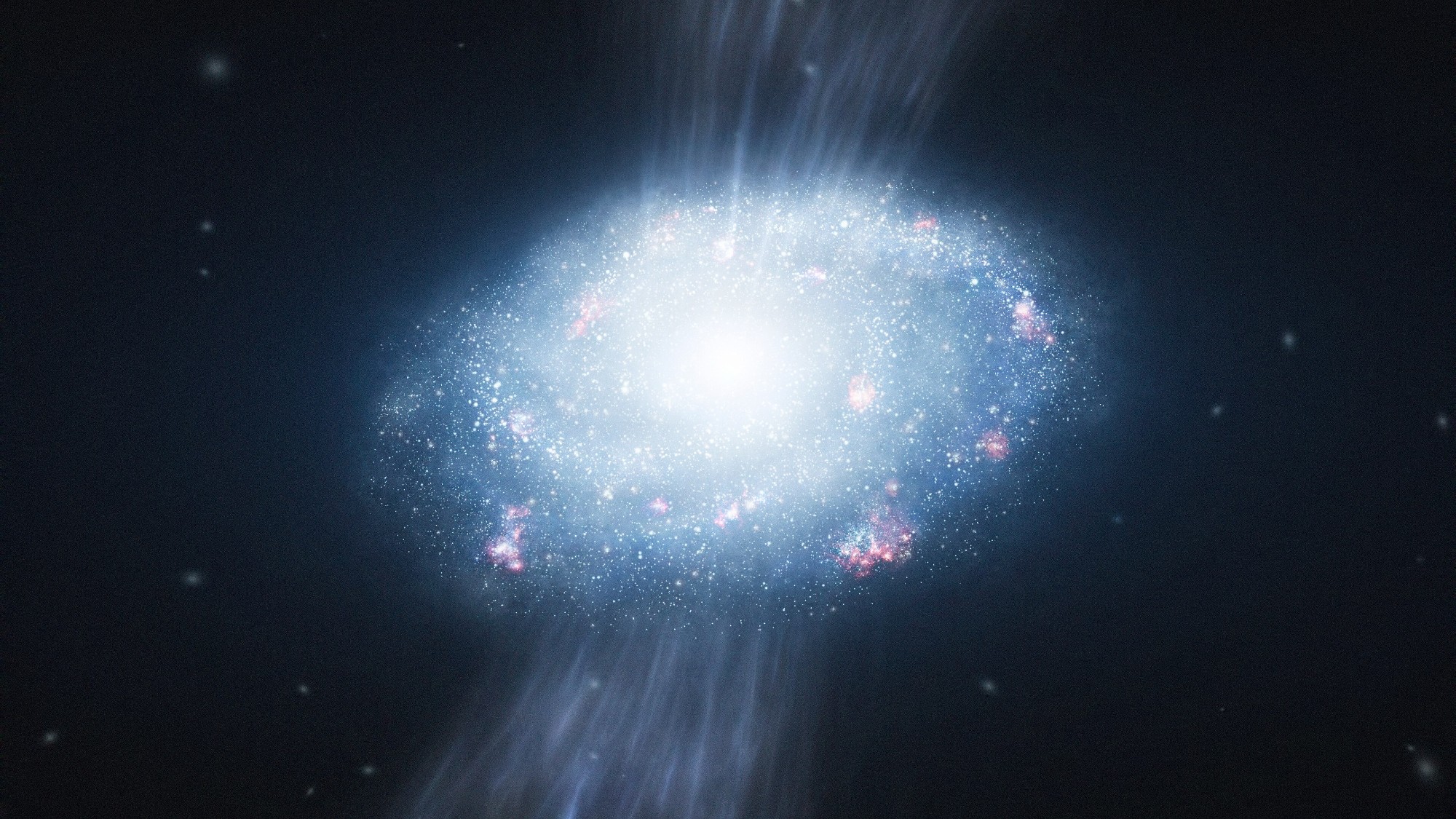
 An artist's impression of a young galaxy, about two billion years after the Big Bang, accreting material from the surrounding hydrogen and helium gas and forming many young stars. (Image credit: ESO/L. Calçada) Share this article 0 Join the conversation Add us as a preferred source on Google Newsletter Subscribe to our newsletter
 Galaxies don't grow forever. At some point, even the most prolific star-forming galaxies start to slow down, then stall, then settle into a long quiet retirement. Astronomers have known about this transition for a long time, but we haven't had a clean physical explanation for why it happens, and why it happens at the particular mass scale that it does.
A new paper led by Preetish Mishra of the Korea Institute for Advanced Study, along with an international team of scientists, makes a clear and testable proposal: that the slowdown in galaxy growth is caused by the birth of a stable cloud of hot gas surrounding the galaxy, and that cloud forms at a very specific mass: roughly 10^12.5 solar masses. Above that threshold, galaxies stop being efficient stellar factories, no matter how much raw material they have on hand.
The question is: what flips the switch?
To get to that calculation, the team used the Horizon Run 5 simulation, one of the largest cosmological simulations ever created. It takes a chunk of virtual universe roughly a gigaparsec across, models the full physics of gas, gravity, star formation, supernovas, and supermassive black holes from shortly after the Big Bang to the present day, and lets researchers track individual galaxies through their entire histories. Mishra and colleagues picked out roughly 20,000 of the most massive central galaxies and watched what happened to them over cosmic time.
The key quantity they tracked is the stellar-to-total mass ratio. It's a measure of how much of a galaxy’s entire mass budget (stars, gas, dark matter, black holes, everything) actually ends up locked into stars. Think of it as a galaxy's star-formation efficiency report.
The team found that this ratio peaks sharply in galaxies with total masses between about 10^12.4 and 10^12.7 solar masses. Below that range, galaxies are turning gas into stars roughly as fast as the gas comes in. Above it, they slow down by more than a factor of three. That peak is the critical mass.
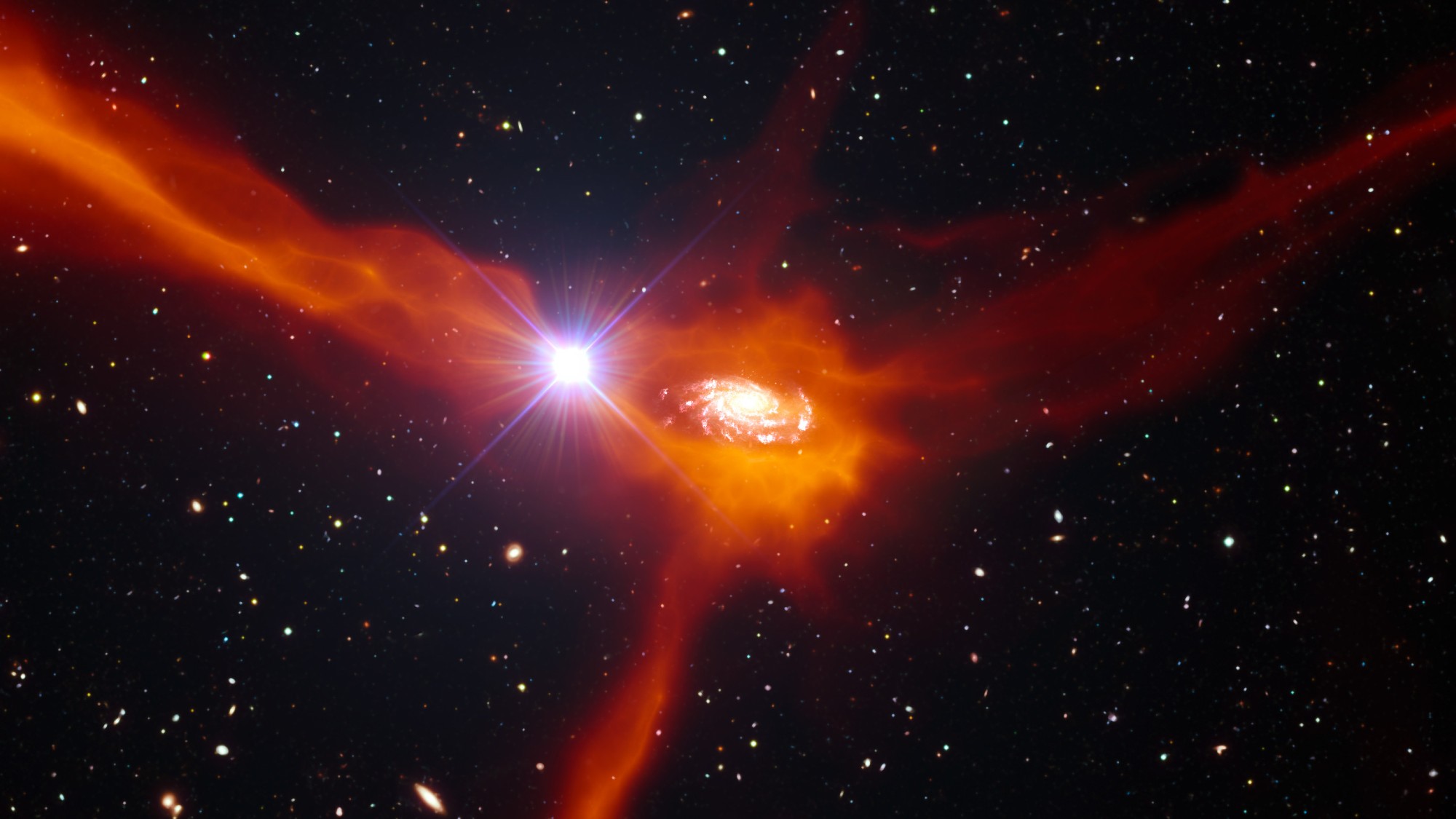
Mishra's theory as to why galaxies stop growing is the formation of a hot gas halo that has reached gravitational equilibrium. As a galaxy grows, the gas falling into it gets shock-heated. Up to a certain mass, that gas cools quickly enough to keep raining down and feeding new star formation.
Past the critical mass, the halo gets dense and hot enough to hold itself up against gravity for billions of years. The gas can no longer cool fast enough to fall in and the galaxy is suddenly cut off from its fuel supply. It keeps gobbling up dark matter and dragging in satellite galaxies, but the cool gas that actually makes stars stops arriving.
The paper also rules out a competing explanation. One natural guess is that galaxies above the critical mass simply lose more of their normal matter to outflows from supernovas and active galactic nuclei. The team checked this directly by computing how much of each galaxy's baryon budget actually stayed bound to the system. The variation turned out to be no more than 30 percent. That isn't nothing, but it can't account for the factor-of-three drop in star formation efficiency. The decisive change is on the inflow side, not the outflow side.
A few caveats are worth flagging. Horizon Run 5 is a simulation, not a telescope, and its results depend on the sub-grid physics used to model star formation, supernovas, and black hole feedback. The authors did sensitivity tests and the basic result holds up, but the precise numerical value of the critical mass scale could shift as those prescriptions improve.
The analysis also restricts itself to galaxies above 10^10.8 solar masses to make sure each one has enough simulation particles to be reliably resolved. Smaller galaxies are a story for another simulation.
What makes this work satisfying is that it pins a famous observational pattern to a single, specific physical mechanism. Not just that galaxies above a certain mass quench, but that they quench because their hot gas halos become self-supporting. That is the kind of statement that can be checked against future surveys of galaxy clusters and the warm-hot intergalactic medium, the gas and dust between galaxies.
We will know whether they got the right answer once those surveys roll in.
View MoreYou must confirm your public display name before commenting
Please logout and then login again, you will then be prompted to enter your display name.
Logout Paul SutterSpace.com Contributor
Paul M. Sutter is a cosmologist at Johns Hopkins University, host of Ask a Spaceman, and author of How to Die in Space.