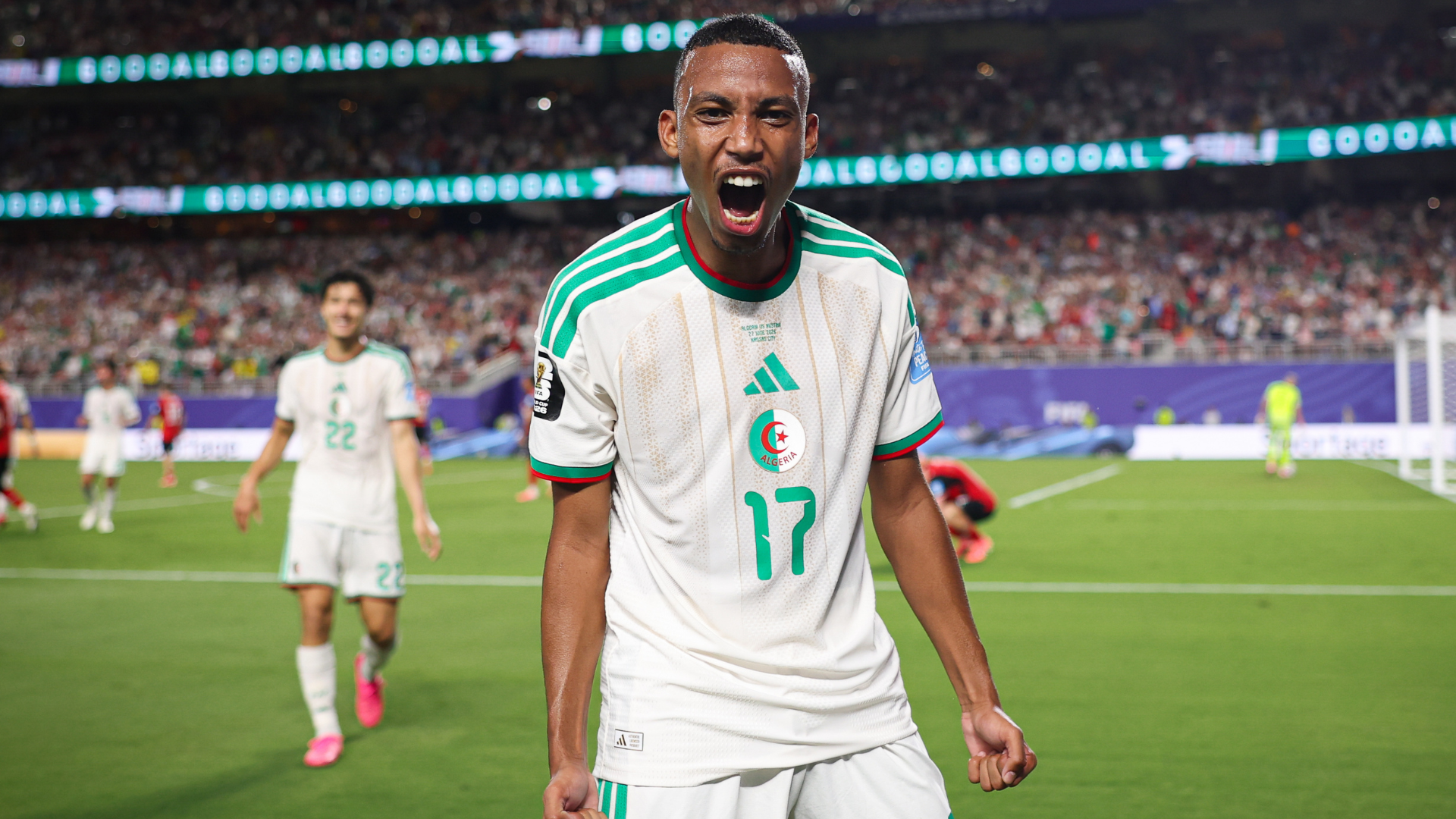
Into the World Cup round of 32 we dive, sort of! There's just the one game on the fixture list Sunday, and frankly, there's not a lot to be said about Canada vs. South Africa. If the hosts, whose failure to get top spot in Group B has taken them away from their homeland and out to Los Angeles, play as well as they have for most of this tournament, they should win. Especially, that is, if South Africa are anything like as bad as they were in the tournament opener.
Instead of looking any further ahead, let's use this morning's column to look back. After all, the conclusion of the group stage seems as good a time as any to assess this new 48-team World Cup and an occasionally head-scratching format that brought high drama and heartache for Iran at the last.
Quality of the field remains high enough
From the outset, it is worth stating that the addition of 16 teams to the tournament did not significantly detract from the quality of the competition as a whole. Of the six lowest-ranked sides when the draw was made, two -- Cabo Verde and Ghana -- qualified for the round of 32, and both claimed impressive 0-0 draws against top-tier contenders to win the whole thing.
Even those that struggled through the group stage left an impression. Haiti gave as good as they got against Scotland and Morocco, Curacao claimed a memorable draw, and Panama were as elegant a team to depart without a goal to their name as the World Cup has seen in many a year. Those three specifically are worth highlighting, given that CONCACAF had been one of the big winners of the expanded format with a 50% upswing in their representatives compared to the old 32-team tournament.
African football had been the big winner of expansion and the doubling to 10 representatives has been a win right the way through the cycle. CAF qualifying remained arguably the most intensely competitive with Nigeria and Cameroon the biggest names to miss out. Perhaps it hardened the qualifiers for what was ahead of them with Tunisia the only side who failed to make the knockout stages. That its nations should be meaningfully tested in qualifying is something that the Asian confederation might wish to consider. Both Qatar and Saudi Arabia were handed the right to host the fourth round of qualifiers entirely in their homeland, but for all the money those two nations have poured into the sport, neither seems to have a better national team than they had three and a half years ago.
World Cup group standings, table, schedule: Results for USMNT, Argentina, Brazil and the entire 48-team field James Benge
Many of the tales of the tournament have come from Africa, whether it is the belligerence with which Cabo Verde defended their goal or the game's next great star seemingly emerging in Yan Diomande of the Ivory Coast. We still seem some way off belatedly vindicating Pele's prediction that an African nation would win the World Cup by 2000, but it is not hard to imagine Senegal, Ivory Coast, Morocco, Algeria or Ghana adding to the quartet of historical quarterfinalists from the continent.
The quality of the field ought never to have been in doubt, though. The state of international football has not radically changed this century. Nations might wax and wane, but it remains the case that there is an inner circle of European and South American teams who will be there at the end, the past champions plus the Netherlands and Portugal. It's just economics, population size and history with the game. After them is a second tier from Europe alongside the likes of Japan, South Korean, Morocco, Colombia and perhaps the United States and Mexico: teams that should always be there or thereabouts and whose eventual goal should be to win the whole thing.
You can even observe tiers in the FIFA rankings: a top four of Argentina, Spain, France and England well over 1800, a clutch of teams between Brazil and Italy (one of the triumphs of the allocation of 48 places is that there are still not quite enough for UEFA, leading to the high-profile absences that actually enhance the tournament), another group down to Uruguay in 19th and then a clutch of perhaps 45 teams who with the right mix of coaching and talent could give it a go at any tournament.
What about the format?
If anything, this World Cup has made a case that the tournament could expand beyond 48 teams -- FIFA has considered a 64-strong field -- were it not for the challenge of hosting and scheduling 128 games in a region over the course of six-ish weeks. That would be an even more vast undertaking for hosts, organizers, and, of course, viewers. After the mammoth six-game days of the third round, it's fair to ask when we would reach the stage of too much.
That, however, has to be set against a structure right now that does not feel quite as balanced as it ought to be. The World Cup may not have delivered a farce as brazen as the Disgrace of Gijon -- the 1982 group stage match where West Germany and Austria conspired for the result that would advance both of them at the expense of Algeria -- but it could have. Perhaps the prospect of getting out of Spain's path intermingled with a bit of the prisoner's dilemma and a whole lot of history to convince Algeria that they needed to go for it in added time against Austria.
The end of their game was a thrilling defense of the format, Riyad Mahrez netting in the third minute of added time before Sasa Kalajdzic headed home at the last to send Austria through and Iran out. "All who watched the game during the last 15 minutes must know there is no hint that the players absolutely wanted to have a draw," said Austria coach Ralf Rangnick. "I think they wanted to win. Nobody can tell me that suddenly in minute 93 somebody would plan: 'oh yes, let's score another goal.' I think maybe it was the thought of one or two players in Algeria, but I think in the rest of the squad I don't think it was the case, and not for me."
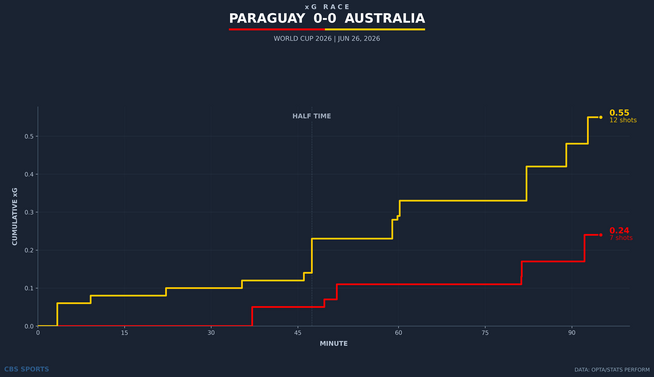
The most obvious risk game might have proven to be a thriller while Croatia's win over Ghana similarly spoke to the competitive instincts of footballers even when 90 minutes of Simpsons-ball would probably have been smarter. What of Australia's 0-0 draw with Paraguay? Less than an expected goal between them, a prolonged spell between the 60th and 80th minute where neither team even went into the other's penalty area, a result that delivered both teams a four-point tally that would almost certainly take Paraguay through as one of the best third-placed teams.
 CBS Sports
 None of the above is to suggest collusion. It is, however, undeniable that in a structure where the third-placed teams are ranked against each other, one team can help out another without meaningfully damaging their own prospects, especially when the head-to-head record is the tiebreaker.
Only with the tournament structured as it is could Germany, already locked into first after a win over Ivory Coast, have afforded the sort of wholesale rotation that might have handed a much easier game to Ecuador, who ultimately beat out a stronger-than-expected opponent to secure their spot in the last 32. Again, it matters less that on this occasion the game did not suffer than that there is a realistic integrity risk in the format.
All of that is to say nothing of the information disparity that made it far harder for Group A's South Korea to know what they should do when a goal down to South Africa than it was for, for instance, Senegal as they rained down the goals on Iraq. Before the tournament started, projection models like Opta's said a team with three points and a minus one goal difference had an 84% chance of qualifying. You can imagine the bind faced by the Koreans, do they chase an equaliser and gamble on being picked off on the break, conceding a second that would lop 20 percentage points off their qualification chances?
So long as the 48-team tournament remains, so will these risks and headaches. Is it a price worth paying to add teams who have clearly improved the tournament (and of course, further games that have made this World Cup an almighty money spinner for FIFA)? It might be that we can only answer that when we've seen the whole thing in action a few more times.
Add CBS Sports on Google Join the Conversation comments