 Billy Steele for Engadget RATING : 8.2 / 10 Pros
 - Small size
- Great sound quality
- Multiroom ready
- Mids and lows can get muddy at times
- Pricier than some of the competition
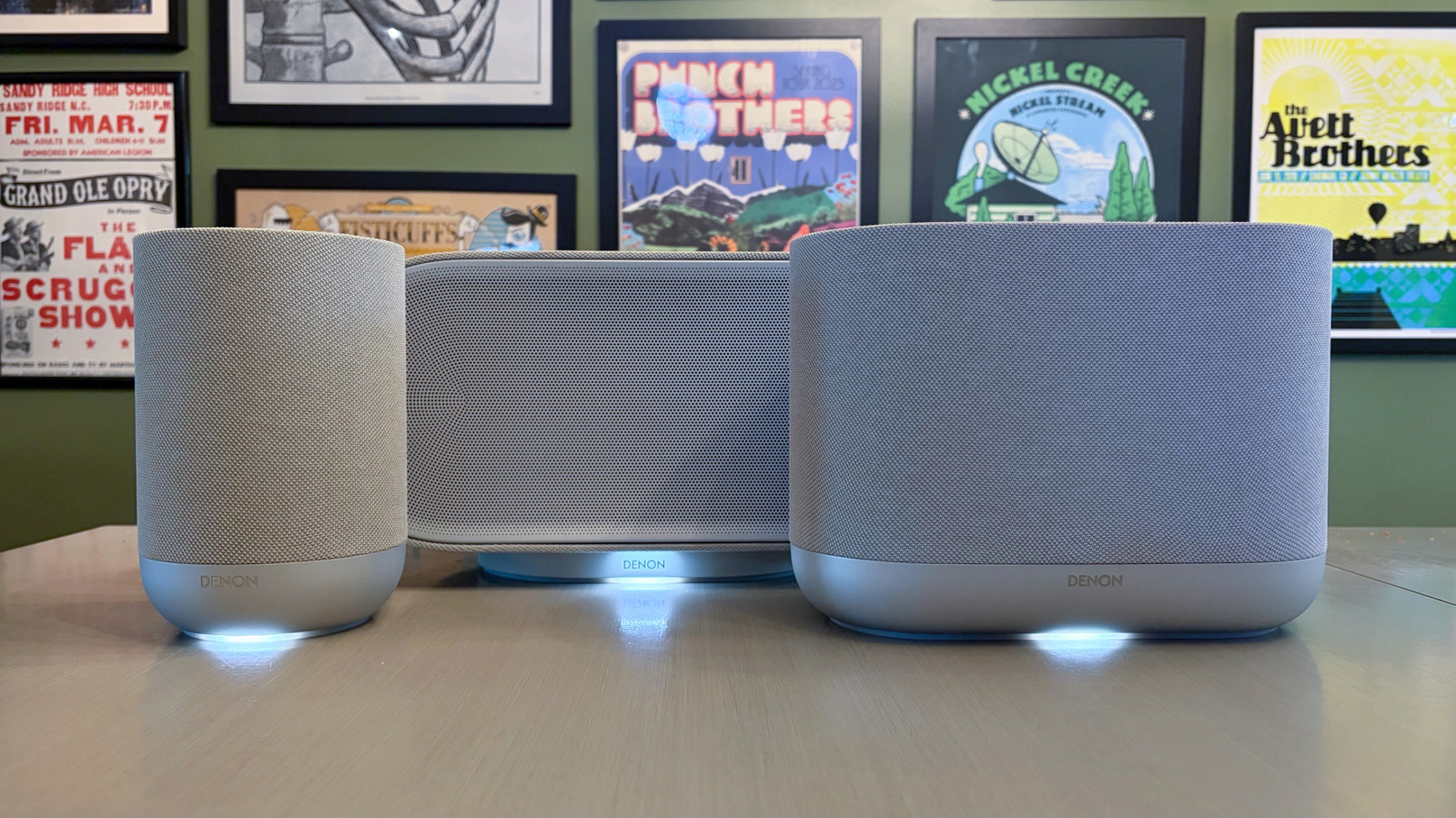
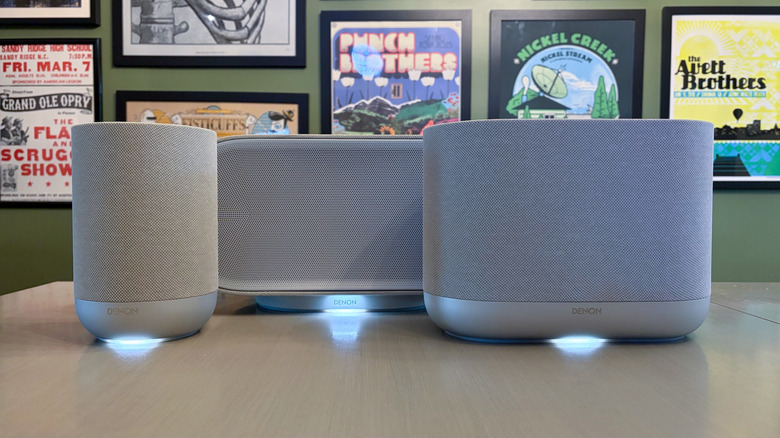
Once upon a time, Sonos was the only brand worth mentioning when it came to multiroom audio. Those days are long gone as several companies now offer Wi-Fi-connected home speakers that work together from multiple rooms and are all controlled by the same app. Denon is one of the competitors that arose over recent years, and its Home line of audio devices takes direct aim at Sonos' crown. Each of Denon's latest products — the Home 200, Home 400 and Home 600 — has its own merits, so deciding on the model that's best for you really comes down to where and how you plan to use them.
A Denon Home primer
 Billy Steele for Engadget
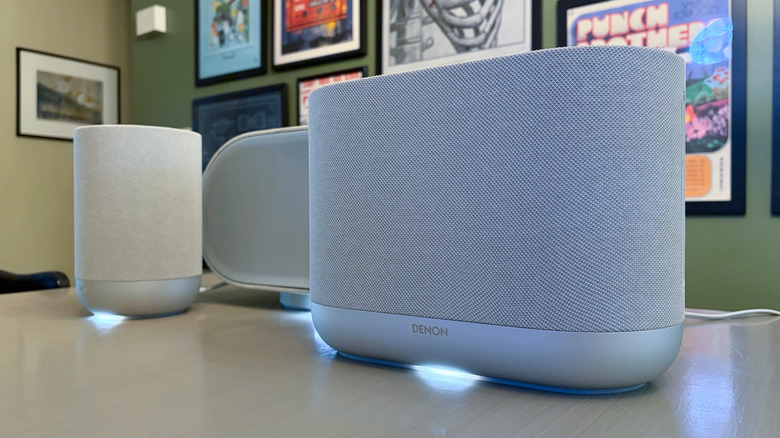
 The Denon Home line isn't new. The company already has the Home 150, Home 250 and Home 350 speakers on its roster, in addition to the Home 550 soundbar and Home Subwoofer. In other words, the company is no stranger to multiroom audio devices. To control all of those speakers, and the three new models, you use the HEOS app that works with compatible products from both Denon and Marantz (both companies are owned by Samsung subsidiary Harman).
Like the Sonos app, the HEOS app is where you do the initial setup and connection for the Home speakers. Once you sync your music streaming services, you can beam tunes to any of the Home speakers you own. The app also ports in local radio for free via TuneIn, so I was able to stream my regional NPR station with a single tap. The HEOS app will let you access any connected media servers as well as wired audio sources via USB and 3.5mm aux. Of course, there's also Bluetooth and AirPlay support if you want to bypass the app completely.
From the Rooms menu in the HEOS app, you have the option to play music everywhere with a single tap of the "All Rooms" button. To remove one or more rooms from the group, you simply drag them out of the list. You can build group presets for any frequently used configurations too. What's more, you have the option to control each room individually here as selecting a room will give you its media player and controls along the bottom of the UI.
The HEOS app doesn't offer a room calibration tool like Sonos' Trueplay, but the software does account for speaker placement before adjusting the sound. During the initial setup, the app will ask if a speaker is placed "away from walls," "near one wall" or "near two walls." Based on your answer, the audio is optimized for "accurate, balanced sound." And yes, you can adjust this if you relocate the Home speakers later.
The app will let you select multiroom audio quality as well, with Normal and High options for increased reliability and increased fidelity (16-bit/44.1kHz) respectively. The latter setting is only recommended if your Home devices are wired with Ethernet or when they all have excellent Wi-Fi signals. Multiroom connectivity between the Home speakers is reliable and offers a seamless soundtrack as I move from room to room. Sometimes using multiple speakers throughout my house produces slight lag that comes across as a bit of reverb. With the Home 600, 400 and 200, I honestly couldn't tell there were three different speakers playing music as I moved from my office to the kitchen and bedroom.
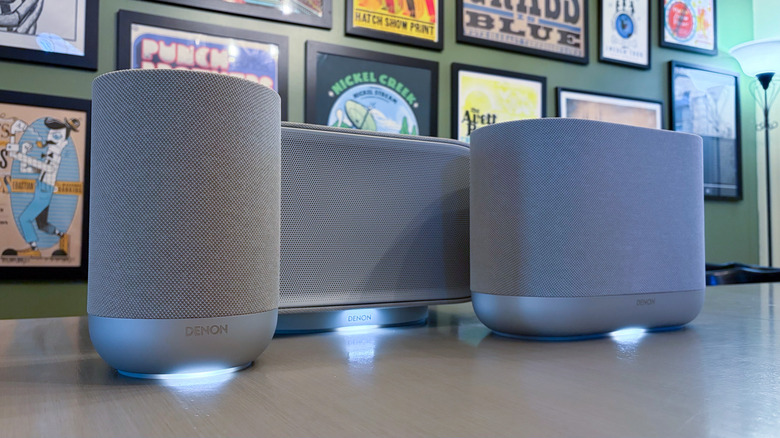
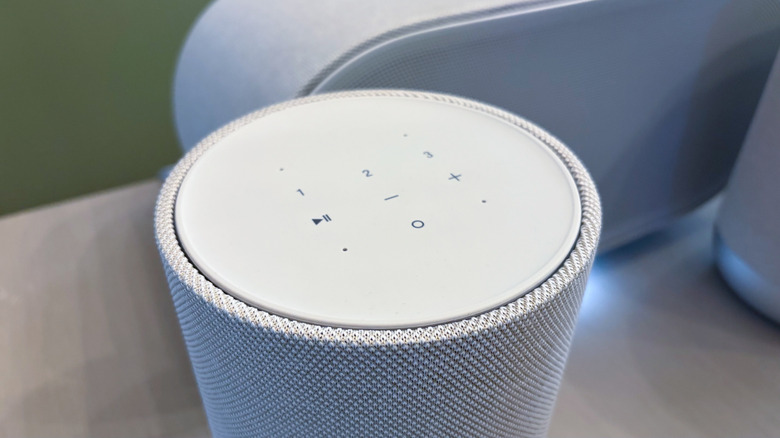
All three of these Denon Home speakers can be used in stereo pairs, although the Home 200's smaller stature makes it best-suited for that. You would need a lot of shelf space in order to use two Home 400s or 600s like this. The trio all sport programmable Quick Select buttons on their control panels, putting commonly used content and settings just one press away. These essentially work like the buttons on a car stereo: Press and hold to store the current playback source, sound mode and audio settings. There's also an Action Button on all three that summons a connected voice assistant without reaching for your phone.
Denon Home 600: Big sound in a big speaker
 Billy Steele for Engadget
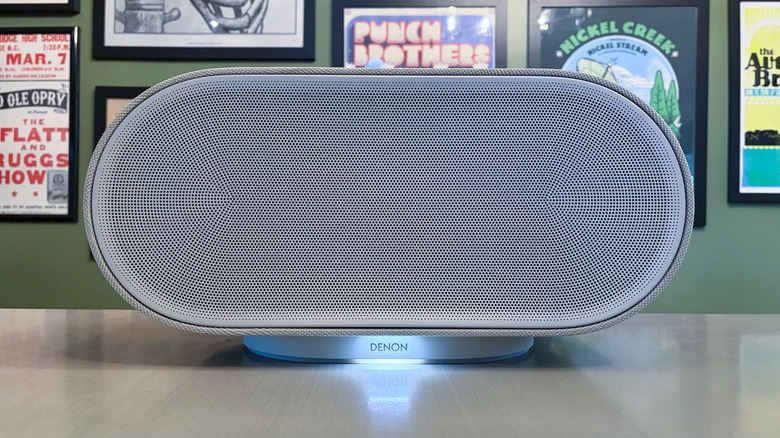
 The Home 600 ($799) reminds me of an oversized Beats Pill. Let's blame it on all of the rounded edges. This is the largest of the new Home speakers, housing eight drivers and eight Class-D amplifiers. More specifically, there's two of each of the following inside: 0.75-inch tweeters, 2.6-inch midrange, 2.6-inch up-firing and 6.5-inch woofers. To fit all of that, Denon opted for a curved construction that measures 17.7 inches x 9.9 inches x 8.9 inches. In other words, you'll need ample shelf space to accommodate one of these beasts.
As the largest of the new Home speakers, the 600 is the loudest and most powerful, but that doesn't come at the expense of clarity. There's an obvious emphasis on vocal precision in the mix, which means the words clearly cut through even the most chaotic of genres. Johnny Franck's clean choruses float above the drums, guitars and other instruments on Bilmuri's "TWICE," for example. The bass doesn't get lost either as those dual 6.5-inch woofers offer ample oomph without overpowering everything else. The speaker also exhibits subtle details that might otherwise be lost on shelf speakers. Things like the banjo on Bilmuri's "EMPTYHANDED" are still plainly heard, even at lower volumes.
While this is the most robust of the three Home speakers, I found the 600 to be a bit too much for my needs. If you have a large space and like to listen loud, this could be a great speaker for you. However, at 50 percent volume, the 600 was almost too loud for casual listening, and using it at a lower level that felt appropriate for my office just felt like a waste. There's no doubt it's an excellent speaker with great clarity and reliable connectivity, but it also might be overkill for some users.
Engadget review score: 8.3/10
Denon Home 400: The best of both worlds
 Billy Steele for Engadget
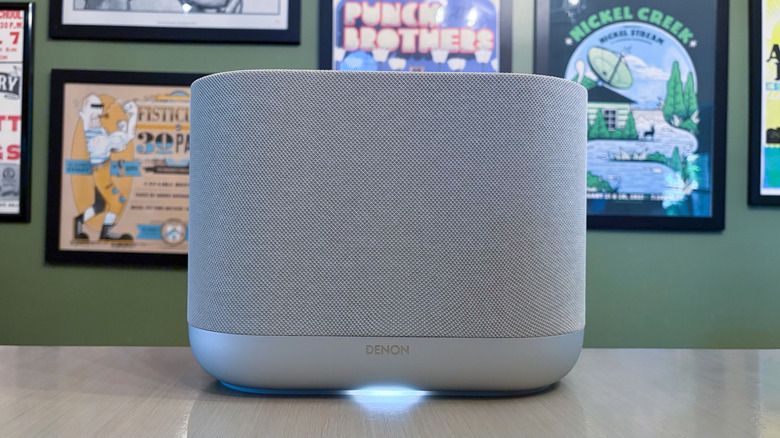
 To me, the Home 400 ($599) is the sweet spot in Denon's latest home audio trio. It's not so big you have to plan carefully where you're going to put it. It also has plenty of punch in terms of both power and overall audio quality. Six drivers provide the sound here, with two 0.75-inch tweeters, two 0.95-inch up-firing and two 4.5-inch woofers, all powered by six Class-D amplifiers.
The design of the Home 400 is also a mix of the 600 and 200. If you took a 600, shrunk it and turned it up on its backside, you'd basically have the Home 400. Or, you could describe it as a horizontally stretched Home 200. Another difference in design on the 400 is that Denon moved the controls to the right side from the top panel. This was likely to give the up-firing drivers ample room to project their sound. I do like that the company opted to put the volume controls at the top of the vertical panel and the Quick Access buttons at the bottom, with play/pause and voice assistant buttons in between. Volume is likely to be the most used (at least, it was for me), so this placement is very intuitive.
Just like the 400 is the middle of the road between the 600 and 200 in terms of size, it also bridges the gap when it comes to sound. There's still ample dedication to vocal clarity and there's plenty of low-end tone from the dual-woofer setup. But unlike what I found on the 200, the overall mix doesn't ever feel compressed compared to the larger Home 600. There's still plenty of detail, even when songs get complex like Nine Inch Noize's synth-laiden "Vessel." The biggest downgrade from the 600 is the less substantial bass tone, which isn't a dealbreaker for me since the Home 400 is no low-end slouch by any means.
Engadget review score: 8.6/10
Denon Home 200: Small and mighty
 Billy Steele for Engadget
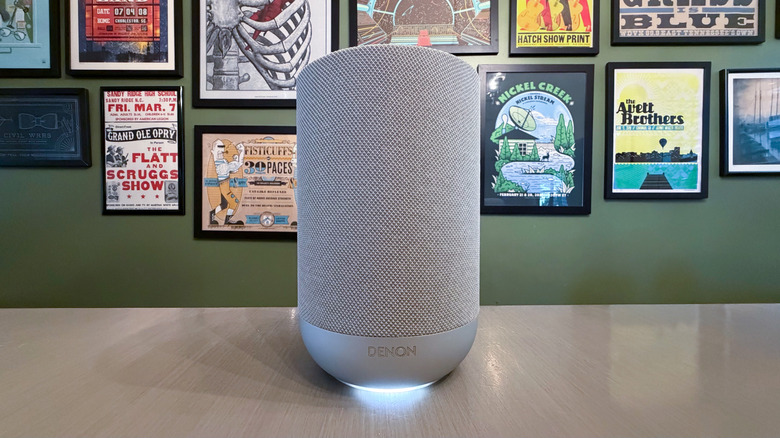
 The Denon Home 200 ($399) may be the smallest of the bunch, but don't mistake this speaker's size for a lack of performance. Inside, two 0.98-inch tweeters and a single 4-inch woofer are powered by three Class-D amplifiers. While all three of these Home speakers can be used as rear surround speakers for the Home 550 soundbar, the 200 is probably the best option there due to its size. I'm not sure many folks would want two Home 600s flanking their living room. Personally, I liked putting the 200 in the kitchen. I frequently listen to music and podcasts while cooking or doing the dishes, but I don't have a ton of extra counter space for anything bigger.
Design-wise, the Home 200 looks quite similar to Sonos' Move speakers. Of course, this Denon unit isn't portable, and it's more cylindrical than the Move 2's more ovular shape. Still, both speakers have top-mounted controls and a segmented, tone-on-tone look. Like the other two Home speakers in this new group, Denon installed a status light at the base of the 200 that's much larger than the one you'll see on the Move 2.
In terms of sound, the 200 still has that trademark Denon vocal emphasis, which, again, really helps with metal, rock and other bombastic musical styles. I did notice that the bass and mids are more compressed on this speaker, but not overly so. You can still hear the sparkle of Bilmuri's Stratocaster riffs without those just becoming sharp treble. There's much less bassy boom overall, but that's understandable given the fact that the 200 has only one woofer, and that it's smaller than the ones in the other two speakers. Still, for a smaller bookshelf speaker, all areas of the EQ are well accounted for here.
Engadget review score: 8.2/10
The competition
 Billy Steele for Engadget
 As I've already mentioned, whenever you're discussing multiroom home audio or connected speakers, Sonos is typically the first name that comes to mind. You won't necessarily find 1:1 counterparts between the two companies, but you can get pretty close for two of the Home speakers. For instance, Sonos' Era 300 is the most comparable alternative to the Home 400. It's the largest Sonos shelf speaker and houses six Class-D amps that power four tweeters and two woofers, plus you get the benefit of the company's Trueplay room calibration for $479. The Era 300 is closest in size to the Home 600, but in terms of audio output, it's more akin to the Home 400.
If you're looking for something to pit against the Home 200, the Era 100 is your best bet in the Sonos lineup. Inside, two angled tweeters and one midwoofer power the sound, backed by three Class-D amplifiers. And once again, Trueplay calibration is available here, as is the ability to easily create a stereo pair or use the Era 100 as rear speakers with a Sonos soundbar. The Era 100 is just $219, which leads me to another point.
Sonos' alternatives to these Denon Home speakers will all save you some money, if you're willing to contend with the company's frustrating app. During my testing, the HEOS app was more reliable and responsive than the Sonos app, though another overhaul for the latter is in the works.
I should also mention that Bose has new home audio speakers that are due to arrive this month. Two of those — a soundbar and a subwoofer — are more suited for the living room, but the Lifestyle Ultra Speaker ($299) could give prospective Home 200 buyers some pause. Its two front-facing drivers and one up-firing driver work with a CleanBass setup that employs QuietPort acoustics for the audio configuration. The speaker is also compatible with Alexa+ and has a 3.5mm aux jack for wired use, in addition to Bluetooth and Wi-Fi. Plus, the limited-edition Driftwood Sand colorway is a real looker with its wood-grain base.
Wrap-up
 Billy Steele for Engadget
 There's no denying that the new Denon speakers give Sonos a run for its money in terms of audio performance and multiroom reliability. The HEOS app is a lot more solid than the current Sonos app that's still recovering; I didn't encounter any delays or the need to repeat commands in order for them to take. Sure, the Home 200 and Home 400 are more expensive than their closest Sonos rivals, but I'd argue they sound better than the Era 100 and Era 300 respectively. And of course, the Home 600 takes that up a whole other level with its near super strength audio power.
No matter which one of these Home speakers you choose, you'll be pleased with the vocal clarity and detailed sound they produce. For smaller rooms or places where you're tight on space, go for the Home 200. For a home office or living room, I'd recommend the Home 400, and if you've got a large space or an insatiable desire to be bombarded by sound, the Home 600 can satisfy both. And most importantly, you won't be let down by a broken app that's necessary to use the speakers to their full potential.