
 Getty
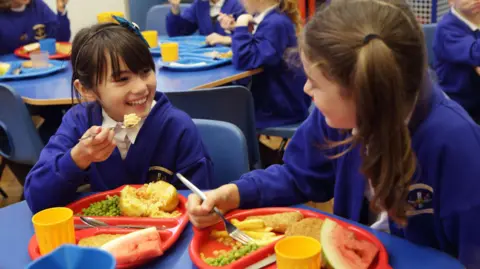
GettyDeep-fried food will be banned and high-sugar items restricted in schools in England under new plans to "overhaul" school dinners.
Under the government's proposals, fruit will replace "sugar-laden treats" for the majority of the school week, and schools will no longer be allowed to offer unhealthy "grab and go" options like sausage rolls and pizza every day.
The Association of School and College Leaders said it supported improving the quality of school food, but said additional funding to pay for the changes would be "essential".
The Liberal Democrats said funding for school meals needed to match rising costs, while Reform UK accused the government of "trying to micromanage people's lives".
The Green Party said cutting unhealthy food from school menus was "welcome and long overdue".
The Department for Education (DfE) says the changes will mean millions of children will get healthier and more nutritious meals at school each day.
Currently, more than one in three children leave primary school overweight or obese, while tooth decay from high-sugar diets is the leading cause of hospital admissions for children aged between five and nine, the DfE says.
Under the new rules, sweetened desserts will be limited to once a week, and more fruit, vegetables and wholegrains will need to be added to school dinner menus.
These are the first changes to the school food standards in a decade, the government says, after plans to revise them were delayed due to the pandemic.
They will apply to primary and secondary schools in England, as part of efforts to improve children's health and nutrition.
Brad Pearce, national chair of the School Food People, said he welcomed the government's review of the school food standards, but said they should be "monitored and funded appropriately".
School meal costs mean less meat and smaller portions, caterers say
Free school meals to be extended to 500,000 more children
The government has announced a nine-week consultation on the proposals.
Secondary schools will have a phased approach for some of the changes, to give them enough time to develop recipes, update menus and train staff.
The final school food standards will be announced this September, and come into force from September 2027.
A "robust" enforcement system will also be developed to check schools are following the new standards, including monitoring schools' compliance.
Previous school food standards introduced in 2015 also included fruit and vegetable requirements, limiting sugar in drinks, and an emphasis on wholegrain foods instead of refined carbohydrates, like white bread or pasta.
But some head teachers have raised concerns that these are not always being followed, often due to costs.
Alongside these standards, any child in England whose parents receive Universal Credit will be able to claim free school meals from September 2026, following a change announced last year which the government said would make 500,000 more children eligible.
Over 500 new free breakfast clubs will also open this week, the DfE says.
Funding for these free breakfast clubs has risen from 60p to £1 per pupil, after schools raised concerns around costs.
Last summer, the School Food People called for the government to increase the funding it provides for free school meals to avoid schools having to top up funding from their core budgets.
A 2025 survey of its members suggested the real cost of delivering a meal was approximately £3.45 - roughly 80p more than the £2.61 given to schools to fund free school meals in England.
Tom Middlehurst, from the Association of School and College Leaders, said improving the quality of school food was "something we wholeheartedly support".
He said the changes "must be implemented in a practical way", including with additional funding to pay for any increased costs.
Munira Wilson, the Liberal Democrats' education spokesperson, said the government "needs to ensure that free school meals funding matches the rising costs, ensuring every child receives a healthy and filling meal essential for their education".
"From talking to parents, head teachers and school governors in my constituency, I know that many are worried about the rising cost of food, and in many cases the current funding just isn't enough, forcing schools to provide smaller portion sizes and poorer quality food," she said.
"The education secretary must urgently address this problem."
A spokesperson for Reform UK said the plans were "yet another example of the government trying to micromanage people's lives".
"Banning foods from school menus won't solve childhood obesity," they said.
"It just removes choice and adds pressure on already stretched schools. We should be focusing on education, personal responsibility, and ensuring families can afford healthy food, not headline-grabbing bans."
A spokesperson for the Green Party said: "Removing unhealthy food from school menus is welcome and long overdue.
"We believe free healthy school meals should be offered to all primary and secondary pupils, not just infants.
"Real change also means tackling the root causes of the 14% of households facing food insecurity – the cost of living and low pay.
"Greens also want to see our food and farming system transformed so it prioritises affordable, healthy food with fair wages for growers."
BBC News has also approached the Conservatives for comment.
Provision of free school meals varies significantly across the UK.
In London, and Wales, the offer of a universal free school meal has been extended to all primary school children up to Year 6.
Although the funding rate for most of England is £2.61, in London schools get a higher rate of £3. In Wales, the rate is £3.40.
In Scotland, all children in the first five years of primary school are eligible for free school meals, as well as all children from families receiving the Scottish Child Payment benefit.
Parents in Northern Ireland, can apply if they receive certain benefits and are below an income threshold of £15,000.


