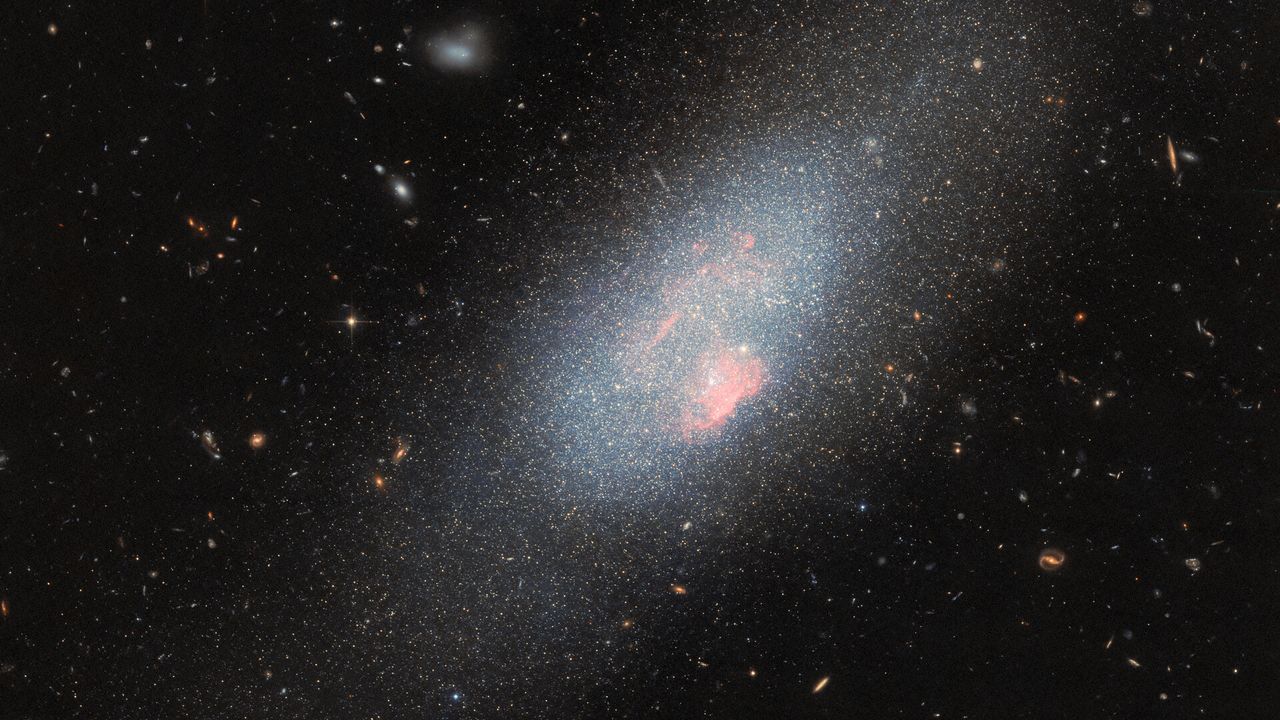
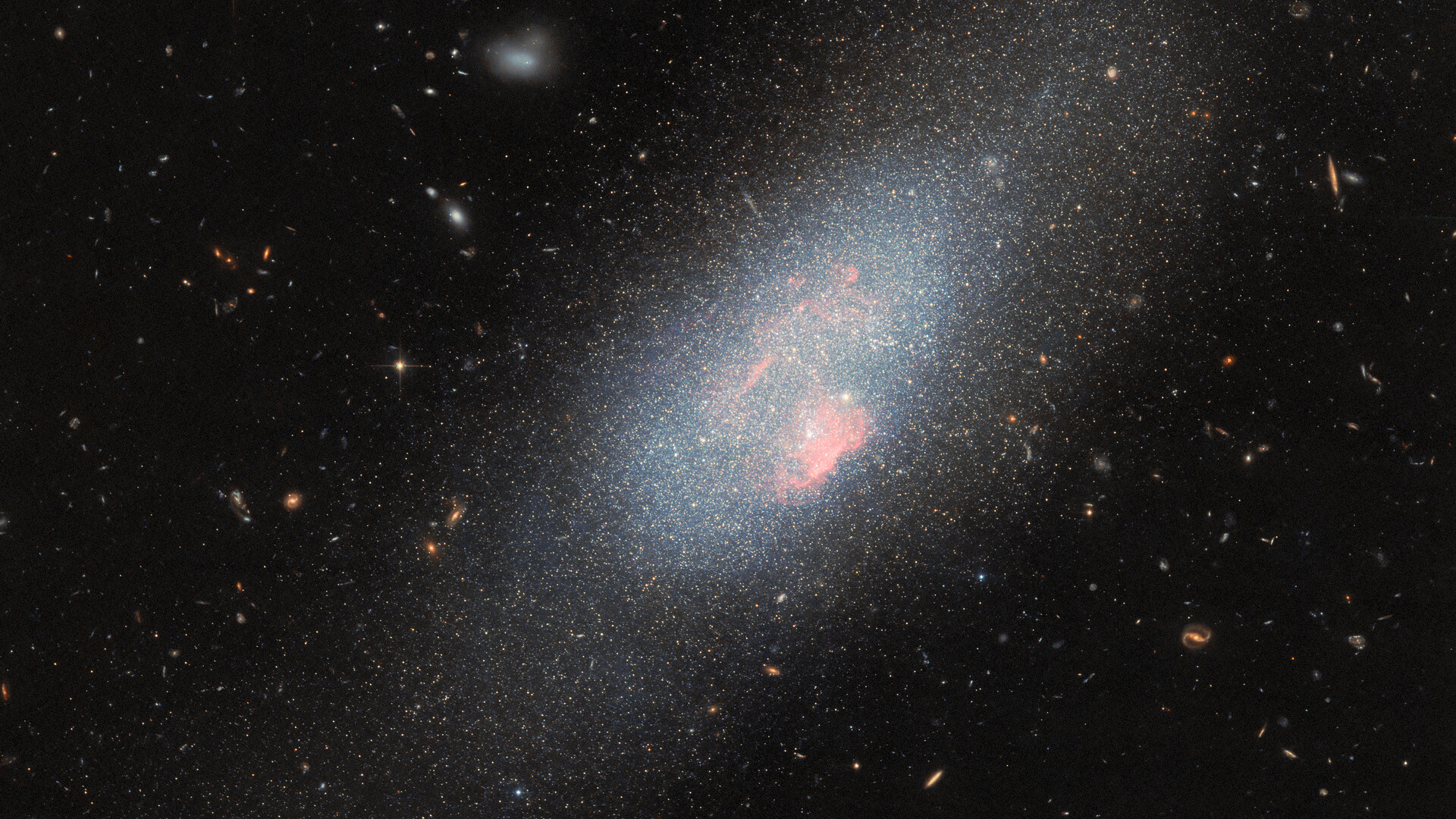
 Hubble Space Telescope image of the compact dwarf galaxy Markarian 178. Mrk 178, which is substantially smaller than our own Milky Way, lies 13 million light-years away in the constellation Ursa Major (The Great Bear). (Image credit: ESA/Hubble & NASA, F. Annibali, S. Hong) Share this article 0 Join the conversation Follow us Add us as a preferred source on Google Newsletter Get the Space.com Newsletter
 Breaking space news, the latest updates on rocket launches, skywatching events and more!
Contact me with news and offers from other Future brands Receive email from us on behalf of our trusted partners or sponsors By submitting your information you agree to the Terms & Conditions and Privacy Policy and are aged 16 or over.You are now subscribed
Your newsletter sign-up was successful
Want to add more newsletters?
An account already exists for this email address, please log in. Subscribe to our newsletterOur universe is full of mysteries, but few are as perplexing as the dark, tiny galaxies that hover around larger ones like the Milky Way.
Small, dim, and almost invisible, dwarf spheroidal galaxies are packed to the brim with something we can't see: dark matter. They're like cosmic icebergs, with most of their mass hidden from plain sight, making them some of the most exotic objects in the universe.
Yet, when we peer at the actual movements of stars inside many of these dwarf galaxies, what we often see is something flatter, more like a gentle hill – a "core." It’s a bit like finding a perfectly smooth, inviting plateau where you expected a jagged, impassable summit. This persistent mismatch has fueled a serious debate, leaving us wondering if our understanding of dark matter, or perhaps galaxy formation itself, is fundamentally off.
This mystery has challenged the standard picture of how galaxies form and evolve. But astronomers are clever, and they keep digging. Consider this: these galaxies aren't just born with their final shape, but instead evolve into it, following a cosmic blueprint. This is the idea at the heart of new research from Jorge Peñarrubia and Ethan O. Nadler, affiliated with the Institute for Astronomy at the University of Edinburgh and the Department of Astronomy & Astrophysics at the University of California, San Diego. They propose that dwarf spheroidal galaxies are always moving toward a specific, stable configuration, a cosmic resting place they call a "dynamical attractor." It's like every tiny galaxy has a pre-determined final form, and no matter its starting conditions, it's destined to build itself into that design.
How does a galaxy find its way to this precise blueprint? It's not a gentle drift toward equilibrium. Stars inside these dwarf galaxies get a constant, chaotic cosmic kick in the pants. They don't just orbit smoothly around the galaxy's center, like planets around a star. Instead, they’re constantly jostled by what Peñarrubia and Nadler describe as "stochastic force fluctuations." Think of it like a pinball machine. The stars are the pinballs, and instead of perfectly smooth walls, they're continually bumping into invisible, unpredictable bumpers, always gaining a little bit of energy.
What are these invisible bumpers? They are "dark subhaloes" — clumps of dark matter embedded within the galaxy's larger, smoother dark matter halo. Yes, even within the mysterious dark matter, there are smaller, lumpier bits. Causing trouble. These dark subhaloes exert unpredictable gravitational forces, giving energy to the stars and pushing their orbits outward. The stars gain energy, their orbits expand, and the entire stellar system starts to puff up and spread out. This process, in which stellar orbits expand and gain energy, is a kind of internal "heating" for the galaxy, driving its evolution. This internal heating is a powerful force, but it’s not the only game in town.
Get the Space.com NewsletterContact me with news and offers from other Future brandsReceive email from us on behalf of our trusted partners or sponsorsThe universe is a busy, often violent place, and dwarf spheroidal galaxies often find themselves caught in the gravitational pull of much bigger galaxies, like our own Milky Way. When a large galaxy tugs on a smaller one, it can rip away its outer layers — a process called tidal stripping. This external stripping accelerates the heating and expansion of the dwarf galaxy, nudging it toward that dynamical attractor even faster. But even dwarf galaxies that are floating alone in the cosmic void, isolated from the gravitational harassment of their larger neighbors, still evolve toward this attractor through their own internal heating. It just takes them a bit longer. For example, a dwarf galaxy in isolation might need as long as 14 billion years — essentially the age of the universe — to fully reach its stable form.
So, how do Peñarrubia and Nadler know this isn't just some clever mathematical conjecture? They didn't just concoct a theory out of thin air. These researchers built entire tiny universes, running elaborate "N-body experiments" — fancy computer simulations that track the motions of zillions of stellar particles and dark subhaloes over billions of years. They even placed some of their model dwarf galaxies on eccentric orbits around a simulated Milky Way, just to see how the relentless tug of tides would affect things. Their experiments showed that a dwarf spheroidal galaxy has to shed more than 99% of its initial dark matter before it starts losing a significant number of its stars, thanks to how the stars and dark matter separate over time.
And they didn't stop there. They also applied what they call the "Heating Argument" to real-world data from the dwarf galaxies orbiting our Milky Way. What they found was fascinating: these galaxies follow specific "tidal tracks" that match what you'd expect from their model. Their stellar orbits, on average, expand to a point where the speed at which the stars are jiggling around — what astronomers call the velocity dispersion — is about half the peak speed that dark matter could make them go within the halo. This holds true for different theoretical dark matter distributions, whether they’re "cuspy" like a sharp peak or "cored" like a gentle plateau. For a common stellar distribution model, the ratio could be 0.54, or for another, 0.48. It’s a remarkable consistency, suggesting a universal behavior.
This all means that the incredible diversity we see in dwarf spheroidal galaxies today — their different sizes and internal motions — isn't necessarily a snapshot of how they were born, like distinct species. Instead, it’s a dynamic story of evolution, a journey driven by both internal gravitational jostling from dark subhaloes and external tidal forces from larger neighbors. They're all marching toward a common, stable state, a kind of cosmic destiny. The structural diversity we observe is largely an evolutionary outcome, not just a random scattering of initial conditions. This reframes our understanding of their very structure and persistence.
Of course, science is never truly settled. We still have many puzzles to crack. Attempts to figure out the exact dark matter distribution inside these galaxies are notoriously tricky, partly because of what's called the "mass-anisotropy degeneracy." It’s difficult to tell if stars are moving in perfectly random directions or if there's a preferred direction, which makes calculating the dark matter's gravitational pull a real headache. Plus, we often can't tell the full 3D orientation of these dim galaxies along our line of sight, adding another layer of uncertainty to their total halo masses and density profiles. So, while we have a brilliant new framework, the precise total masses and density profiles of individual dwarf spheroidal galaxies remain elusive. This model, for instance, simplifies by not fully accounting for how dark subhaloes affect the smooth overall dark matter potential.
Still, this work gives us a powerful new lens through which to view these tiny, dark-matter-dominated worlds. It highlights how the subtle, ongoing interactions within and around a galaxy can completely reshape its destiny. The universe, it seems, has a way of guiding even its smallest inhabitants toward predictable, stable forms, offering a tantalizing glimpse into the grand, unfolding story of cosmic evolution. What other hidden attractors are out there, waiting for us to discover? We've got a lot more to learn about how these cosmic dance partners choreograph their lives, and the detective work continues, one tiny, dark galaxy at a time.
 Paul SutterSpace.com Contributor
Paul M. Sutter is a cosmologist at Johns Hopkins University, host of Ask a Spaceman, and author of How to Die in Space.
View MoreYou must confirm your public display name before commenting
Please logout and then login again, you will then be prompted to enter your display name.
Logout MORE FROM SPACE... 1Only 12 people on Earth saw this 'ring-of-fire' eclipse. Here's how one improvised to capture a once-in-a-lifetime photo from Antarctica
- 2Watch SpaceX launch advanced GPS satellite for US Space Force early on April 21
- 3Giant BlueBird 7 mobile phone satellite will be deorbited after faulty Blue Origin launch
- 4'Sunshine' was 2007's answer to 'Project Hail Mary', and it told a much darker tale of solar catastrophe
- 5The Lyrid meteor shower returns with ideal viewing conditions! Here's what to look out for this week