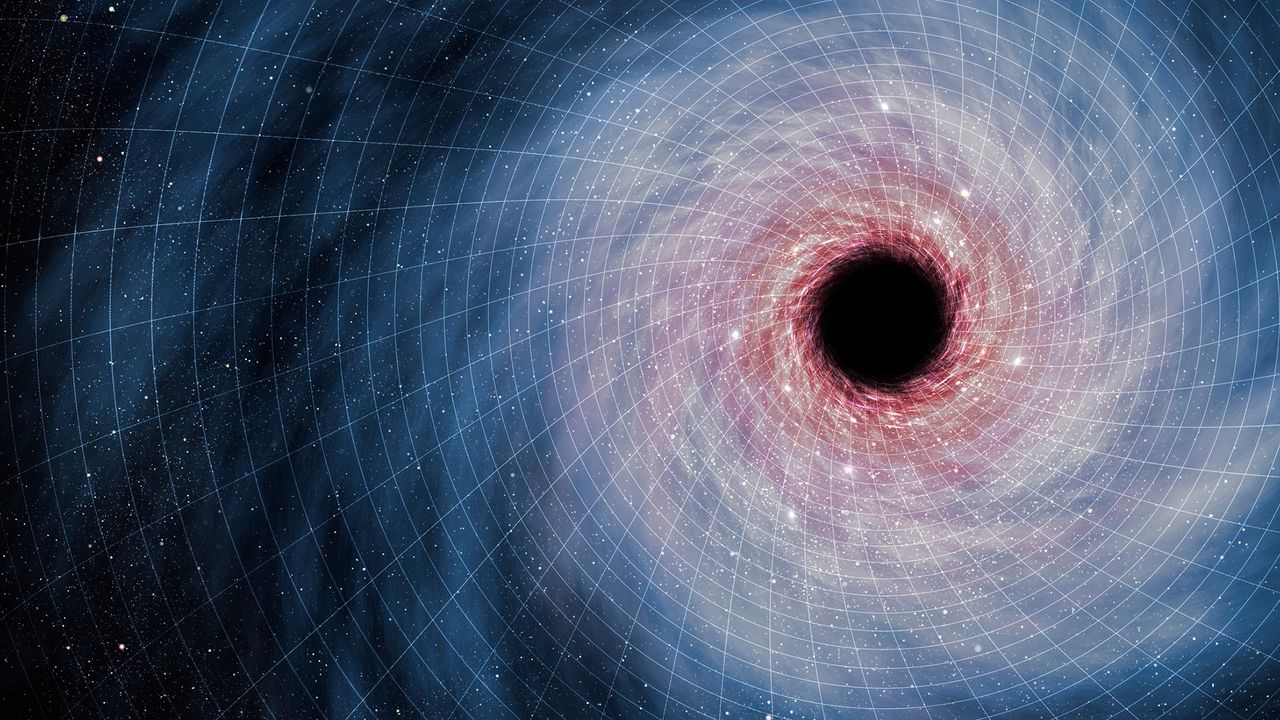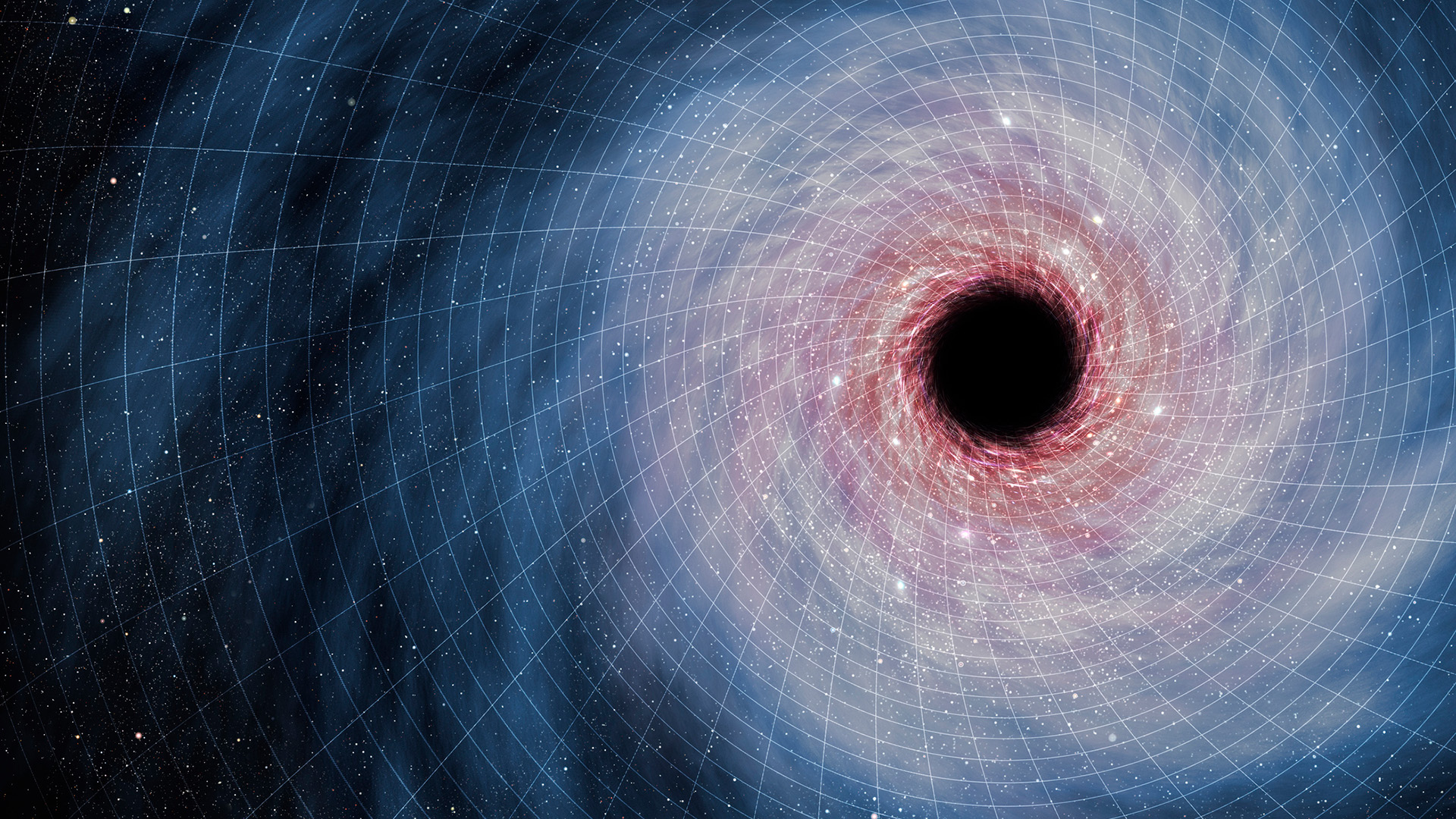
An illustration of space-time curving around a black hole. New theoretical research picks up a problem contemplated by Stephen Hawking and Kip Thorne about whether ‘naked’ singularities can emerge from rare patterns in space-time geometry. (Image credit: MARK GARLICK/SCIENCE PHOTO LIBRARY via Getty Images)
Share this article Join the conversation
Follow us Add us as a preferred source on Google Newsletter Subscribe to our newsletter
A new theoretical study adds fresh support to the idea that a mathematical pattern of ripples in space-time geometry could give rise to naked singularities and microscopic black holes. The new finding advances research into a subject that has vexed physicists for decades.
In 1997, Stephen Hawking famously conceded defeat on a 1991 bet with fellow theoretical physicists Kip Thorne and John Preskill about the possible existence of naked singularities: objects like black holes but without an event horizon (a point beyond which light, and all other matter, cannot escape), making them observable. Hawking eventually admitted that such objects could exist. Thorne and Preskill’s prize? T-shirts to cover their "nakedness."
The evidence that swayed Hawking came from physicist Matthew Choptuik. In 1993, Choptuik studied a specific set of solutions to Albert Einstein's general relativity equations. When solved numerically, on what was then considered a supercomputer, he showed how naked singularities could hypothetically occur under very specific conditions.
Choptuik found that by modeling the gravitational collapse of a simple form of matter, such as a field, and fine-tuning the initial conditions, an unstable state can be constructed. This theoretical state later became known as a space-time crystal — a self-organized repetitive mathematical pattern of ripples in space-time geometry — containing a singularity with infinite curvature (a naked singularity). Because such a singularity wouldn’t form inside a black hole, it could theoretically be observable.
But much like the phase transition from liquid water to ice, this state is delicate, with the field teetering on the edge between dissipating to become empty space or forming a microscopic black hole.
However, significant doubt remained about such a state's existence, even theoretically.
"Whenever you formulate a system in numerical code, you always have a problem because you can only represent a finite number of digits on a computer," study co-author Christian Ecker, an astrophysicist at Goethe University in Germany, told Live Science. "The historic computer simulations could only go so far before inaccuracies became unavoidable."
Sign up for the Live Science daily newsletter now
Get the world’s most fascinating discoveries delivered straight to your inbox.
Contact me with news and offers from other Future brandsReceive email from us on behalf of our trusted partners or sponsors
Though more recent numerical methods offer much higher accuracy, they are not exact and can never provide deep understanding of the phenomenon that traditional analytical methods (such as manipulating equations using algebra and calculus) offer.
In the new study published May 12 in the journal Physical Review Letters, the researchers mathematically described the formation of space-time crystals, naked singularities and microscopic black holes precisely.
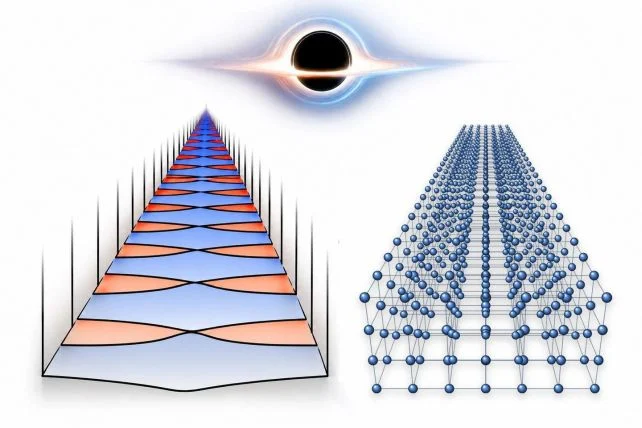
An illustration of a space-time “crystal” (left) compared to a natural crystal lattice (right).
(Image credit: TU Wien)
A pen and paper solution
They succeeded using just pen and paper, and some mathematical sleight of hand. "Whenever physicists find a small parameter, they are happy because they can first solve the equations when this parameter is zero, then add small corrections to it with standard perturbation theory," co-author Daniel Grumiller, an astrophysicist at the Institute for Theoretical Physics, Vienna University of Technology, told Live Science. "General relativity by itself doesn’t have a small parameter, but if you inject a small parameter [one over the number of dimensions and let this number be huge]… then you can use these perturbative tools and get a handle on otherwise very tough equations."
When taking the number of dimensions to be infinite, the team's exact solution could fit on just a few lines. This solution is unrealistic given we are most certainly not living in an infinite dimensional universe. However, as they brought the number of dimensions down to more realistic numbers, the solution required additional terms that made the expressions ever more complicated.
Related stories
"The lowest dimension that we can consistently connect with so far is 52, but the numerical data extends only up to dimension 14 — so there's a gap," Grumiller said, referring to the fact that neither pen-and-paper nor numerical techniques are accurate enough to cross paths yet.
"In the future, we plan to extend the numerics to higher dimensions, so that we can actually connect the two," Grumiller added.
Doing so would provide a compelling case that space-time crystals, naked singularities and microscopic black holes are mathematically possible in a universe like ours — however, this would still not prove they actually exist in reality. In the end, Hawking may have awarded those T-shirts too soon.
Article Sources
Ecker, C., Ecker, F., & Grumiller, D. (2026). Analytic Discrete Self-Similar solutions of Einstein-Klein-Gordon at Large d. Physical Review Letters, 136(19), 191401. https://doi.org/10.1103/qgl5-5l3t
See how much you know about black holes with our black hole quiz!
 Benjamin Skuse
Live Science contributor
Benjamin Skuse is a professional freelance writer of all things science and technology. Previously, he earned a PhD in applied mathematics from the University of Edinburgh and an MSc in science communication from the University of the West of England. His work has appeared in New Scientist, WIRED, IEEE Spectrum, Physics World, Sky & Telescope, Photonics Focus, and many more outlets.
View More
You must confirm your public display name before commenting
Please logout and then login again, you will then be prompted to enter your display name.
Logout