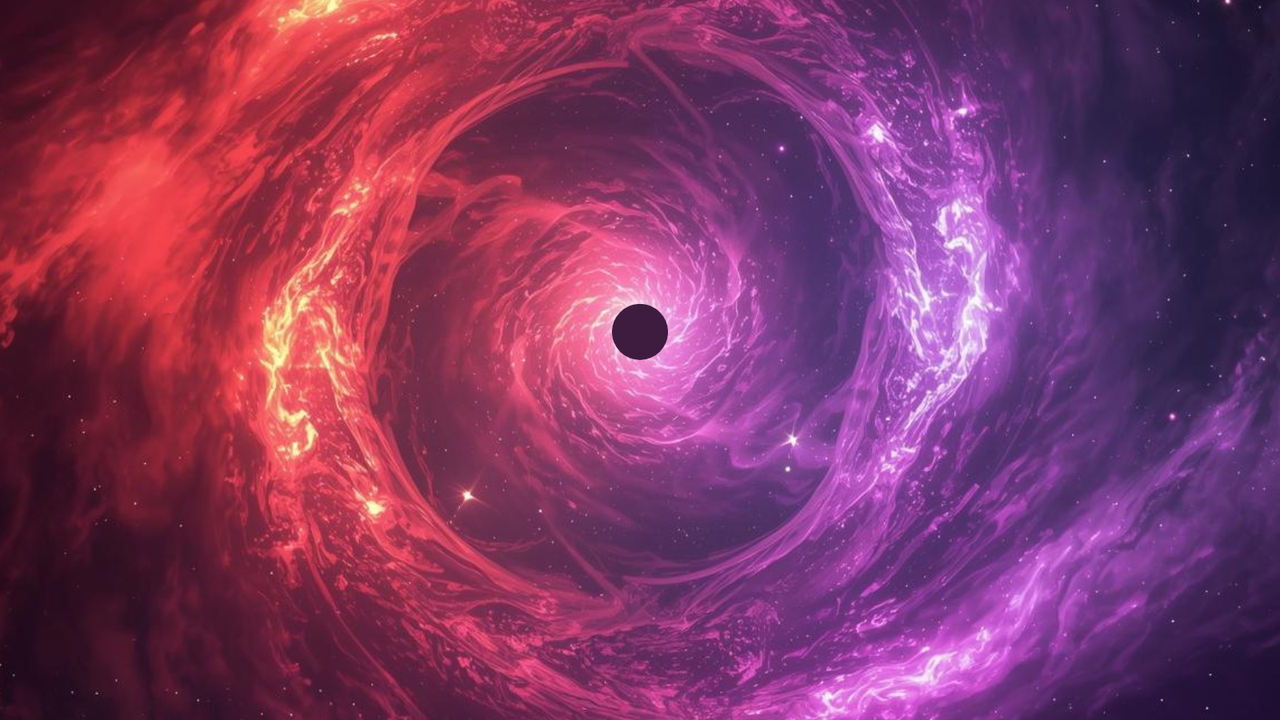
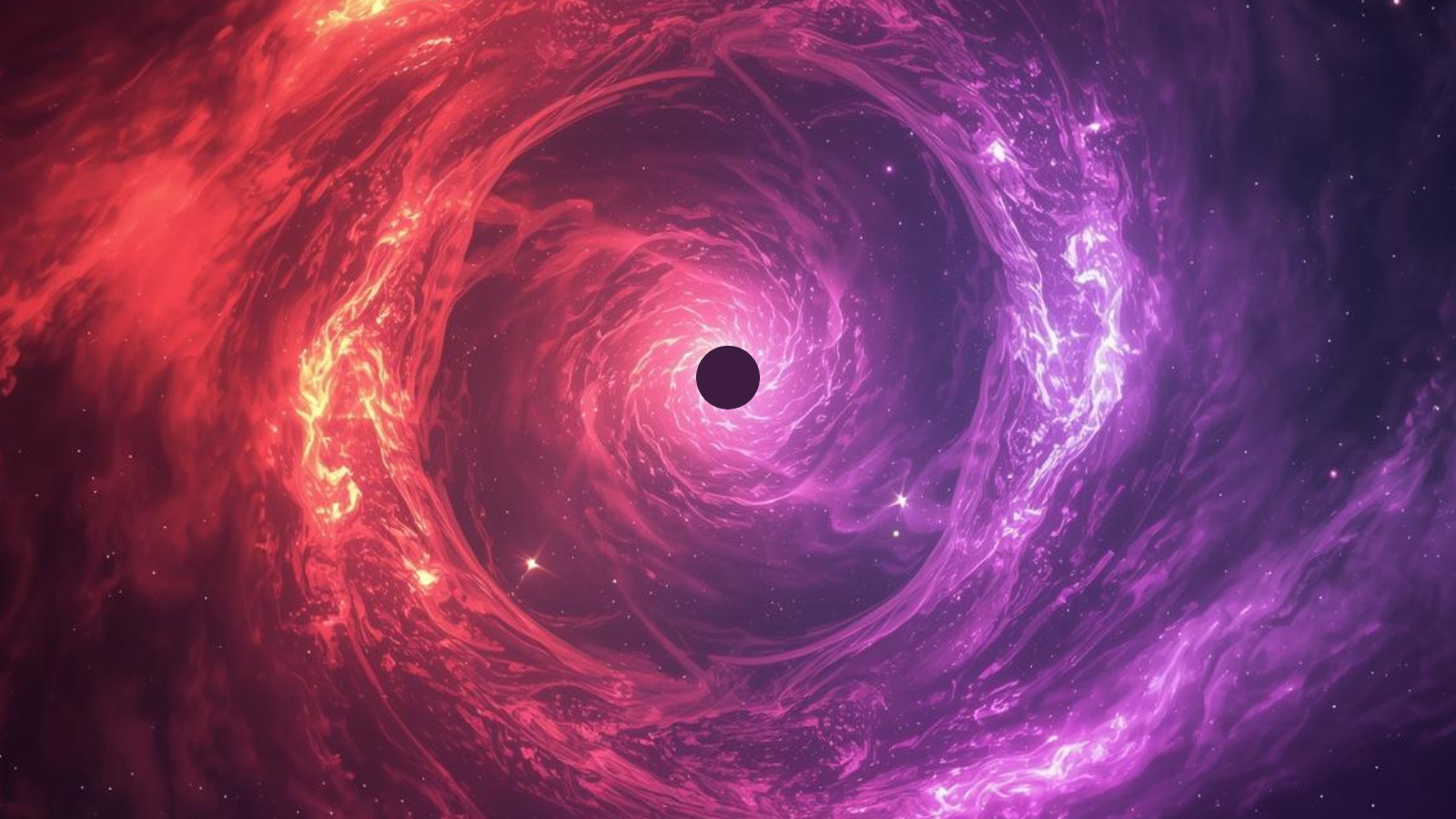
 An illustration shows a primordial black hole embedded in matter and antimatter, but did these Big Bang-born black holes prefer to consume antimatter? (Image credit: Robert Lea (created with Canva)) Share this article 0 Join the conversation Follow us Add us as a preferred source on Google Newsletter Get the Space Newsletter
 Breaking space news, the latest updates on rocket launches, skywatching events and more!
Contact me with news and offers from other Future brands Receive email from us on behalf of our trusted partners or sponsors By submitting your information you agree to the Terms & Conditions and Privacy Policy and are aged 16 or over.You are now subscribed
Your newsletter sign-up was successful
Want to add more newsletters?
An account already exists for this email address, please log in. Subscribe to our newsletterOne of the most fundamental and curious mysteries in the universe is the fact that anything exists at all. That is because during the Big Bang, equal amounts of matter and antimatter particles should have been created — antimatter being like the "opposite" of regular matter, meaning it's made up of antiprotons and antielectrons. And when matter and antimatter particles meet, they are mutually annihilated.
That means in a universe split up into matter and antimatter, large structures such as galaxies, stars, planets, moons and even our bodies should struggle to exist. Thus, some early quirk of the universe must have eliminated antimatter and allowed a matter-dominated cosmos to prosper. For some time, scientists have been keenly searching for evidence of what this type of event might be.
Article continues below"Primordial black holes are hypothetical black holes that formed soon after the Big Bang because of extreme, high-density fluctuations in the early universe. They are good candidates for being the seeds of supermassive black holes at the centers of massive galaxies, as well as of intermediate-mass black holes at the centers of globular clusters," Poplawski told Space.com. "There are other models of elimination of antimatter, but they all assume some physics beyond the Standard Model of particle physics.
"The mass asymmetry between matter and antimatter was surprising, but it immediately suggested to me that it could be a simple and natural cause of the observed matter-antimatter imbalance in the universe."
Was antimatter a drag in the earlier universe?
Poplawski explained how there are also unknown processes that violate the balance between a family of particles called baryons and their antimatter counterparts, the antibaryons.
"The mass asymmetry and the resulting black-hole capture asymmetry produced the matter–antimatter imbalance in the observable universe without violating the conservation of baryon number and invoking new physics beyond the Standard Model," Poplawski explained.
Get the Space.com NewsletterContact me with news and offers from other Future brandsReceive email from us on behalf of our trusted partners or sponsorsThe researcher says that because antimatter particles are more massive than matter particles, during pair production in the early universe, the antimatter particles were slower than the corresponding matter particles.
"Because the probability for gravitational capture of a massive particle by a black hole increases as its speed decreases, the antimatter particles were captured by black holes at larger rates than the corresponding matter particles," Poplawski said. "The missing antimatter fell into primordial black holes and what did not fall was annihilated by matter."
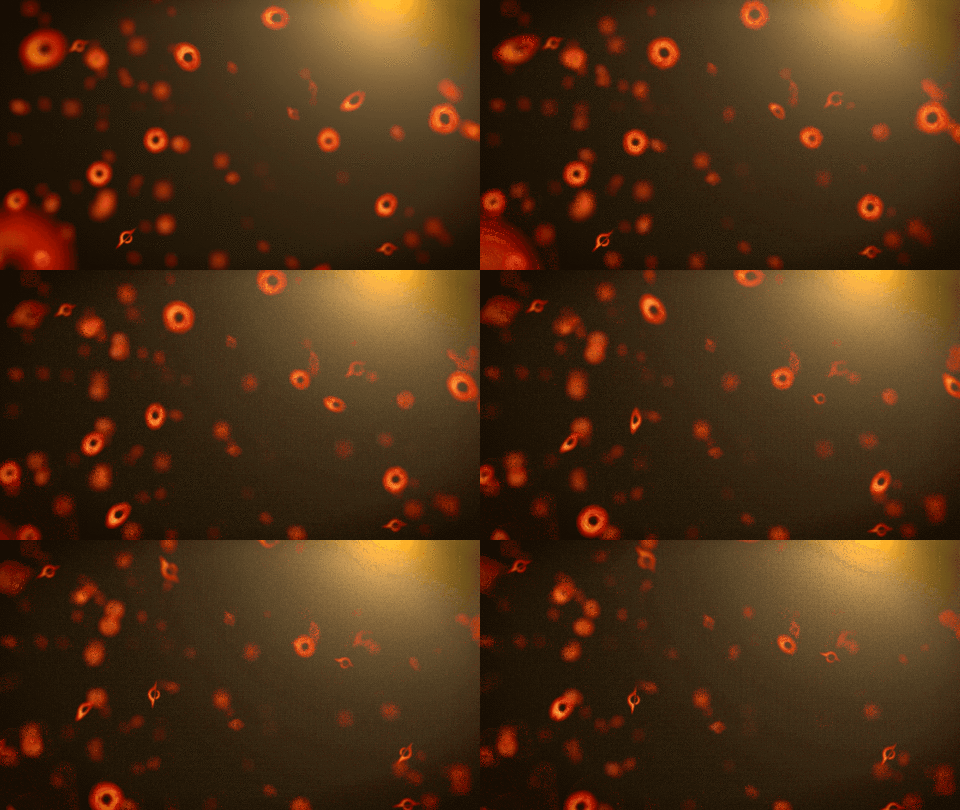
This could explain another problem in cosmology that has become pressing ever since the James Webb Space Telescope (JWST) began spotting supermassive black holes around 500 million years after the Big Bang. This is an issue because the merger and feeding process that allows supermassive black holes to grow to masses of millions, or even billions, of times that of the sun were previously thought to take at least 1 billion years to reach fruition. Seeing supermassive black holes before the universe was 1 billion years old therefore presents a considerable puzzle.
Poplawski thinks that by gobbling up antimatter, primordial black holes could have gotten a head start on these growth processes.
"Primordial black holes consumed more antimatter than matter, and because antimatter was much heavier than matter, primordial black holes enormously increased their masses," he said. "This could possibly explain how supermassive black holes recently observed in the early universe have grown so quickly."
Of course, there is a long way to go before this theory is accepted by the scientific community at large. One thing that could aid in its acceptance is obtaining observational evidence of the existence of primordial black holes, which since they were first proposed by Stephen Hawking in the 1970s, have remained frustratingly hypothetical.
"Primordial black holes would have existed in the very early universe, which is currently very difficult to probe. I hope that gravitational waves and neutrinos could be possibly used in the future to test this hypothesis," Poplawski said. "Also, there could be future experiments testing if matter and antimatter particles may have slightly different masses at higher densities or smaller distances compared to those currently probed. "In fact, some recent experiments showed that mesons and antimesons decay differently. This difference might be related to matter-antimatter mass asymmetry."
Poplawski's research is available on the preprint paper repository arXiv.
 Robert LeaSenior Writer
Robert Lea is a science journalist in the U.K. whose articles have been published in Physics World, New Scientist, Astronomy Magazine, All About Space, Newsweek and ZME Science. He also writes about science communication for Elsevier and the European Journal of Physics. Rob holds a bachelor of science degree in physics and astronomy from the U.K.’s Open University. Follow him on Twitter @sciencef1rst.
View MoreYou must confirm your public display name before commenting
Please logout and then login again, you will then be prompted to enter your display name.
Logout MORE FROM SPACE... 110 iconic William Shatner 'Star Trek' moments to celebrate his 95th birthday
- 2See the delicate crescent moon dance with the 'Seven Sisters' of the Pleiades tonight
- 3What if the next great astronomer isn't human? How AI is revolutionizing our study of the cosmos
- 4'This is really intolerable': Astronomers protest giant orbiting mirror project and SpaceX's million AI satellites
- 5Russian cargo spacecraft suffers glitch after launching toward International Space Station