"Sometimes dead is better." Who can forget the immortal words of Jud Crandall, delivered by the incomparable Fred Gwynne in the 1989 film adaptation of Stephen King's Pet Sematary? Turns out Crandall could have been talking about somewhere just as otherworldly as the cursed Chumash burial ground at the heart of one of King's most terrifying works of fiction.
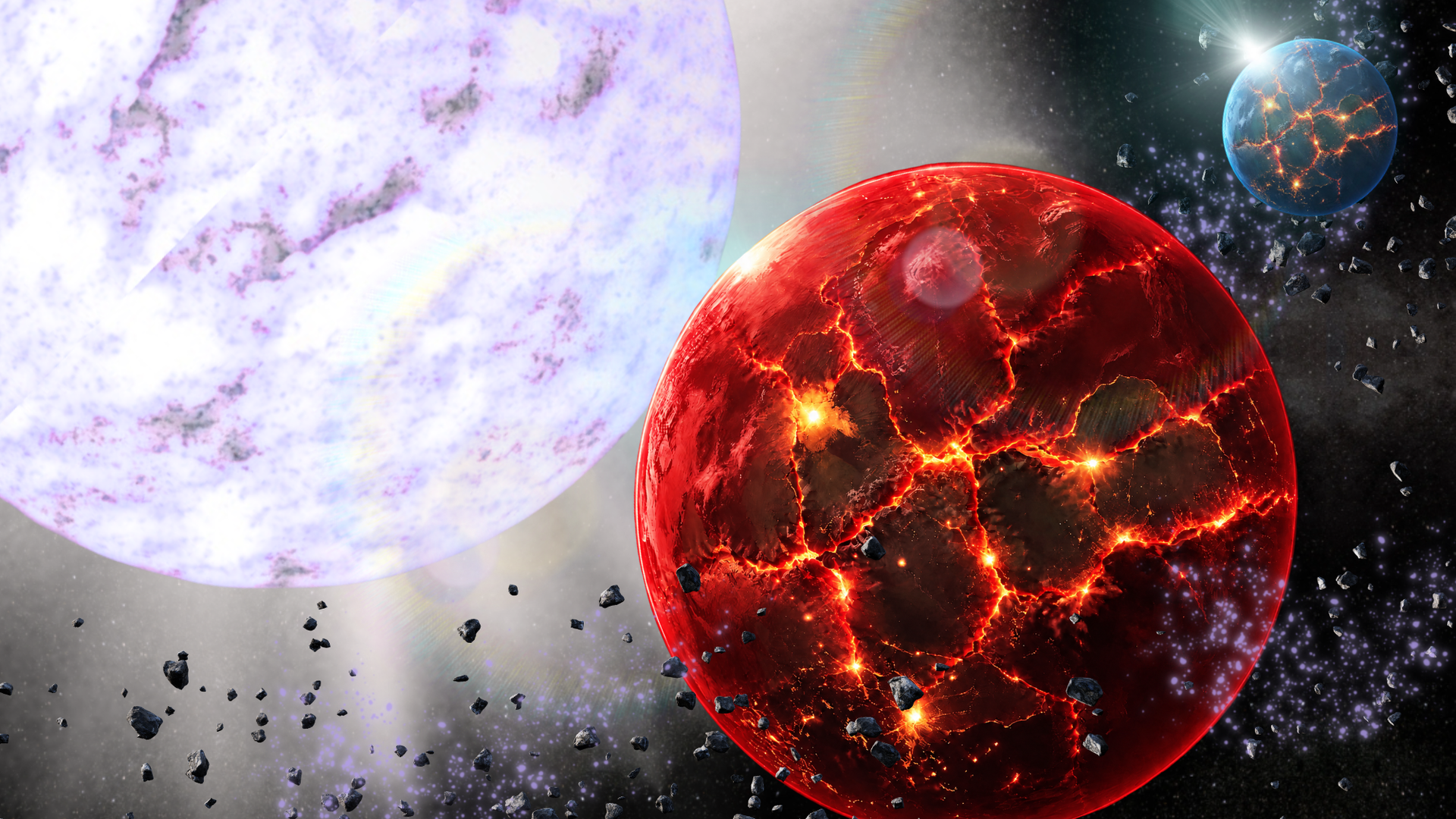
That's because astronomers have discovered two husks of two zombie planets shuffling through the gory remains of what was once their planetary neighbors around a long-deceased star, or white dwarf. The shattered planets were revealed by a clear gap in the debris around the white dwarf J1328−1450, located around 1,600 light-years away from Earth. One of the remnants is estimated to be no larger than the size of the average solar system asteroid, while the other is estimated to be between the size of the moon and the dwarf planet Pluto.
If this wasn't creepy enough, this haunting planetary system could be a grisly warning about the future of our own solar system after the inevitable death of the sun.
White dwarfs like the one at the heart of this system are formed when stars around the same mass as the sun run out of hydrogen in their cores. This means they can no longer fuse hydrogen into helium, the nuclear fusion process that provides the outward push that supports a star against the inward push of its own gravity. As a result, the stars' cores collapse while the outer layers, where nuclear fusion is still proceeding, puff out. This so-called red giant phase can see stars increase their radius by many 100s of times. When it happens to the sun in around 5 billion years, our star will expand to consume the inner planets, including Earth.
The red giant phase ends when the outer layers disperse along with the wreckage of consumed planets, leaving a smoldering stellar core, now a white dwarf, surrounded by the disk-shaped remains of its outer layers and cannibalized planetary children. But this may not be the final death of all the planets that once orbited the now-dead star.
"We have known for some time that planets may survive beyond the transformation of their central star, but this is the first example of a complex system with a double debris disc and potentially two surviving planetesimals," research leader Nicola Gentille Fusillo, an astronomer at the Università degli Studi di Trieste, Italy, said in a statement.
Violent stellar death can't kill these two planetary Jason Voorhees
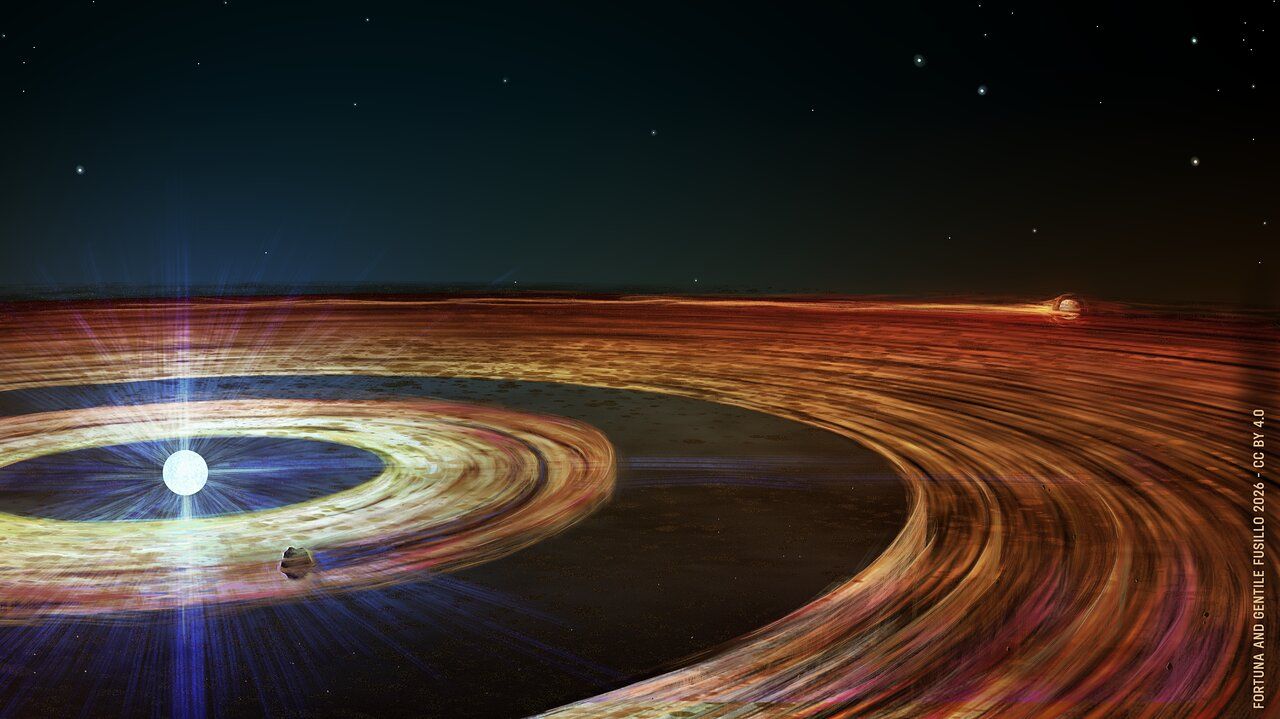
This system differs from others seen because of the large gap between the remarkably stable inner and outer rings. All previously known debris discs around white dwarfs have been surrounded by single, flat, rotating disks, not a double structure like this.
"The system is a rare glimpse of the violent, chaotic process by which a planetary system meets its end, and it hints that dead stars can have disc structures far more complex than previously realized," team member Gentle Fusillo of the Astronomical Observatory of Trieste said. The team thinks that this unique double structure is evidence of planets that weren't completely vaporized during this white dwarf's red giant phase.
That means just like the residents and campers of Crystal Lake couldn't finish off Pamela Voorhees' baby boy, even an expanding star couldn't finish these two planets.
The team's observations, made with the Very Large Telescope (VLT), revealed the presence of calcium, oxygen, magnesium, and iron in the disk around the white dwarf. This indicates the destroyed planets had a composition similar to the rocky planets of the inner solar system.
The researchers also found evidence of a diversity of composition in the destroyed planets. The chemistry of the outer rings deviated from that of the inner rings, indicating that at least two of the consumed planets had very different compositions.
"The system therefore offers a remarkable glimpse of what the future of planetary systems, including systems like our own, might look like," Lagos-Vilches explained.
The team's research was published on Monday (Oct. 26) in the journal Nature Astronomy.