 Some cancers don't respond well to immunotherapy. An existing drug for asthma might help, research hints. (Image credit: koto_feja via Getty Images) Share this article 0 Join the conversation Add us as a preferred source on Google Newsletter Subscribe to our newsletter
 A common asthma drug could be repurposed to help tackle hard‑to‑treat cancers, such as triple‑negative breast cancer, an early study suggests.
The research finds that cysteinyl leukotriene receptor 1 (CysLTR1), a protein found on many cells, may be hijacked by tumors to turn important immune cells into sleeper agents that work for the cancer instead of against it. Those immune cells, called neutrophils, would normally directly kill tumor cells, help to rally other immune cells against cancer, or boost the effects of certain cancer therapies.
If the new study's finding is confirmed in future research, an existing medication could offer a way to target this receptor and thus reverse cancers' resistance to common immunotherapies. There's already a drug on the market that can block CysLTR1, called montelukast, which has historically been used to treat asthma and allergies.
The work suggests that "you can repurpose these drugs to revive or to reprogram those neutrophils to become immune stimulatory cells that basically sensitize tumors to immunotherapy," study co-author Dr. Bin Zhang, a professor of cancer immunology at Northwestern University Feinberg School of Medicine, told Live Science. The research, published Tuesday (May 19) in the journal Nature Cancer, could also help to explain why some patients don't respond to immunotherapy, a treatment that redirects the immune response toward cancer cells.
"There are not many options available for patients who are resistant [to immunotherapy]," Zhang said. "But now, using this drug, it seems like they [could] start to respond to the treatment."
Immune cells called to the dark side
CysLTR1 is an important actor in immune responses; it helps recruit immune cells to a site of infection and prompts the lungs to produce mucus and cough out any invading microbes, for instance.
Sign up for the Live Science daily newsletter nowContact me with news and offers from other Future brandsReceive email from us on behalf of our trusted partners or sponsorsThe problem comes when that reaction gets out of hand. In asthma, blocking CysLTR1 can do wonders, alleviating symptoms like wheezing, breathlessness and allergy‑related nasal symptoms. The drug montelukast does just that, and it has been approved by the Food and Drug Administration (FDA) since 1998 to treat asthma and hay fever.
The new research suggests that CysLTR1 can also be co‑opted by tumor cells to cause neutrophils to adopt "tumor‑promoting" behavior. By releasing chemicals that tweak the behavior of immune cells — cytokines and cysteinyl leukotrienes — tumor cells encourage neutrophils to release powerful molecules that help cancer cells invade surrounding healthy tissue. They also help tumors ward off attacks from other immune cells that would normally seek out and help kill cancerous tissue.
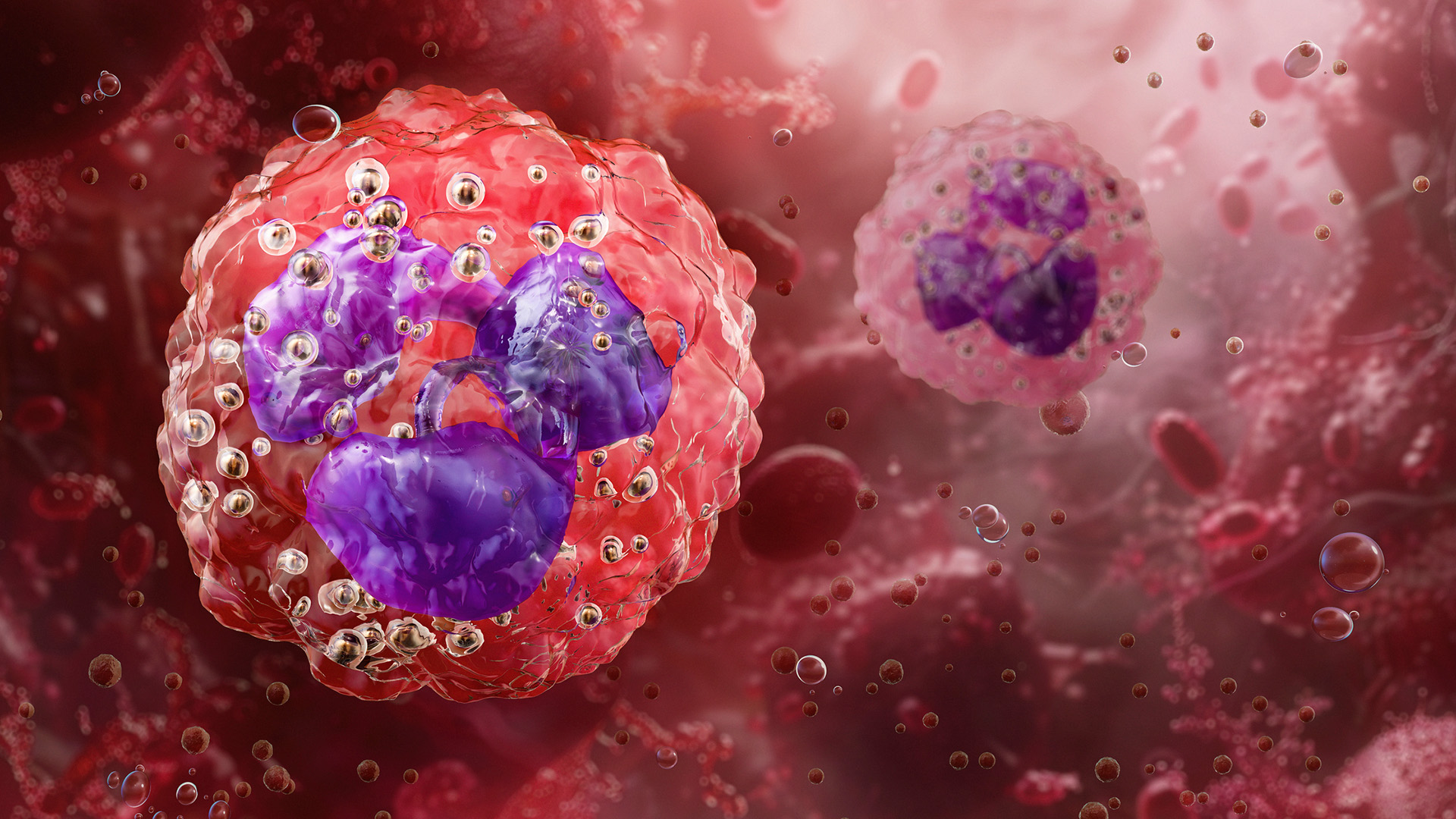
Neutrophils (pictured) are critical immune cells that can sometimes be hijacked by cancer.
(Image credit: RUSLANAS BARANAUSKAS/SCIENCE PHOTO LIBRARY via Getty Images)"We identified this molecule plays a very important role in controlling neutrophils, which is one of the most abundant immune populations in the circulation, particularly in cancer patients," Zhang said.
When researchers blocked CysLTR1 in lab mice, by either turning the gene off or using montelukast, they found that they could slow tumor growth, increase the mice's survival time, and make previously resistant tumors respond better to immunotherapy drugs.
Blocking CysLTR1 worked across several tumor types in mice, including breast, colon and melanoma‑like cancers. It was particularly strong when combined with a common type of immunotherapy called "checkpoint blockades," causing once-resistant tumors to shrink under treatment.
This is important because some cancers, such as triple‑negative breast cancer, don't tend to respond well to checkpoint blockades, Zhang said. At least from preclinical models, we suggest that when checkpoint blockades and montelukast are combined together, "you see beautiful results reflected by increased survival" across multiple tumor types.
"It's a very amazing result," he said.
Turning science into treatment
In experiments with human cells, the team found that blocking CysLTR1 in human blood reduced neutrophils' ability to shut down cancer‑killing immune cells. It also stopped neutrophils from maturing into this tumor‑helping, immune‑suppressing state, suggesting that the same pathway the team saw in mice is also active in people. Using a genetic analysis, the team unraveled the chain of events that CysLTR1 triggers to switch into this "cancer-promoting" mode.
They then uncovered clues that this same mechanism had left traces in large cancer datasets. They found that patients whose tumors had more of the receptor tended to do worse overall and responded less well to checkpoint blockades.
Shakti Ranjan Satapathy, a postdoctoral researcher at Lund University in Sweden who studies this field but was not involved in the new research, said the study was "important and timely" and "moves the field forward."
Zhang is hopeful that the team will be able to launch a clinical trial on the back of their results."It's not easy, sometimes, doing a clinical trial, but in this case, it may be a little bit less challenging because those drugs are available," he said.
The team also suggests that doctors screen for this receptor to determine whether patients are likely to resist immunotherapy. "We are probably the first to demonstrate [CysLTR1 as] maybe a functional biomarker that could be linked to the patient prognosis and help predict the immunotherapy resistance," Zhang said. Still, there is a lot to be tested before this drug can be confidently rolled out in the context of cancer, he said.
Related stories- Metformin may prevent severe morning sickness
- Migraine molecules may drive endometriosis pain. Existing drugs might help.
- Experimental drug doubles one-year survival in pancreatic cancer
"'Quickly move into trials' should not be confused with 'ready for routine cancer treatment,'" Satapathy cautioned. "Repurposing an approved drug still requires an appropriate dose, dosing schedule, patient selection strategy, safety monitoring, pharmacodynamic readouts, and evidence of benefit in combination with immunotherapy."
For one, montelukast is occasionally linked to substantial neuropsychiatric side effects when used for hay fever, including suicidal thoughts and mood changes, leading the FDA to raise a boxed warning in 2020. One alternative, Zhang said, might be to test whether the receptor could be targeted directly with an antibody, which could potentially cause fewer side effects, rather than a chemical, though further research will be needed to assess if this is the right path.
"Hopefully, we can have a real clinical impact," he said, "but that's too early to say."
DisclaimerThis article is for informational purposes only and is not meant to offer medical advice.
Article SourcesTang, H., Xie, P., Ahn, J. et al. Targeting cysteinyl leukotriene receptor 1 reprograms tumor-promoting myelopoiesis and overcomes immune checkpoint therapy resistance. Nature Cancer (2026). https://doi.org/10.1038/s43018-026-01174-7
 Marianne GuenotLive Science Contributor
Marianne is a freelance science journalist specializing in health, space, and tech. She particularly likes writing about obesity, neurology, and infectious diseases, but also loves digging into the business of science and tech. Marianne was previously a news editor at The Lancet and Nature Medicine and the U.K. science reporter for Business Insider. Before becoming a writer, Marianne was a scientist studying how the body fights infections from malaria parasites and gut bacteria.
View MoreYou must confirm your public display name before commenting
Please logout and then login again, you will then be prompted to enter your display name.
Logout