 Image source, PA MediaByTom EnglishBBC Scotland's chief sports writer in Charlotte
- Published49 minutes ago
For much of Saturday afternoon, the skies above Charlotte were a dirty shade of gray, the rain bucketing down, the wind blowing hard, thunder and lightning seen and heard every minute or so.
If Steve Clarke was looking out of his hotel room, that's the biblical scene he would have taken in. In a sense, the ideal backdrop for a bombshell.
Within minutes of Scotland being officially dumped out of the World Cup, the news of the head coach's departure dropped. Unlike the weather, there was no warning.
The manner of his exit was typical of the man; low-key, no fuss, no interviews as yet, no need in his mind to explain his thoughts any more than he already has.
The length and detail in his valedictory statement suggests this was in the pipeline for a day or two but there's no word on why he has taken this decision.
And why so abruptly? Why not get back home, take a break and think about it? Snap judgements and emotional reactions are not Clarke traits, so why has he done this now?
The players didn't know this was coming and neither did many of the Scottish FA board. A month ago these same people announced, with some fanfare, that Clarke was staying for four more years.
Clarke steps down as Scotland boss
- Published10 hours ago
'Bye-bye, Scotland' - Clarke's leaving letter to Tartan Army
- Published9 hours ago
New deal, new beginnings & a sudden exit - Clarke's Scotland timeline
- Published5 hours ago
There's a constituency of football folk who didn't want him to continue and they kept things civil. There's another constituency that just don't like the man and never have.
He incensed some Rangers fans when mocking them for sectarian singing when he was manager of Kilmarnock - he said they were stuck in the dark ages - and a chunk of them have neither forgotten nor forgiven.
And now he's gone. His legacy is a really good one, but there is a sense of relief that there's going to be a new voice and fresh ideas now, as long as a good appointment is made, which is very far from a given.
Seven years is an eternity. There is some pain for the Scottish FA that the manager they committed to for four more years only last month has now walked.
For the Clarke critics - the balanced and the bonkers - there is an element of being careful what you wish for because there are no outstanding, and realistic, candidates out there.
The denizens of Hampden are under significant pressure to get the right manager from a limited pool. Scotland have six Nations League games between September and November.
To play this video you need to enable JavaScript in your browser.
This video can not be played
Figure caption,Tartan Army react as Steve Clarke steps down as Scotland boss
Clarke's bumpy road out of wilderness
Clarke will be just a dot on the landscape by then, but he has been a significant force for Scotland for the longest time, a manager who took the team out of the wilderness but never to the promised land of knockout major championship football. That was his goal in American and he failed.
Three major championships in seven years, though. A whole host of good times - amid plenty of bad. Scotland toiled at all three of those tournaments but they got there.
People can scoff at that now, but they have short memories. Those qualifications brought many millions of pounds into the coffers of the Scottish FA.
The nation had forgotten what it was like to reach that level before Clarke fetched-up. A desperate fatalism had taken root in the game.
There was no hope, only cynicism. Two games before he took over, Scotland lost 3-0 against Kazakhstan. It was pathetic.
In his first game in charge, a scratchy and late win against Cyprus, a crowd of 31,277 turned up at Hampden.
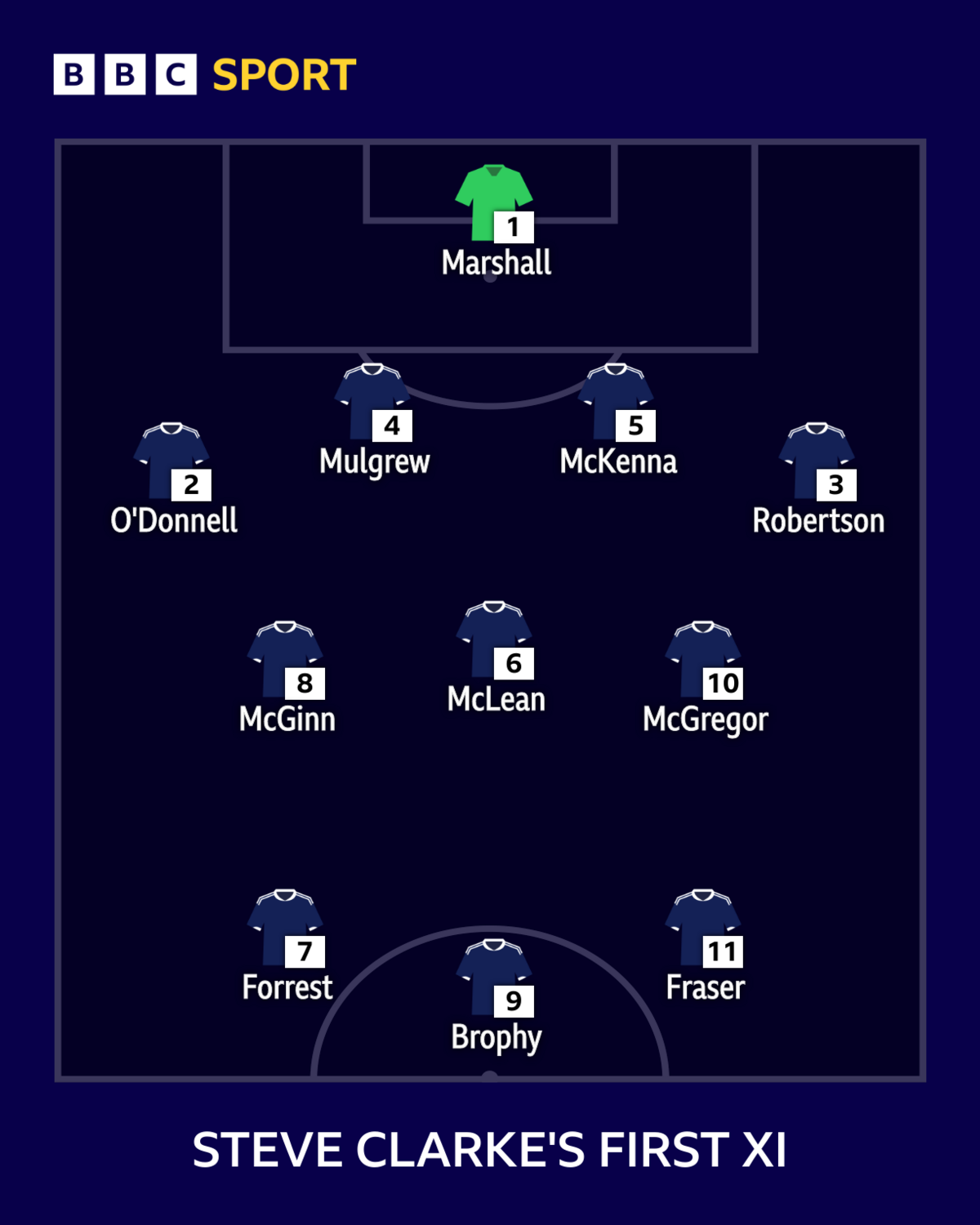 Image caption,
 Clarke's first Scotland XI, against Cyprus in 2019
In subsequent home games, 32,432 turned up for the 2-1 loss to Russia, 25,524 were there to see Belgium win 4-0, 20,699 were at Hampden to see them beat San Marino and 19,515 were in attendance when they beat Kazakhstan.
Clarke referred to this era in his farewell message. Bar a loyal band of Tartan Army members, there was total indifference.
The peaks and troughs under Clarke were quite something. He was a manager with a capacity to bounce back.
Scotland experienced a stratospheric high of back-to-back penalty shoot-out victories to qualify for the Covid-delayed Euros, then failed dismally when they got there.
Clarke came again with a strong bid to reach the 2022 World Cup, winning six competitive matches in a row for the first time since 1930. They saw off Denmark along the way and earned themselves a home semi-final play-off against Ukraine - and flopped.
They flopped again, 3-0 against the Republic of Ireland, in the Nations League that followed.
Clarke quits Scotland immediately after World Cup exit
Andy Burke, Pat Nevin and Tom English react to Clarke's departure
28/06/26
Listen on SoundsGoodwill ebbs away but results still come
These were times of danger for Clarke. The knives were out, but he went again in the qualifiers for Euro 2024.
The campaign was riveting and Hampden was rocking like rarely before. They beat Spain at home and, memorably, did Norway at the death away from home.
The night they beat Georgia in the Glasgow monsoon was one of the most memorable of the entire Clarke regime. Khvicha Kvaratskhelia and all of that.
To Germany for the Euros; another awful experience culminating with a 1-0 loss to Hungary. Clarke was negative and his team sank without trace.
He reacted badly in the aftermath. That failure and the truculence that followed it cost him a lot of goodwill. He was in trouble again.
The manager with multiple lives stirred once more. Better yo-yo than no-no. The Nations League campaign ended with a draw against Portugal and wins over Croatia and Poland. Things were cooking again.
To play this video you need to enable JavaScript in your browser.
This video can not be played
Figure caption,'Disappointing' - Clarke's last interview as Scotland suffer defeat to Brazil
And Lady Luck was shining on him. In qualifying for the World Cup, Scotland were dreadful against Greece at home and won, dreadful against Belarus at home and won again. Those were the performances that John McGinn called "jobby."
They lost in Greece and would have been in the play-offs had it not been for Belarus getting a miraculous draw against Denmark in Copenhagen.
They took advantage of that extraordinarily good break in the epic game of the ages against the Danes - one of the greatest nights in the history of the team.
That was the bliss before the brick wall of America. Now comes the search for a manager to do what Clarke did, only do it better.
The squad is pushing on, one of the oldest at this World Cup.
Clarke's three goalkeepers in America had a combined age of 103. Lyndon Dykes and Lawrence Shankland are 30, with another five players soon to join them. John McGinn, Ryan Christie and Jack Hendry are 31, Andy Robertson is 32, Grant Hanley and Kenny McLean are 34.
The new man has problems in goal and at centre-back. There is an absence of creative and dynamic central midfielders, a shortage of wingers with real pace and a serious problem in making chances for strikers who are forced to live off crumbs.
Scotland came a long way under Clarke but the road to where they want to be stretches out for many miles. Another manager gets to navigate it now. He won't be short of backseat drivers.
Get in touch
Send your views on the Scotland football team
Contact formContact formRelated topics
World Cup fixtures and group standings
How to watch the World Cup on the BBC
- Published6 June

Everything you need to know about the World Cup
- Published1 April