

 Getty ImagesThere has been a sharp drop in Indians going to Canada to study
At an overseas education consultancy in the Indian capital, Delhi, students sit with their parents, flipping through brochures from universities in Italy, Germany and Australia.
But one destination, once the top choice, is now largely absent.
"Until 2023, most of our applications were for Canada," says Shobhit Anand, who runs the consultancy, which helps students navigate the admission process, including visa applications.
Now, he says they have seen a drop of nearly 80%.
"People don't want to apply to Canada anymore. We are also seeing a very high visa rejection rate."
According to a report submitted by Canada's auditor general to parliament last month, the share of Indians in the country's incoming international student population was just 8.1% in September 2025 - a sharp drop from 51.6% in 2023.
There are a number of reasons: visa and immigration restrictions, high living costs and, in 2023, a diplomatic crisis that damaged ties between the two countries (the situation is better now).
- How relations between India and Canada hit rock bottom
- India and Canada reset ties with 'landmark' nuclear energy deal
For years, Canada held a strong appeal for middle-class Indian families. Its private colleges offered a seemingly reliable pathway - even for average students - to study abroad and eventually settle there.
The route was mostly straightforward: enrol in a two-or three-year vocational course, find a job after graduation and, within a few years, apply for permanent residency. The process typically took around five years, experts say.
It worked - until it didn't.
The shift has been driven by a mix of policy changes and economic pressures.
In early 2024, Canada announced a two-year restriction on how many international students could be admitted to its undergraduate and diploma programmes - capping it at around 350,000 study permits per year (postgraduate courses were unaffected).
This was a big blow for many Indian students.
At the same time, living costs surged and jobs became harder to find. Rents climbed sharply across major cities, while financial requirements tightened.
The Guaranteed Investment Certificate (GIC) - proof of funds required to study and live in Canada - was doubled from C$10,000 ($7,227; £5,378) to more than C$20,000 in 2024.
"For many families, securing that amount is difficult - and with the risk of visa rejection, they hesitate," says Sushil Sukhwani of consultancy Edwise Overseas Education. "That became a major barrier."
As consultants note, getting a study visa has also become harder.
Study permit rejections rose from 38% in 2023 to 52% in 2024 in Canada, according to ICEF Monitor, which focuses on international student mobility. In price-sensitive countries like India, where studying abroad depends on careful financial planning, families are now far less willing to take that kind of risk.
So the question has shifted from how to go to Canada to whether to go at all.
"There's real fear. Even if you get there, can you make it work?" Anand says.
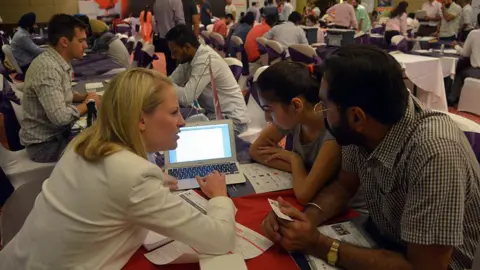 AFP via Getty ImagesUntil 2023, Canada was a favoured destination among Indians aspiring to move abroad
The Canadian auditor general's report also mentions concerns around a now-scrapped fast-track visa system known as the Student Direct Stream (SDS). Popular among Indian applicants, it allowed quicker processing for those who met certain financial and language requirements.
Approval rates under SDS for Indians rose from 61% in 2022 to 98% in 2024, even as officials flagged risks such as fraudulent applications, students not attending classes and rising asylum claims. By the end of 2024, the scheme was scrapped and scrutiny has since tightened.
The report said the scheme was being "targeted by non-genuine students seeking entry to Canada". While it did not name countries, it noted that almost all approved SDS applications were from India.
- Indian students face exit from Canada over fake papers
- Do international students get what they pay for?
Jobs are another big concern.
Many private colleges expanded rapidly during what experts describe as the "international student boom" - a surge in overseas enrolment, particularly after the pandemic, when Canada saw record numbers of foreign students.
But many of these institutions offered limited academic value and operated largely as revenue-driven businesses, experts say.
As a result, job opportunities failed to keep pace with the growing number of graduates, leaving many students unable to recover the high cost of studying abroad.
In Delhi, Anand recalls a former student who moved to Canada two years ago. After completing his course, the 24-year-old struggled to find stable work and relied on part-time jobs to get by.
"He could not make ends meet," Anand says. The student has since returned to India and is now looking for work.
His story reflects a broader pattern. The visa cap hit undergraduate colleges the hardest, while elite institutions and universities were largely insulated.
McGill University president Deep Saini told the BBC that Indian students broadly fall into two camps.
"One group is academically driven - they apply to top universities in Canada, the US or Europe for quality education. The other sees education primarily as a pathway to migration and tends to enrol in smaller colleges," he adds.
That distinction helps explain who was hit hardest by the crackdown. Canada's visa restrictions were largely aimed at students enrolling in smaller, lesser-known colleges as a cheaper and easier route to gaining permanent residency - not those coming purely to study.
Top universities like McGill, which draw more academically motivated students, were mostly shielded from the impact.
Saini says his university did see a slight dip in international admissions after 2023, driven both by tighter visa rules and diplomatic tensions - but calls it "collateral damage" rather than a direct hit.
International student numbers - particularly Indians - at McGill are now returning to normal, he adds.
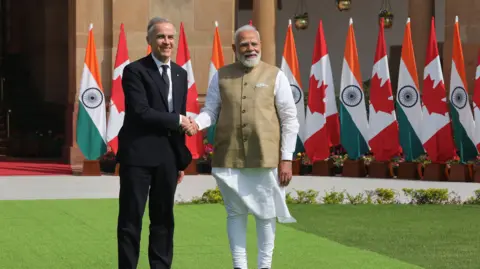 EPATies between India and Canada have improved after Mark Carney (L) took office as Canada's PM
As diplomatic relations improve, there are signs of hope.
Prime Minister Mark Carney visited India earlier this year, accompanied by officials from several top Canadian universities.
There are efforts to rebuild relations, including new education partnerships and scholarship initiatives.
But for students like Tanishq Khurana, the decision is no longer as straightforward.
The 17-year-old had planned to apply last summer, but a conversation with a consultant made him pause.
"I was told about rising visa rejections and colleges limiting undergraduate admissions. That made me rethink everything," he says.
At one point, Khurana considered staying in India for his undergraduate studies and going abroad later. But the pull of Canada remained and he has now decided to apply again to pursue a bachelor's degree in clinical psychology.
"The reason for my choice of Canada is fairly simple. My sister is settled there and so are many of my cousins. So the country is familiar and the education and job opportunities are better than in India," he says.
Canada still offers a post-graduation work permit of up to three years, a key draw. But that alone no longer guarantees the next step.
With living costs rising and jobs harder to find, many graduates have found themselves in limbo - legally allowed to stay, but struggling to build the life they came for.
The promise that once came with a Canadian study permit - a job, a life and a foothold abroad - is no longer a given.
For many Indian students, what was once a plan is now a bet.
Follow BBC News India on Instagram, YouTube, X and Facebook.
AsiaStudentsIndiaCanada