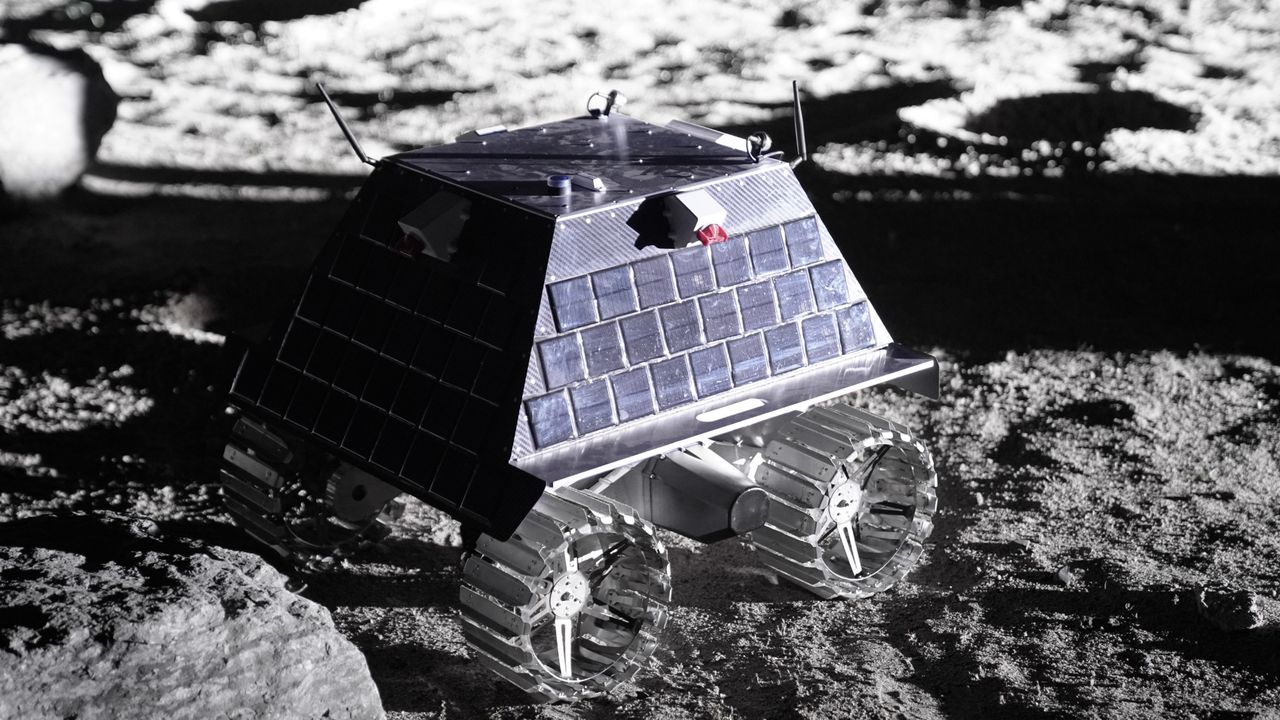
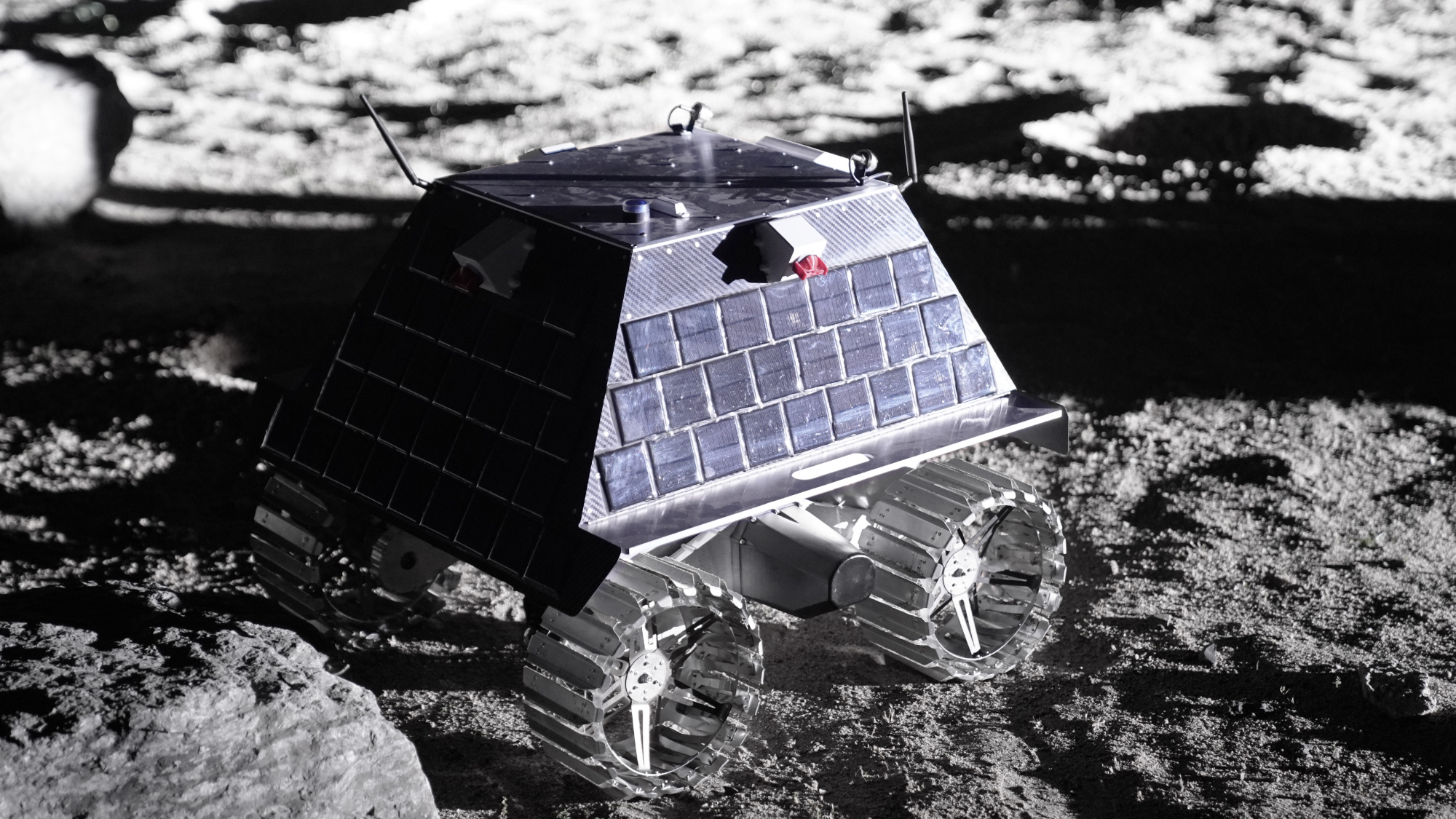
 A prototype of a Canadian lunar rover in testing at the Canadian Space Agency, on moon-like terrain. (Image credit: Canadian Space Agency) Share this article 0 Join the conversation Follow us Add us as a preferred source on Google Newsletter Get the Space.com Newsletter
 Breaking space news, the latest updates on rocket launches, skywatching events and more!
Contact me with news and offers from other Future brands Receive email from us on behalf of our trusted partners or sponsors By submitting your information you agree to the Terms & Conditions and Privacy Policy and are aged 16 or over.You are now subscribed
Your newsletter sign-up was successful
Want to add more newsletters?
An account already exists for this email address, please log in. Subscribe to our newsletterCanada will cancel its first rover mission to the moon's south pole as the Canadian government shifts its spending to other projects.
The water-seeking moon rover project, first announced by the Canadian Space Agency (CSA) in 2021, is terminated in the department's spending plan for 2026-27. The news comes as NASA — a major CSA partner — makes big changes to its Artemis program of lunar exploration, including putting a long-planned moon-orbiting space station on hiatus to focus on a base on the surface.
"It's hopefully not a lost cause," rover mission lead scientist Gordon Osinski, a professor of Earth and planetary materials at Canada's Western University, told Space.com. "We've built up knowledge. I think the science team has come a long way in the last couple of years. The faculty members on it, the researchers — also all of the graduate students and postdocs — they'll be able to take that knowledge that they've learned throughout their future careers."
Article continues belowOsinski, known in the lunar science community as Oz, said the science team received the news in February. His team spent a month "trying to fight the cancellation" to no avail. With NASA hoping, however, to start sending monthly robotic missions to the moon as soon as next year, Osinski said his team would be happy to offer expertise to these efforts — if they are asked.
CSA did not cite NASA's recent Artemis changes in its rationale for cutting the rover, instead pointing to a Canadian priority shift. "The government is committed to restraining the growth of day-to-day operational spending to make investments that will grow the economy and benefit Canadians," the CSA wrote.
A prominent example of current Canadian government space priorities (although CSA did not cite this) was shown earlier this month: The Canadian defense department committed $200 million CDN ($146 million) over the next 10 years to lease a launch pad in Canso, Nova Scotia, for eventual sovereign launches. Jobs and innovation were said to be benefits of the spaceport funding.
Decades of background work
The coffee-table-sized moon rover — whose launch was expected on Firefly Aerospace's 2029 mission funded by NASA's Commercial Lunar Payload Services (CLPS) program — was tasked to search for lunar water ice, as well as to explore the moon's geology and environment. (Firefly and NASA have not publicly stated yet how the rover's expected spot on the lander will be reallocated.)
Get the Space.com NewsletterContact me with news and offers from other Future brandsReceive email from us on behalf of our trusted partners or sponsorsThe mission was supposed to carry six instruments to the moon's surface — five Canadian payloads and a NASA radiometer flying under a NASA-CSA agreement. The 77-pound (35 kilograms) vehicle also was expected to bring 20 years of Canada's space-rover knowledge into the spotlight: Oz confirmed that local expertise stemmed in large part from millions in stimulus spending the CSA gave for demonstration rover projects in the wake of the 2008 recession.
As is typical with Canadian missions, the lunar rover was positioned as a targeted niche project with a modest budget. The rover's cancellation was part of just $6.7 million CDN ($4.9 million) in cuts from the 2026-27 agency budget, in which CSA is expected to spend $913.9 million CDN (nearly $668 million).
Projecting out to the 2029 launch date, the CSA stated that removing the rover and eliminating 45 full-time-equivalent agency positions "through natural attrition and revised staffing" will save the agency a further $26 million CDN ($19 million) between 2027-28 and 2028-29.
The rover was being built by Ontario company Canadensys Aerospace, alongside industrial and academic partners, under a CSA contract for $43 million CDN ($31.4 million). Upon cancellation, the rover was at Phase C of development and approaching critical design review later this year. Canadensys stated it was "understandably disappointed" by the mission termination, and is speaking with European and American entities about other possible opportunities.
Meanwhile, the 50-person rover science team will continue to see funding "for the length of their grants", CSA stated. Oz said those funding details are still being worked out.
"A lot of our support is still up in the air," he said. "And so, you know, the real honest answer is that I'm not entirely sure how much of what we originally proposed to do as a science team we will be continuing. I think that's still going to be answered over the next days and weeks, to get a bit more clarity on that."
Rover, repurposed
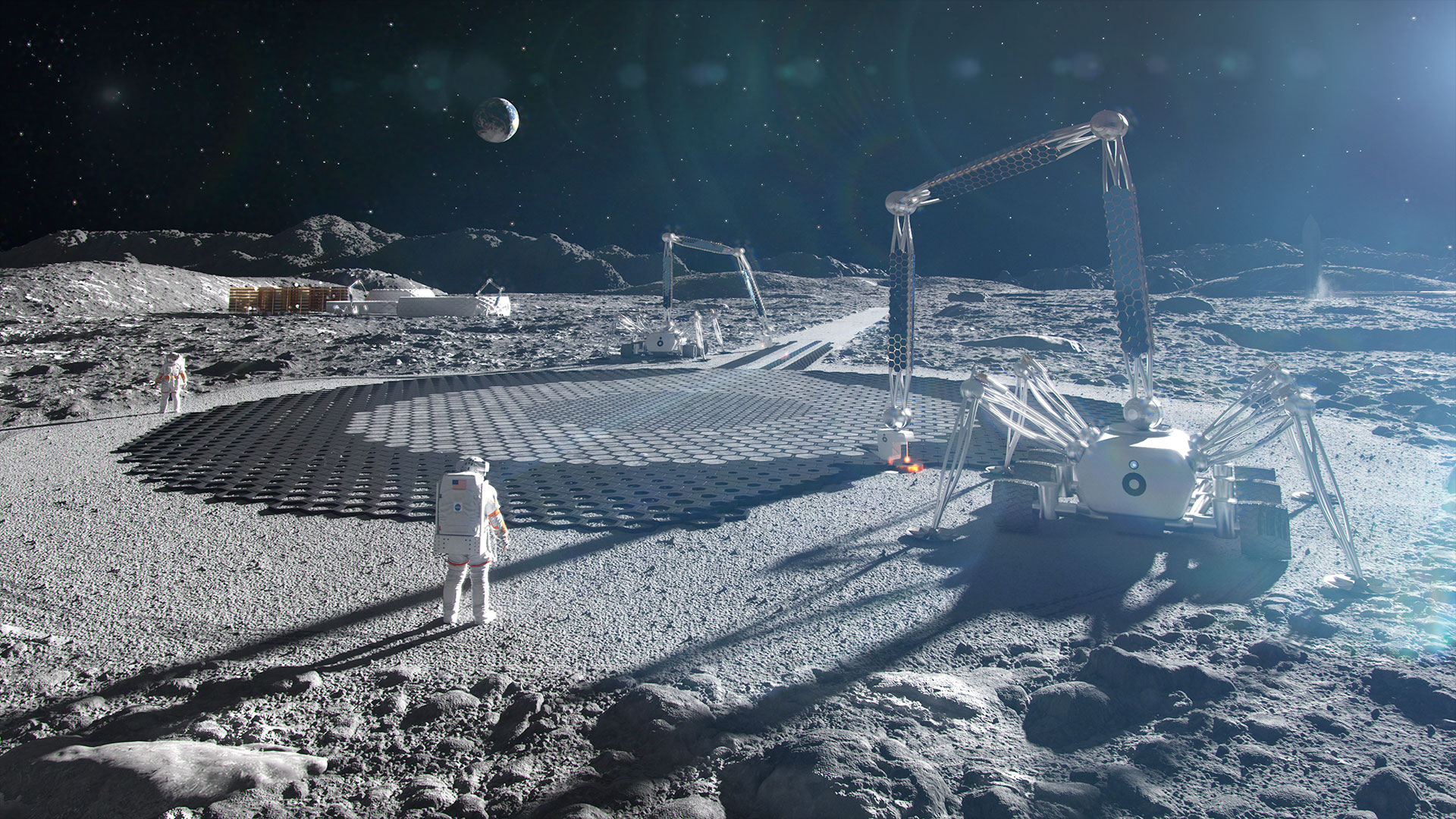
The rover-planning work will be used, CSA emphasized on an updated mission-description page, for projects such as a planned Canadian lunar utility rover — essentially, a cargo vehicle for astronaut missions landing no earlier than 2033. Three companies — Canadensys, Canadarm manager MDA Space and rover-software company Mission Control — are all doing CSA-funded preparatory studies for the utility vehicle ahead of prime contractor selection.
Oz also drew a direct link between the rover's landing-site characterization, which Western did on behalf of Firefly, to the first Artemis landing mission with humans.
Firefly's CLPS mission will touch down at the moon's south pole on the rim of Haworth Crater. Oz has two students and a postdoc who not only worked on that team but who are also assisting Oz as he co-leads the science excursion work for the first Artemis astronaut landing, which is expected no sooner than 2028 on the Artemis 4 mission.
Days from Artemis 2?
CSA's rover-cessation announcement was tied to fiscal budget-deployment milestones in the Canadian government. By coincidence, however, the news came just days before the possible launch of one of the highest-profile Canadian space missions in history: CSA astronaut Jeremy Hansen will be one of the four astronauts flying on the NASA-led Artemis 2, which will lift off as soon as April 1 to take a 10-day loop around the moon.
Hansen, a mission specialist, will join NASA commander Reid Wiseman, NASA pilot Victor Glover and NASA mission specialist Christina Koch on the first crewed moon mission since Apollo 17 landed there in 1972. Hansen will be the first non-American to do a moon mission, while Glover and Koch will be the first person of color and woman, respectively, to do so.
Western University was not only the science lead for the canceled moon rover, but in a typical link showing how closely Canadian space missions are related, it was also among the partners in Hansen's training. In September 2023, Oz led Hansen, other Artemis 2 astronauts, and researchers in exploring a moon-like crater in northern Labrador, Canada. (Hansen has participated in many such remote geology excursions with Oz since first joining the CSA in 2009.)
The canceled moon rover foreshadowed larger uncertainty in Canadian lunar projects as of Tuesday (March 24). As part of its Artemis planning, NASA announced it would "pause" Gateway — a moon-orbiting space station with international contributions — in favor of deploying infrastructure to a lunar base. Gateway was supposed to be maintained by MDA Space's Canadarm3, a CSA-funded robotic arm used to pay for Hansen's seat and Canadian science on Artemis 2, as well as future Artemis opportunities.
NASA said it is in discussions with international partners about how to reconstitute the Gateway hardware, but it has not yet offered any specifics. MDA Space emphasized later on Tuesday that Canadarm3 is part of a CSA contract that is continuing. "Our work on the Canadarm3 program continues to progress," officials stated. Because Canadarm3 is in the design phase, they added, there is "flexibility to pivot to an alternate operating environment."
 Elizabeth HowellContributing Writer
Elizabeth Howell (she/her), Ph.D., was a staff writer in the spaceflight channel between 2022 and 2024 specializing in Canadian space news. She was contributing writer for Space.com for 10 years from 2012 to 2024. Elizabeth's reporting includes multiple exclusives with the White House, leading world coverage about a lost-and-found space tomato on the International Space Station, witnessing five human spaceflight launches on two continents, flying parabolic, working inside a spacesuit, and participating in a simulated Mars mission. Her latest book, "Why Am I Taller?" (ECW Press, 2022) is co-written with astronaut Dave Williams.
View MoreYou must confirm your public display name before commenting
Please logout and then login again, you will then be prompted to enter your display name.
Logout MORE FROM SPACE... 1We've finally seen 'Exodus' gameplay, it's 'Mass Effect' with a space grappling hook
- 2'It was an incredible moment': One photographer's journey to capture the March 3 total lunar eclipse over Malaysia
- 3Rocket shines under the northern lights | Space photo of the day for March 25, 2026
- 4Like 'accelerating from stationary to supersonic flight': Europe's Hera probe boosts speed, stays on course for November asteroid rendezvous
- 5Europe plans EPIC SpaceX mission to send 4 astronauts to the ISS before its retirement