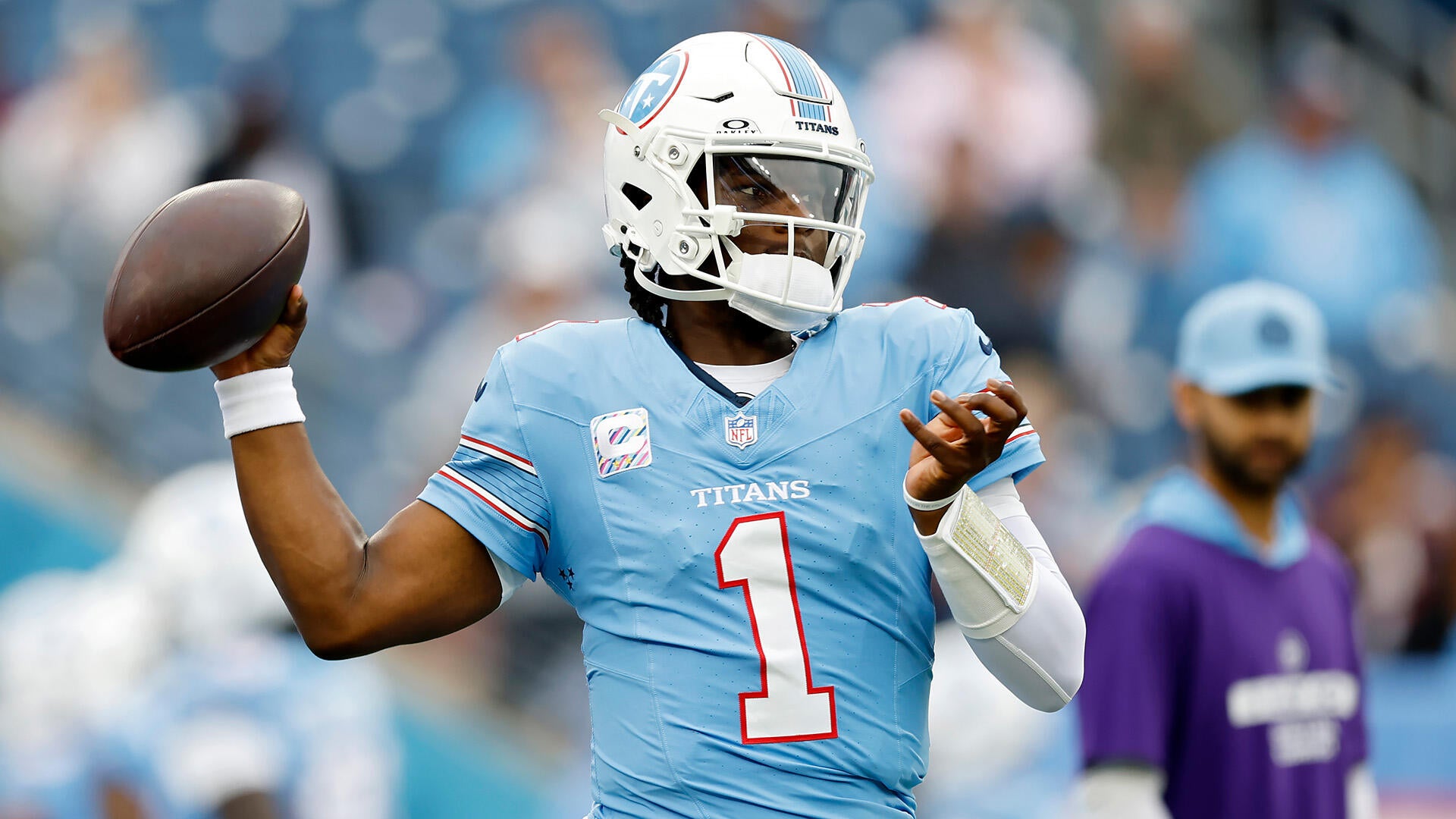
Cam Ward isn't going anywhere. After Sunday's 26-3 loss to Houston dropped the Titans to 0-5, Robert Saleh made it clear that benching the second-year quarterback isn't on the table. Tennessee remains committed to the former No. 1 overall pick, even as the offense continues to stumble its way through the season.
As CBS Sports' Jordan Dajani explained Monday, benching Ward wouldn't solve Tennessee's many problems. It would only make it harder to determine whether he's the team's long-term answer.
But there's a difference between believing in a young quarterback and seeing evidence he's getting better. Ward is 3-19 through 22 starts, and the numbers tell a story that goes well beyond wins and losses. So what does history tell us about how the future might look? And if Ward and the Titans can't right the ship, would the organization think about drafting a(nother) quarterback with a(nother) top pick?
To find an answer, I looked at first-round QBs since 2000, comparing their first 22 NFL starts with their next 22. The results offer some hope, although there's a pretty big difference between improving and becoming the franchise quarterback Tennessee thought it drafted.
How bad has Ward been?
Among 56 first-rounders who started at least 22 games in their first three seasons, Ward ranks tied for 51st in EPA per dropback (-0.15) and 52nd in yards per attempt (5.8). His 38% offensive success rate ranks 49th.
The unusual part? Ward hasn't been reckless with the football. His 1.4% interception rate is among the lowest in the group. But his 2.6% touchdown rate ranks tied for 50th, and he rarely generates explosive completions. Basically, he's avoiding interceptions without making enough plays to move the offense consistently.
First-round quarterbacks through their first 22 starts
QB (draft position, year)
EPA/db
YPA
TD%
INT%
Bryce Young (No. 1, 2023)
-0.20
5.5
2.3
2.3
Zach Wilson (No. 2, 2021)
-0.17
6.4
2.4
2.9
Kyle Boller (No. 19, 2003)
-0.15
5.6
3.1
2.9
Cam Ward (No. 1, 2025)
-0.15
5.8
2.6
1.4
David Carr (No. 1, 2002)
-0.13
6.3
2.2
3.6
Joey Harrington (No. 3, 2002)
-0.13
5.4
3.0
3.9
Alex Smith (No. 1, 2005)
-0.11
6.3
2.8
4.6
Jared Goff (No. 1, 2016)
-0.05
7.2
4.8
2.1
Josh Allen (No. 7, 2018)
0.00
6.7
3.9
3.1
Five of the nine quarterbacks in the table were selected No. 1 overall, and seven were top-three picks, a reminder that even the most highly regarded prospects aren't guaranteed immediate NFL success.
Can Ward follow the comeback blueprint?
Josh Allen and Jared Goff both struggled early in their NFL careers before becoming high-level starters. But after 22 starts, Allen was already at 0.00 EPA per dropback, while Goff was at -0.05, both substantially better than Ward's -0.15. (EPA per dropback measures how much a quarterback's passing plays increase or decrease his team's expected points, with positive numbers indicating more productive plays.) Allen and Goff then made another jump in starts 23-44, improving to +0.14 and +0.13, respectively.
Ward's closer comparisons aren't nearly as reassuring. Of six first-round quarterbacks who had similar struggles as Ward over their first 22 starts, five improved their EPA per dropback. That's the good news. The bad news? Only Bryce Young and David Carr actually climbed into positive territory.
Young does provide some reasons for hope: His EPA improved from -0.20 to +0.02, while his yards per attempt went from 5.5 to 6.4. Alex Smith offers a different lesson. He actually got worse over his next 22 starts before eventually developing into a productive veteran, both later in his 49ers career and after he was traded to the Chiefs.
So patience can pay off. But improvement doesn't automatically mean a team found its long-term starter. What would that improvement look like for Ward? Here's how three quarterbacks performed over their next 22 starts, with results ranging from modest improvement to a significant turnaround.
What improvement could look like over Ward's next 22 starts
Benchmark
Pass yards
Comp%
TD–INT
YPA
EPA/db
Modest: Kyle Boller
4,176
58.6%
22–25
6.1
-0.06
Meaningful: Bryce Young
4,331
63.1%
33–14
6.4
+0.02
Major: Jared Goff
6,415
64.1%
39–19
7.9
+0.13
What Ward's college evaluation tells us
There's another layer to Ward's story, one I remember from evaluating him in college.
Ward was No. 3 on my final 2025 big board, behind Travis Hunter and Abdul Carter. The arm talent was special, as was his ability to throw accurately off-platform and from any arm angle. And from Washington State in 2022 through his final season at Miami, he became noticeably better at getting through reads, navigating the pocket and playing on time.
Still, the same concerns kept showing up. He could lock onto his first read, pass up an easy completion or leave a clean pocket looking for something bigger. Those plays were often thrilling in college. Against NFL defenses, they can turn into sacks or wasted downs.
The numbers tell a similar story. Entering his final college season, Ward had a First-Round Readiness Score (FRED) of just 6.8, nowhere near the historical first-round benchmark of 50. (FRED measures how closely a quarterback's college resume resembles those of previous first-round picks.) But after his remarkable 2024 season at Miami, Ward's score jumped to 49.3, an improvement of 42.5 points in one season.
For perspective, Allen had already reached 51.6 before his final college season, while Patrick Mahomes was at 55.7. Ward, meanwhile, went from nowhere near the first-round benchmark to QB1 in one season. That doesn't diminish what he accomplished. It does remind us how much of his evaluation rested on a late breakout, even as his film showed real development.
Now, Tennessee needs Ward to make another jump. But they also have to consider what happens if it never comes.
Should Tennessee draft another quarterback?
That brings us to the 2027 draft, where the latest "can't miss" class has been less-than-stellar depending on where you've focused your attention through the first six weeks.
As we sit here in the middle of October, my top four quarterbacks in the '27 class are Darian Mensah, Trinidad Chambliss, Drew Mestemaker and Jayden Maiava, with CJ Carr and Julian Sayin tied for fifth. Dante Moore and Arch Manning, my QB1 and QB2 over the summer, have been inconsistent, and Moore hasn't played since suffering a concussion vs. USC in late September.
By the way, of the names above, only Sayin had a FRED score north of 50 coming into the season. And while those scores are neither draft grades nor indicators of NFL success, they do further illuminate the problem: The Titans could be choosing between a talented quarterback who hasn't yet delivered and another talented quarterback who arrives in town with many more unanswered questions.
Tennessee shouldn't use a first-round pick on a quarterback because Ward has struggled. They also shouldn't pass on one just because they used the No. 1 pick on Ward two years earlier.
If Ward starts the remaining 12 games, as Saleh seems to suggest he will, he'll have 34 career starts by the time Tennessee has to make that decision. The team doesn't need him to become Josh Allen by January -- hell, Bryce Young was benched three games into his second season. He got another chance a few weeks later, and now two years after that, he's playing every bit like a franchise quarterback.
The lesson: These things take time, man.
For the Titans, though, there needs to be more than the occasional glimpse of hope. They need to see steady improvement, the kind that suggests Ward is on his way to becoming that guy.
And if those improvements don't happen, Tennessee will start over. It happens across the league every year. There's a fine line between patience and hoping things to be, mostly because hope ain't a plan. And waiting without evidence of a turnaround? That's something else entirely.
Add CBS Sports on Google Join the Conversation comments