
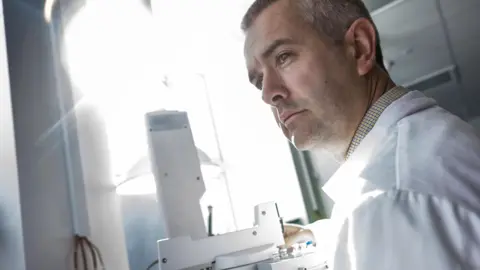
 University of PlymouthStephen Grimes hopes the project will inspires curiosity in people
Residents and community groups are being urged to join a citizen science project to learn more about tiny micrometeorites which arrive on Earth from space.
The University of Plymouth's Cosmic Dust in the City project aims to "inspire curiosity" and encourage people to scour gutters and rooftops safely in the quest for micrometeorites.
Millions of the particles, which measure less than a millimetre and weigh less than a gram, make it through the Earth's atmosphere daily.
Dr Stephen Grimes, from the university's school of geography, earth and environment said: "This project will transform mundane rooftops and gutters all around Plymouth into portals to the cosmos."
He said: "Micrometeorites are samples of the Solar System's building blocks which can offer insights into early planetary formation, Earth's atmospheric history, and climate evolution."
He added they were "really small bits of space dust that have made their way from around the asteroid belt into the inner solar system and then travelled through our atmosphere and landed on our planet."
Variations over millions of years
Grimes added citizen scientists in Plymouth and surrounding areas "can help overcome a key challenge in urban micrometeorite research, accessing multiple sample sites and processing material to build a national archive".
He explained it would help researchers "assess cosmic dust flux, identify variations over millions of years, and improve understanding of where and when particles enter the atmosphere and how the change once they have landed on Earth".
The project is run in collaboration with The Box, Plymouth and would be split into three phases kicking off with public talks and workshops in schools, libraries, and community centres, and guides and videos explaining what micrometeorites are and how to find them.
Spotting a meteorite
Citizen scientists will then be encouraged to gather sediment from rooftops and gutters and use magnets, sieves, and microscopes provided by the project to isolate potential micrometeorites.
Grimes said: "You just need a dustpan and brush to brush the stuff out of a gutter or off a flat roof.
"You need a bowl to wash it in, to wash away that organic matter, a sieve to get it to the right size fraction and then a magnet to sort out the magnetic fraction because these micrometeorites have got iron in them."
The isolated candidate particles will then be analysed at the Plymouth Electron Microscopy Centre, and their discoveries will be shared on a project website and a public exhibition.
Grimes said it was almost impossible to see a micrometeorite with the naked eye.
"These particles measure less than a millimetre, meaning that if you look on the roof of your house or in a gutter, you wouldn't be able to distinguish something that has come from outer space from any other particles or debris."
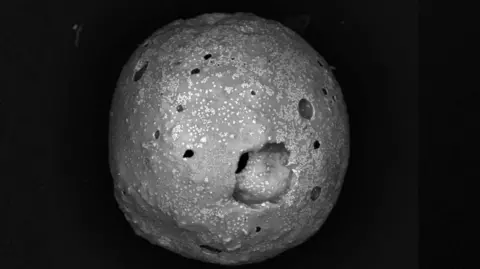 University of PlymouthThe quest will look for micrometeorites like this one found on the university roof
 He said people would be given detailed training about collecting samples safely and how to send them to the lab "so that people aren't putting themselves in any danger but also so any samples being shared with us have a good chance to be a micrometeorite".
They will also provide equipment including magnets and sieves for the citizen scientists.
"If something has come from space, it will likely include metals that will attach to the magnet and the sieves will enable people to sift possible micrometeorites from other materials," Grimes added.
"There is the wow factor for people. It's the opportunity for people to find their own bit of space rock," he said.
Follow BBC Cornwall on X, Facebook and Instagram. Follow BBC Devon on X, Facebook and Instagram. Send your story ideas to [email protected].
More on this story