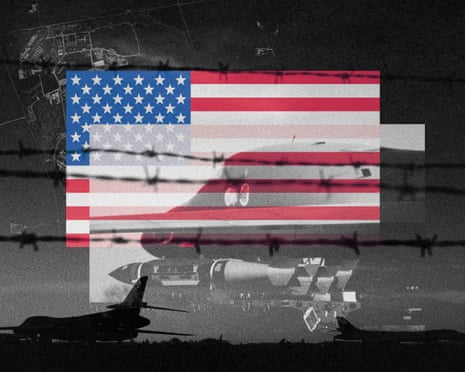
 The American bases in the UK play a critical role in US military and intelligence operations. Composite: Guardian Design/ReutersThe American bases in the UK play a critical role in US military and intelligence operations. Composite: Guardian Design/ReutersBunker busters and a Burger King: a visual guide to US military bases on British soil
War with Iran has brought 15 American sites across the UK countryside firmly into the spotlight
They are dotted across the UK countryside, often obscured from public view behind highly secured perimeter fences. Technically, they are on British soil, and misleadingly most have “Royal Air Force” in their name.
But in many respects, these military outposts are under the control of the US president and commander-in-chief.
There are more than 12,000 US military personnel stationed in the UK operating from at least 15 bases and facilities.
They play a critical role in US military and intelligence operations, providing launch sites for huge bombers and infrastructure for global spying operations. As of last year, one Suffolk base may now be home to some of the US nuclear arsenal.
The bases also boast some home comforts: RAF Lakenheath has a bowling alley, a Burger King and baseball fields.
The US war with Iran in recent weeks has illustrated the utility of the bases, as waves of military aircraft have taken off from places such as RAF Fairford, in Gloucestershire.
Yet the war is prompting rare questions about the presence – and purpose – of such bases on UK soil. For almost three-quarters of a century the British political establishment has viewed them as a cornerstone of the UK’s alliance with the world’s mightiest power.
Keir Starmer, the British prime minister, initially resisted use of the US bases in the Iran conflict, and then insisted they should only be used for “limited defensive” purposes.
Threats by the US president, Donald Trump, of military operations that would probably constitute war crimes, his open disdain for the UK and the Nato alliance, and the apparently rapid disintegration of the so-called special relationship, have all served to put these UK-based military installations in the spotlight.
The Green party leader, Zack Polanski, has said the UK should consider closing US bases in Britain as part of a wider dismantling of the military alliance between the two countries. But where are the US military bases? What exactly do they do? And who ultimately controls them?
Where are they?
Map showing the location of the 15 US military sites cited in the Pentagon documentThe locations of 15 bases in the UK were disclosed in a Pentagon document that lists all of its bases around the globe. (This figure does not include six other US sites in Britain that are in effect too small to be included in the list.)
With the exception of Lossiemouth in Scotland, all the bases are located in England. Lord Coaker, a British defence minister, told the House of Lords on 24 March that there were 12,300 American military and civilian employees spread across the bases and facilities. (This number does not include American military personnel stationed at other UK facilities, such as Nato sites.)
Major bases include RAF Croughton in Northamptonshire, best-known for the controversy over the death of 19-year-old Harry Dunn. He was killed in 2019 when he was hit by a car driven on the wrong side of the road by Anne Sacoolas, a US intelligence official whose husband worked on the base.
Croughton is a key communications hub responsible for relaying top-secret material to the US military and intelligence agencies. The CIA has reportedly used the base to relay information intercepted by listening stations installed in US embassies around the world.
RAF Fairford
Satellite image or RAF Fairford showing how the runway length is 3,046 metres longThroughout the Iran war, photographers lingering at RAF Fairford’s perimeter have captured an unsettling spectacle of heavy bombs being loaded on to American aircraft. The images threw into sharp relief the vital role the Gloucestershire base has played in supporting the US’s bombing campaign.
Fairford’s value to the US is its particularly long runway, which extends almost 2 miles (3km). It is reinforced to support heavy bombers such as the B-1 and B-52, both of which have been attacking Iran. The aircraft are capable of carrying large payloads, including so-called “bunker buster” bombs.
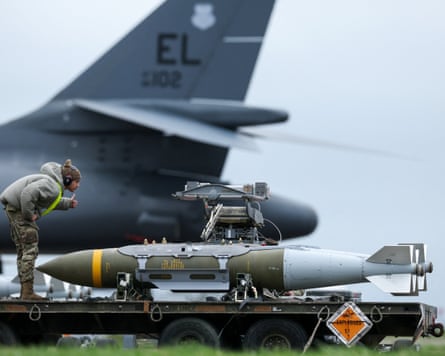 Members of the ground crew handle munitions at RAF Fairford airbase. Photograph: Phil Noble/Reuters
By launching missions from the base – half an hour’s drive from Swindon – rather than the US, the air force has reduced the distance to bombing targets in Iran by thousands of miles. Before a fragile ceasefire came into effect this week, as many as four such flights were departing from RAF Fairford each day.
Map showing the flight path of a US B-1B bomber aircraftRAF Mildenhall
Satellite image of RAF MildenhallLocated in the flatlands of west Suffolk, RAF Mildenhall has approximately 4,000 American military personnel and has been described by the US air force as a “power projection platform”. The base has played an active role in supporting US bombing missions over Iran thanks to a fleet of refuelling aircraft stationed at the base.
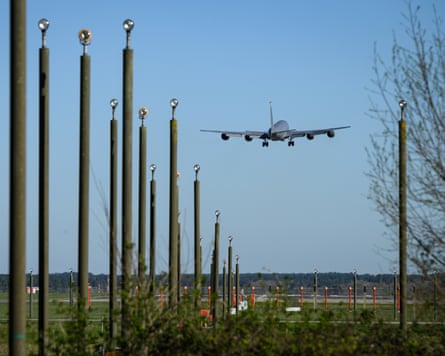 A Boeing KC-135R Stratotanker performs training manoeuvres at RAF Mildenhall on 7 April. Photograph: Leon Neal/Getty Images
The so-called tankers have made frequent flights from Mildenhall down to the Mediterranean Sea, where they have completed aerial refuelling missions, helping to keep other US military aircraft in the skies as they fly to and from Iran.
Map showing the flight path of a Stratotanker aircraft leaving from Mildenhall at 8:41am and returning at 4:12pmRAF Lakenheath
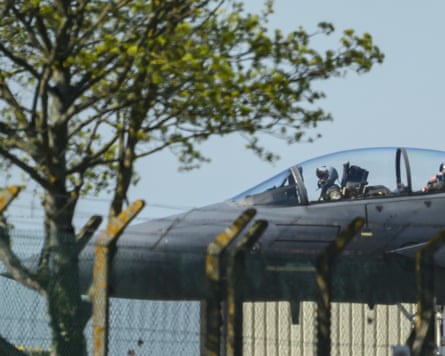 An American Boeing F-15E Strike Eagle fighter plane after landing at RAF Lakenheath on 7 April. Photograph: Leon Neal/Getty Images
RAF Lakenheath is the largest American base in the UK. Nestled between a forest and farmland, the base is a pocket of America in East Anglia. Its high perimeter fence serves as a symbolic border: US military police patrol inside, British officers outside.
The base, which has more than 6,000 US military personnel – the population of a small town – is home to several fighter jet squadrons consisting of F-35s and F-15Es. Many of Lakenheath’s aircraft are now in the Middle East, but the base has also served as a staging post for moving aircraft from the US to the region.
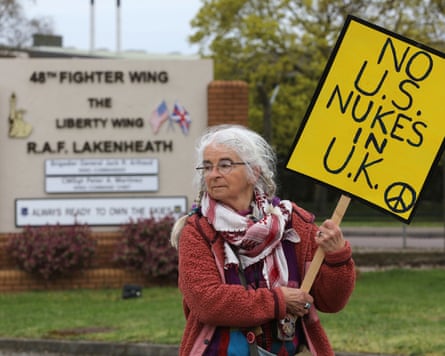 A protester holds a sign outside RAF Lakenheath during a demonstration on 4 April. Photograph: Martin Pope/Getty Images
In recent years there have been indications the US is once again storing nuclear weapons at Lakenheath – a return to the days of the cold war. For decades, its air force maintained an arsenal of powerful nuclear weapons at the base ready to devastate the Soviet Union at a moment’s notice.
They were removed in 2008 but experts believe it is highly likely they returned to the base last year. Analysts spotted tell-tale signs showing their presence, but the official stance of both the American and the British governments is to neither confirm nor deny if nuclear weapons are there.
RAF Menwith Hill
Satellite image of RAF Menwith Hill showing a data centre and 37 golfball-shaped radomesMenwith Hill is part of a global network of American electronic eavesdropping stations that straddle the planet to give the US the ability to intercept the communications of virtually anyone, anywhere. It is run by the secretive National Security Agency (NSA) and is its biggest base outside the US.
The 1,000 US personnel stationed at the base work in close cooperation with GCHQ, the British electronic surveillance agency. Approximately 300 British employees are based at Menwith Hill, according to recently disclosed figures.
The huge white “golf balls” of Menwith Hill in the Yorkshire Dales are visible from miles around, and passing hikers might speculate about their purpose. Called radomes, they contain powerful equipment that helps the US eavesdrop on large parts of the globe.
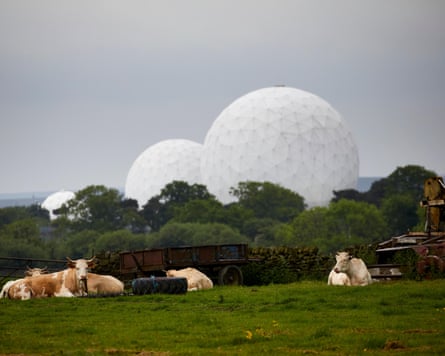 Radomes at RAF Menwith Hill. Photograph: Mark Waugh/Alamy
One of the key tasks for American intelligence officers at Menwith Hill is to spy on communications in the Middle East. They are likely to be playing a key role in listening in on Iran’s political and military leaders.
Intelligence gathered by Menwith Hill has also reportedly been used by the American military to pinpoint and kill suspected enemies overseas through drone strikes – a legally questionable practice.
Does the British government have any control over the US bases?
It is unclear – and subject to debate – precisely how much control the UK government has over the Americans’ use of the bases. Broadly, the terms of the deal were set out 74 years ago in a communique agreed by the then leaders of the two countries: the prime minister, Winston Churchill, and the president, Harry Truman.
At the time, the US was building up a huge arsenal of nuclear weapons stored at its bases in the UK that could have been dropped on the Soviet Union if war broke out.
In a brief paragraph, Truman and Churchill agreed that “the use of these bases in an emergency would be a matter for joint decision by the [British] government and the US government in light of the circumstances prevailing at the time”.
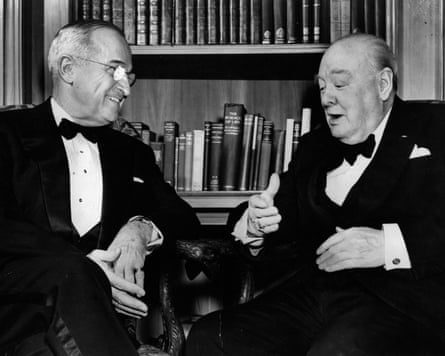 Harry Truman and Winston Churchill. Photograph: Keystone/Getty Images
The two countries signed a series of formal agreements governing the use of these bases in 1951 and 1973. However, there are an unknown number of secret agreements. Al Carns, a junior defence minister, said in February: “Classified agreements also apply in some areas, reflecting the sensitive nature of specific operational activities conducted at these facilities.”
The British government states that it considers any request to use UK bases on a case-by-case basis, while its approval includes “appropriate consideration of the legal basis for any proposed activity”.
How this works, however, is opaque. Starmer has said US bases in the UK will only be used for defensive missions, but not explained how that is enforced.
Critics have queried, for example, whether the Americans are giving the British government detailed targeting plans before individual bombing missions each time they take off from RAF Fairford – and if so, whether that information can be trusted.
Global network
Map showing the location of American military sites outside the USWhile they are highly significant in their own right, the US bases in the UK are best understood as nodes in a vast network of military sites spread around the world; there are 566, according to recent Pentagon data. Britain has the fourth highest number of bases, after Germany, Japan and Italy – three countries the US and its allies defeated in the second world war.
The number of bases in any country is not always an indication of their importance. Often, geography is key. Al-Udeid airbase in Qatar, which has been repeatedly targeted by Iranian missiles, is the largest US base in the Middle East and a major hub for operations in the region.
However, access to other important sites, such as two bases the US jointly operates with Spain has – to Trump’s fury – been blocked. The Spanish government denied the US permission to use the bases for what it called an “unjustified and dangerous military intervention” in Iran.
Italy also prevented the US from using a base in Sicily as the Americans did not follow the required authorisation procedure.
While such acts of resistance have been sporadic, and proven more of a nuisance to the US than a serious impediment to its war, they have highlighted a weakness in the system: for all of America’s military supremacy, use of the bases is contingent on maintaining diplomatic relations.
That is not Trump’s style, and the US president is reportedly contemplating a very different tack: punishing some European countries for not supporting US efforts in Iran.
One option is said to involve shifting some US bases or US military personnel to countries deemed to have been more helpful during the offensive, such as Poland, Romania, Lithuania and Greece. Given the fraught state of relations, the UK may not be on that list.
Explore more on these topics- US military
- US-Israel war on Iran
- Defence policy
- Military
- US national security
- UK security and counter-terrorism
- news