
 Reuters
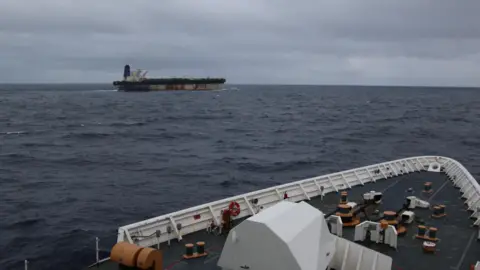
British forces are in advanced preparations to board and detain ships in Russia's so-called shadow fleet, after the prime minister approved military action against the vessels.
Russia has been accused of operating ships without a valid national flag to avoid sanctions on oil and help fund its war in Ukraine.
Ministers identified a legal basis in January that would allow forces to board sanctioned vessels in UK waters and it is understood the first such operation will happen soon.
Sir Keir Starmer said the move would starve "Putin's war machine of the dirty profits that fund his barbaric campaign".
Ministers are keen to emphasise the threat still posed by Russia, despite much of Whitehall's attention being focused on the war in the Middle East in recent weeks.
The approval to board the vessels came as the prime minister arrived in Finland ahead of the Joint Expeditionary Force (JEF) summit in Helsinki, a military coalition of northern European nations. Starmer will address the summit on Thursday.
Royal Navy personnel have supported countries including Finland, Sweden and Estonia with the monitoring and tracking of shadow fleet vessels in recent weeks.
No UK military personnel have yet boarded any vessels but senior government figures are keen for that to change.
Specialist military units have been undertaking training in recent weeks to wargame different scenarios, including how to deal with armed crews.
That training is understood to now be complete and Ministry of Defence officials are working on the assumption that the first operation of this type will happen sooner rather than later.
Those involved could include the Special Boat Service and the Royal Marines, depending on the level of resistance expected from crews aboard the shadow vessels.
The government believes around 75% of Russia's crude oil is transported by ageing ships and has imposed sanctions on 544 vessels thought to be in the shadow fleet.
Ship-tracking technology can be used to identify which sanctioned vessels are headed for UK waters weeks before they arrive.
Military planners and defence officials are understood to be monitoring these tracking systems to identify which vessels will be the first to be boarded and detained.
Earlier this year British armed forces assisted US troops in seizing the Marinera oil tanker, which American officials accused of breaking sanctions by carrying oil for Venezuela, Russia and Iran.
Ministers then began exploring how British forces could lead similar operations against sanctioned vessels travelling through UK waters.
Government lawyers identified the Sanctions and Money Laundering Act from 2018 as a legal means to allow the use of military force.
But analysis by BBC Verify suggested that dozens of sanctioned vessels sailed through the English Channel in the weeks after that legal mechanism was identified.
The Defence Secretary, John Healey, and the Attorney General, Lord Hermer, met their counterparts in the Joint Expeditionary Force in recent weeks to go through the precise legal implications for different types of scenarios.
Speaking ahead of the JEF summit, Starmer said the world was "increasingly volatile and dangerous".
He added: "Putin is rubbing his hands at the war in the Middle East because he thinks higher oil prices will let him line his pockets.
"That's why we're going after his shadow fleet even harder, not just keeping Britain safe but starving Putin's war machine of the dirty profits that fund his barbaric campaign in Ukraine."
A Conservative Party spokesperson said: "Any effort to keep sanctioned ships out of our waters is important.
"But Labour's failure to back our armed forces with the resources they need shows he is in denial about the scale of the threats our country faces."


