
 Justin RowlattClimate editor
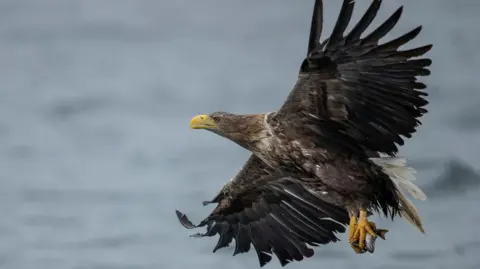 Getty ImagesFewer then 150 pairs of White-tailed Eagles are thought to live in the UK
Some of Britain's rarest birds of prey are still being illegally killed despite decades of legal protection, according to the Royal Society for the Protection of Birds (RSPB).
The charity's report, to be published on Wednesday, records 921 confirmed attacks between 2015 and 2024, with more than half, according to the RSPB, on or near land managed for game shooting.
Mark Thomas, head of the RSPB's investigations unit, said the killings were "about money", with birds of prey targeted to stop them taking young pheasants, partridges or grouse, leaving more birds to be shot by paying customers.
Shooting organisations strongly deny persecution is widespread across the industry. They say it is carried out by a small minority and condemn it outright.
But the RSPB is calling for gamebird shooting in England and Wales to be licensed, arguing estates should face tougher consequences when protected birds are killed on their land.
Targeted species include eagles, red kites, peregrine falcons, hen harriers, goshawks and barn owls. The RSPB says it only classifies cases as "confirmed" when they are backed by forensic, eyewitness or video evidence.
Its investigations unit, staffed by former police officers and bird experts, works to identify those suspected of killing protected birds. The RSPB says evidence gathered by its investigators, including hidden-camera footage, has helped secure three convictions this year.
Two involved birds being beaten to death after they were caught in traps. One case involved a buzzard, the other a goshawk. Some live-capture traps are permitted for pest control of species like crows and pigeons, but traps must be checked regularly and non-target species released unharmed.
The third case involved covert surveillance at a hen harrier roost in the Yorkshire Dales where investigators captured evidence of a planned attempt to kill one of the UK's rarest birds of prey.
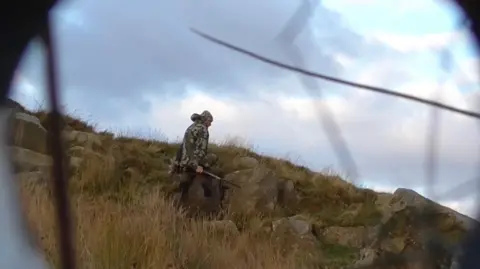 RSPB secret filmingCovert footage from the RSPB was used as evidence in a hen-harrier persecution case
RSPB footage showed head gamekeeper Racster Dingwall arriving with a shotgun while hidden audio recorded a discussion of killing other protected birds and whether a harrier might be satellite-tagged.
Dingwall later admitted offences linked to an attempt to kill a protected hen harrier and was ordered to pay a fine of £1,520.
The RSPB says recorded incidents have fallen in recent years, but argues the long-term pattern shows criminal prosecutions alone are not enough.
It wants gamebird shooting in England and Wales to be licensed, as red grouse shooting now is in Scotland. It says licences could be suspended or withdrawn at the civil standard of proof, even where a criminal prosecution is difficult.
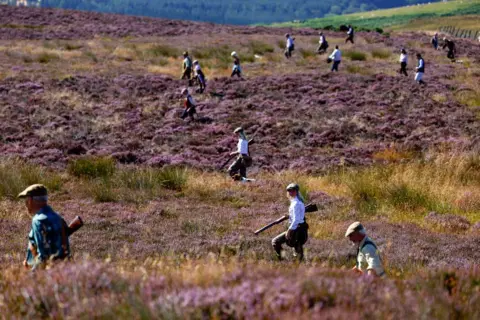 Getty ImagesShooting organisations say gamebird shooting contributes to rural economies
Shooting organisations oppose the proposals, saying it would penalise responsible estates and risk conservation work.
"What we should do is strengthen law enforcement to prosecute individuals who commit these crimes. They have no place in the modern shooting community," Dr Marnie Lovejoy, of the British Association for Shooting and Conservation, told the BBC.
She said licensing would add another layer of regulation to activities already covered by law and would affect everyone involved in shooting.
She added that the sector makes a significant contribution to nature recovery, spending around £500m a year on conservation work - the equivalent, BASC estimates, of 26,000 full-time jobs and 14m workdays.
The government has not backed the RSPB's proposals, but says it will work with the shooting sector and others to explore wider measures, including licensing.
A Defra spokesperson told the BBC: "Many estates already meet high environmental standards, and we want all estates to achieve these same high standards."
Professor Davy McCracken, from Scotland's Rural College, has spent 35 years studying upland management and wildlife. He says the tension between protecting birds of prey and managing land for grouse shooting is ultimately economic: "That is where the root of the conflict actually lands."
But he agrees persecution is carried out by a minority of those with game-shooting interests, and says focusing only on them can obscure conservation work elsewhere in the sector.
White-tailed eagles to be released in Exmoor despite farmer warnings
English 'rainforests' illegally burned - campaigners

Sign up for our Future Earth newsletter to keep up with the latest climate and environment stories with the BBC's Justin Rowlatt. Outside the UK? Sign up to our international newsletter here.
RSPBClimateBirds of prey