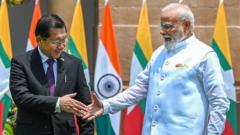

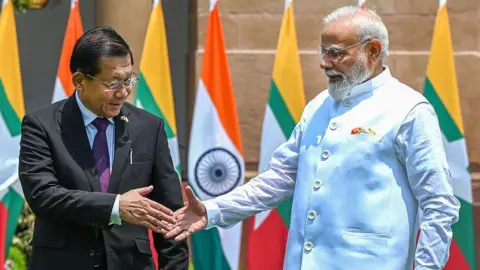
 Getty ImagesPM Modi met Myanmar President Min Aung Hlaing in Delhi on Monday
Myanmar President Min Aung Hlaing, who is in India on a five-day visit, has held talks with Prime Minister Narendra Modi, focusing on areas including trade, connectivity, border security and defence.
This is his first visit abroad since becoming president earlier this year, and it is being closely watched as a sign of how regional powers intend to engage with Myanmar's military-backed leadership following a widely criticised election and five years of civil war triggered by a coup in 2021.
Myanmar and India share a 1,643km (1,021-mile) border and developments on one side often have consequences for the other, particularly in India's north-eastern region where security, migration and cross-border trade is closely intertwined with events in the neighbouring country.
In February 2021, Min Aung Hlaing, then the armed forces commander-in-chief, seized power by ousting the elected government of Aung San Suu Kyi, shortly after her National League for Democracy won a landslide election victory.
The military takeover sparked nationwide protests that later evolved into an armed resistance movement and a civil war that has killed thousands of people, displaced millions and left large parts of the country outside military control.
Consequences of the conflict also spilled across the border into India, with thousands of people, many from Myanmar's Chin ethnic minority, taking refuge in India's north-eastern states of Mizoram and Manipur.
Myanmar held elections between December 2025 and January 2026. The military-backed side secured an overwhelming victory in the polls in which many opposition parties were barred from contesting and large conflicted areas were unable to participate. In a parliament dominated by military loyalists, Min Aung Hlaing was elected president in April.
The authorities presented the vote as a step towards a return to civilian government, but opposition groups, Western governments and international observers criticised the election. Critics argued that the transition would do little to alter the military's grip on power, while the authorities maintained that the vote was free and fair.
Between the 2021 coup and being elected president, Min Aung Hlaing has travelled to Russia and China.
But this is his first foreign visit since taking office in April.
Modi's last official visit to Myanmar was in 2017.
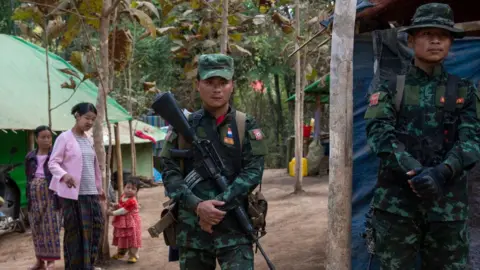 Getty ImagesThe Myanmar conflict has evolved into an armed resistance movement and a civil war that has killed thousands of people
The talks between Modi and Min Aung Hlaing touched on Myanmar's political situation, India's Foreign Secretary Vikram Misri told a press conference on Monday.
He added that the Indian prime minister raised broader issues related to democracy in the neighbouring country and discussed Aung San Suu Kyi - currently under strict house arrest.
Misri said Delhi continued to support "enduring peace" and an inclusive process involving all stakeholders in Myanmar, arguing that sustained dialogue rather than disengagement offered the best chance of progress.
Myanmar's state-run English-language newspaper, the Global New Light of Myanmar, has published a joint statement saying both countries underscored the need to prevent the misuse of Myanmar's territory for activities "inimical to their security interests".
It added that Min Aung Hlaing reiterated Myanmar's assurance that its territory "would not be permitted to be used against India's security interests", while Modi reaffirmed India's support for Myanmar's sovereignty and territorial integrity.
Upon arriving in India on 30 May, Min Aung Hlaing visited Bodh Gaya and offered prayers at the Mahabodhi Temple, built at the site where Buddha is believed to have attained enlightenment.
He later travelled to Delhi for official talks before heading to Mumbai, where he met business leaders to explore investment opportunities and expand bilateral trade.
Analysts say the visit is important for Myanmar's leadership, because it has sought to broaden diplomatic engagement after years of international criticism and isolation.
"It is a big diplomatic gain for Myanmar because with this visit the president is getting validation from the world's largest democracy," Rajiv Bhatia, a former Indian ambassador to Myanmar, told the BBC.
Gautam Mukhopadhaya, another former Indian ambassador to Myanmar, said Min Aung Hlaing "is trying to acquire greater regional and international respectability as an elected president".
For India, the visit reflects a long-standing view that strategic interests in Myanmar outweigh concerns about the nature of the government in Nay Pyi Taw.
Bhatia said India has three broad interests in Myanmar: stability along its north-eastern frontier, the success of its Act East policy and managing the strategic implications of China's growing influence in the country.
Myanmar occupies a key place in India's regional strategy as the only member of the Association of Southeast Asian Nations (Asean) that shares a land border with India.
Bhatia said the visit can have a "positive impact" on Asean countries, as they "strive to develop a coherent approach to the Myanmar question".
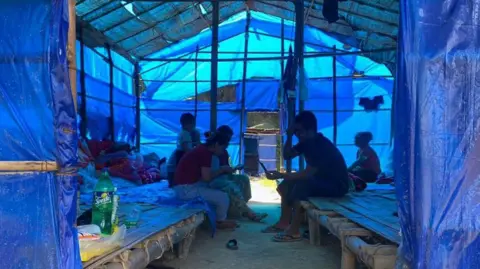 AFP via Getty ImagesThe conflict following the 2021 coup forced thousands of Burmese people to cross border and take refuge in India's north-eastern states of Mizoram and Manipur
Analysts also pointed to Myanmar's importance in the wider strategic competition between India and China.
The country provides China with a route to the Bay of Bengal, reducing Beijing's dependence on the Strait of Malacca for some trade and energy supplies.
Mukhopadhaya says since 2017, China has widened its influence in Myanmar and become more open about supporting its military leadership in pursuit of its own strategic and economic interests.
The India visit also comes against the backdrop of Myanmar's strained - but changing - relations with many Western countries.
The US and several of its allies had imposed sanctions on the military leadership after the 2021 coup.
But now, Mukhopadhaya said, the Donald Trump administration "hasn't shown much interest" in the country in his second term and suspended much of its foreign assistance, including support to Myanmar refugees and opposition groups.
The Quad countries - which include the US, India, Japan and Australia - also appear to share an interest in bringing back stability in Myanmar, said Bhatia.
The conflict inside Myanmar has also altered realities along the India border.
"In the last few months, the Myanmar army has been able to push back the armed struggle to the east and north. They are closely watching the western border, and it is quite likely that they will seek cooperation from India in containing the armed struggle against the military," Mukhopadhaya said.
Bhatia said India ultimately wants to see a more stable Myanmar emerge from the conflict. "Clearly, a more independent Myanmar is what India is looking for," he added.
Follow BBC News India on Instagram, YouTube, Twitter and Facebook.
Myanmar coup Narendra ModiIndiaMyanmarAung San Suu KyiNew DelhiAsia