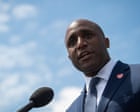
 Kansas City Mayor Quinton Lucas speaks during a news conference on infrastructure outside the Capitol in Washington in 2021. Photograph: Caroline Brehman/CQ-Roll Call/Getty ImagesKansas City Mayor Quinton Lucas speaks during a news conference on infrastructure outside the Capitol in Washington in 2021. Photograph: Caroline Brehman/CQ-Roll Call/Getty ImagesBlue city, red state battle: Kansas City feuds over ‘colonial’ police system
Democratic city does not control its police force – and reform attempts have been thwarted by Republicans
Quinton Lucas said he thinks his city’s police department “is a colonial system”.
“I think it is anti-Black. I think it is anti-immigrant. I think it is anti-almost everything we stand for in terms of making sure that diverse populations in major cities have a voice in terms of navigating it,” the Kansas City mayor said.
In most cities, speaking this way about the local police would lose someone an election. But Kansas City’s political leaders have a problem that is unique among the nation’s large cities. They do not control the city’s police force. As a legal artifact of the civil war and a product of conservative Missouri politics, a state commission operates the Kansas City police department.
Kansas City is a Democratic stronghold. More than three-quarters of its voters chose Joe Biden in 2020 and Kamala Harris in 2024. But it is a blue city floating in a sea of red. Trump won Missouri with 57% in 2020 of voters and 59% in 2024. The state legislature has Republican supermajorities in both houses, backed by a gerrymandered political map. And three successive Republican governors have won election in part by promising to get tough on crime in the state’s big cities.
For blue cities in red states, that’s become the standard. Republicans campaign on curbing urban evils to appeal to the fears of suburban and rural voters, with little attempt at winning votes in cities deemed lost to liberalism. The rhetoric of Donald Trump has only amplified conservative catcalls and emboldened attacks. The Guardian will be looking at this dynamic over the next year.
Conservatism once held local control as a core political value. Today, Republicans regularly enact legislation constraining local initiatives, from blocking regulation for construction worker breaks in the Austin heat, to disbanding a police oversight committee in Memphis after the Tyre Nichols shooting, to outlawing gender identity protection in Des Moines municipal code. But nothing draws Republican artillery on to a city’s position more than crime.
Even though Kansas City taxpayers spend more on police than the legislature’s mandate, a board they do not control still demands more, Lucas said.
“We’re currently in a huge fight right now where the police department said they were $2 or 3m short on funding,” said Lucas, the youngest mayor elected in Kansas City since the civil war. “And what you end up seeing often is this issue with transparency, an issue with accountability, and I think long term, a concern about who can actually make sure that there is a change for us.”
In the days before the civil war, Missouri’s governor, Claiborne Fox Jackson, favored secession, and created a state police board as an attempt to control weapons in St Louis and Kansas City, in anticipation of the upcoming war. Jackson’s plan was unsuccessful, but the board remained in place until the state’s courts dissolved it in 1932. However, Kansas City was then under the control of Tom Pendergast, a notoriously corrupt political boss who began using the police department to help rig votes. The legislature reimposed state control in 1939.
Kansas City has been a punching bag for conservative Missouri politicians ever since. In 2017, Republican Eric Greitens, a former Navy Seal, succeeded Democratic governor Jay Nixon, securing a Republican trifecta in state government. Greitens seized on conservative backlash against the civil unrest generated by the police killing of Michael Brown in the St Louis suburb of Ferguson in 2014, calling the protests as a “disaster” and calling for stronger “command presence” from “career politicians”.
Last March, Missouri governor Mike Kehoe, a Republican, signed a bill to return the St Louis Metropolitan police department to state control as well, ending local oversight by the mayor’s office. The bill passed on party lines, with Democratic lawmakers describing the law as fundamentally racist.
In Kansas City, the board of police commissioners consists of four members appointed by Missouri’s Republican governor, and the city’s mayor. This five-person board hires or fires its police chief and 1,200-plus police officers. It controls the $364m budget of the city’s police department.
Lucas ran on a platform of crime reduction. But there’s only so much any mayor of Kansas City can do about crime, given the state’s control of the city’s policing. Lucas is routinely outvoted by the other four Republican commissioners. He finds the situation frustrating.
“The system is not meant to aggressively look to new forms of violence prevention,” Lucas said. “The biggest concern that I have lately is the progress you’ve seen in some American cities versus ours.”
Kansas City regularly ranks in the top 10 for its homicide rate among cities larger than 100,000 residents. In 2025, it ranked eighth.
Violence spiked across the country during the pandemic, and Kansas City was no exception. Its homicide rate increased by 19% in 2020. The rate fell back to about the 2019 baseline in 2021 before increasing again by about 10% in 2022, an uncharacteristic move relative to other large cities, which had begun to see murder rates fall from pandemic highs.
Many big cities with high murder rates began adopting violence interruption programs over the last decade. Kansas City’s then police chief Rick Smith ended the city’s violence interruption program in 2017, but homicide rates only began falling when the city reinstituted it in 2023.
Gwen Grant, president and CEO of the Urban League of Greater Kansas City, is critical of Lucas’s posture toward Smith, the police chief.
“It’s been a rocky road,” said Grant. “The relationship between Lucas and Governor Mike Parson was very strained, especially during the George Floyd era. I was leading an effort with the NAACP and other civil rights groups calling for the firing of then police chief Rick Smith. He was a Trumper and his handling of policing – specifically police-involved homicides of unarmed Black men – was horrible.”
That has led to lawsuits, which drive up policing costs that Kansas City residents – who have no control over their policing – have to bear.
“This year they were out of money, but at the same time, we learned that they had settled more than $11m in lawsuits,” Lucas said.
The conservative backlash to “defunding the police” in 2024 led Missouri voters to mandate by constitutional referendum that Kansas City must spend at least a quarter of its municipal budget on policing.
Kansas City voters opposed this mandate by a 2-1 margin. They were outvoted in a narrow 51-49 statewide loss. Kansas City’s suburbs in Jackson county supported the constitutional amendment by about a 3-2 margin.
That speaks to the careful politics Kansas City leaders have to engage in with Republican leaders in a bright red state.
“I mean it’s always dependent upon the governor,” Lucas said. “I’ll note that our governor, while a perfectly fine man, is someone who also just put redistricting on us, and it led to Kansas City potentially not having a Democratic congressional seat … They may pay us good lip service, but they don’t necessarily support our ability to be free.”
Lucas has said that the state’s permissive gun laws contribute to the city’s violence. Missouri restrains its municipalities from enacting local legislation that restricts gun ownership. Cities can’t create “red flag” laws to take guns away from someone deemed a threat, nor prohibit the open carry of firearms, nor ban firearms in local buildings. State law prevents local legislation more strict than state or federal law.
Lucas has been applying an attorney’s eye to the detail of that law. Rather than try to ban guns, his office is drafting legislation to criminalize possession of a “switch” – a device that converts a Glock handgun into an automatic weapon – at the local level.
Federal law criminalizes automatic weapons. Instead of letting Missouri’s pre-emption get in the way, Lucas hopes to rely on gun laws set by conservative congresspeople to argue that a local law making the same thing illegal should meet the standards of Missouri’s conservative legislators. It is a “tough on crime” measure, after all. Isn’t that what they want, Lucas asked?
“We have a gun violence problem in America,” Lucas said. “I think the people of Kansas City see it and want to see it cured, not just want to see it become part of the statistics game to say how bad cities are.”
Explore more on these topicsShareReuse this content