
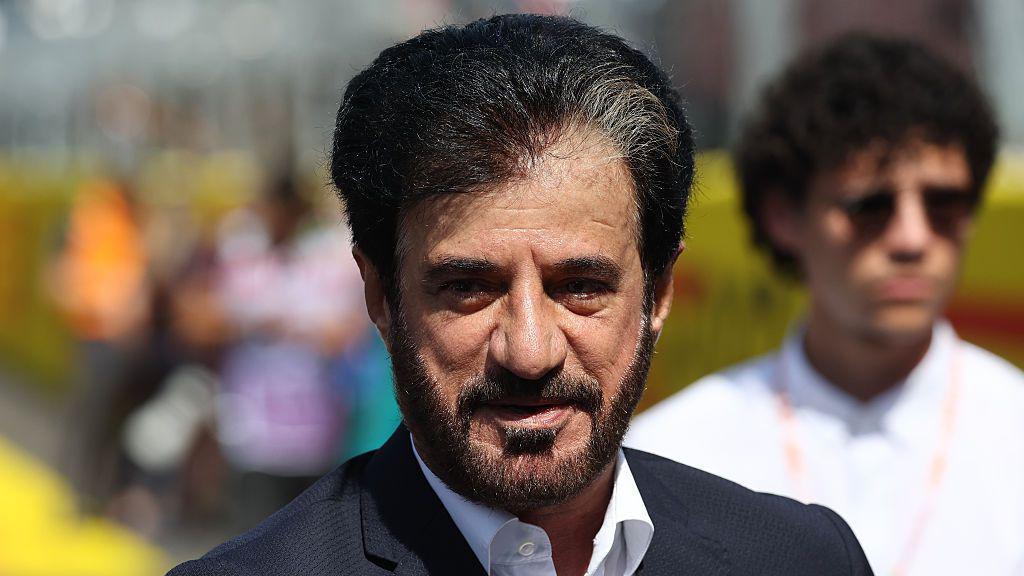
 Image source, Getty ImagesImage caption,
 FIA president Mohammed Ben Sulayem has been head of motorsport's governing body since December 2021
ByAndrew BensonF1 Correspondent- Published43 minutes ago
FIA president Mohammed Ben Sulayem is proposing a removal of term limits for the position as head of motorsport's governing body.
The move would enable the 64-year-old Emirati - who was re-elected unopposed in December as a result of a quirk in election rules that prevented anyone else from standing - to continue as president beyond the current 12-year limit.
Under current rules, the presidential term is four years and a person can stand for re-election twice - therefore completing a maximum of three terms.
The plan to change the FIA's statutes will be discussed and voted on at next month's FIA General Assembly, where it is expected to be passed by members.
An FIA spokesperson said: "A proposal has been put forward to establish a consistent approach to tenure across all FIA bodies, similar to what currently exists for the world councils and the senate.
"The proposal is subject to approval by the World Councils and by the General Assembly. FIA bodies retain full authority to democratically elect officeholders."
Other FIA roles that currently have term limits include the president of anti-doping committee, and the head of the F1 cost-cap committee.
The current three-term limit was put in place by Ben Sulayem's predecessor Jean Todt. The Frenchman replaced Max Mosley, who served as FIA president from 1993 until agreeing not to stand again following a dispute with F1 teams in 2009.
Asked by BBC Sport why it was decided to abolish term limits for all posts, rather than instate them for those that don't currently have them, an FIA spokesperson was unable to provide a specific answer.
However, a spokesperson pointed to the NFL in the US, saying Roger Goodell had been commissioner since 2006 and had "transformed the sport into a global brand and it has an outstanding governance record".
Last year, the president of the International Olympic Committee (IOC), Thomas Bach, rejected the chance to stay on longer than 12 years - a move that would have required a change of statutes - saying "our organisation is best served with a change in leadership; new times are calling for new leaders".
Tim Mayer, who was blocked from opposing Ben Sulayem for the FIA presidency because of the organisation's election rules last year, told BBC Sport: "Term limits are not a bureaucratic detail.
"They are a fundamental safeguard of good governance, recognised as essential to preventing the concentration of power, ensuring renewal of leadership, and maintaining accountability to those an organisation exists to serve."
Mayer also pointed to Bach, saying the IOC had "treated this as a core governance principle".
What is going on with Ferrari and will Verstappen quit? F1 Q&A
- Published1 day ago
Canadian GP Review: Ecstasy, Agony and Strategy Blunders
In two further proposed changes, the rules for FIA presidential candidates have been made stricter.
A requirement for candidates to "demonstrate sufficient experience within an FIA member or an FIA body" will be added.
And the time by which prospective presidential candidates have to submit the list detailing their support team of vice-presidents has been more than doubled from 49 days to 100 days before the date of the election.
Both would make it more difficult for someone to challenge Ben Sulayem at a subsequent election.
The move to allow indefinite presidential terms follows a period of controversy surrounding Ben Sulayem and the governance of the FIA.
Mayer and two other people were barred for standing against Ben Sulayem because of a rule that dictates presidential candidates must submit a list of their prospective vice-presidents for sport, which must be selected from each of the FIA's six global regions.
But the published list last year contained only one candidate from South America, Brazilian Fabiana Ecclestone - wife of former F1 boss Bernie - who was already a member of Ben Sulayem's team.
That prevented any other candidate from naming a potential vice-president for sport from South America, which meant no-one else could enter the election.
This rule was already in place prior to Ben Sulayem becoming president.
One of those prospective presidential candidates, Laura Villars, is currently suing the FIA in the French courts challenging its election process.