
 ‘On Wednesday, Roberts-Smith will appear for the first time as the defendant in a criminal court, a court that ultimately has the power, should he be found guilty, to send him to prison for life.’ Composite: Victoria Hart/AAP‘On Wednesday, Roberts-Smith will appear for the first time as the defendant in a criminal court, a court that ultimately has the power, should he be found guilty, to send him to prison for life.’ Composite: Victoria Hart/AAPAnalysisBen Roberts-Smith is back in court, now as a defendant. His case reminds us that there are laws even amid warBen Doherty
The former soldier’s previous defamation trial presents the rare situation of there being hours of evidence of his alleged crimes already on the public record
For almost every day of his marathon defamation trial, Ben Roberts-Smith VC, sat in the same spot in the federal court. A chair by the window, bathed in sunshine, from where he could glare at witnesses giving evidence.
He sits now in a very different position.
In the defamation case he was the applicant, seeking to stare down allegations he was a war criminal and a murderer.
At stake was his once-lionised reputation – hard-won and painstakingly curated over years – as well as millions of dollars, borrowed from benefactors who believed and bankrolled him.
He lost.
On Wednesday, Roberts-Smith will appear for the first time as the defendant in a criminal court, a court that ultimately has the power, should he be found guilty, to send him to prison for life.
The stakes, dramatic before, are now cataclysmically higher.
In modern Australia, few have fallen so far.
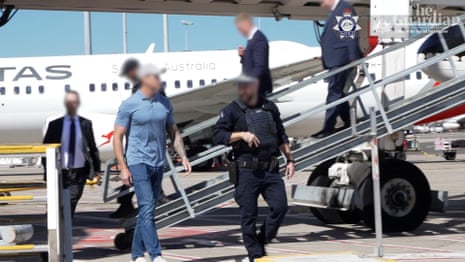 0:48Ben Roberts-Smith arrested by Australian federal police at Sydney airport – video
 Marched, sullen and alone, from a plane at Sydney airport on Tuesday morning, Roberts-Smith has endured an extraordinary fall from grace.
The most famous soldier of his generation – the recipient of the Victoria Cross for “most conspicuous gallantry” – he once enjoyed an unparalleled public reputation, lionised as the modern embodiment of Australia’s Anzac legend, feted as father of the year.
Now, he faces five counts of the charge of “war crime – murder”, each of which carries a potential life sentence.
Roberts-Smith is alleged to have murdered unarmed civilians while he was serving in Afghanistan, people who posed no threat to Australian soldiers, who should have been afforded protection, and who were instead killed for no reason.
Roberts-Smith is, as any accused, afforded the presumption of innocence until proven guilty. He has consistently, and vociferously, denied all allegations of wrongdoing and defended his conduct in wartime and peace.
But this case presents the rare situation of there existing hours of evidence on the public record around these allegations, aired through the defamation trial that Roberts-Smith himself brought to court.
Thousands of documents have been produced in evidence and dozens of soldiers subpoenaed to testify about what they saw, and what they did.
 ‘The legal machinations will grind on for years.’ Ben Roberts-Smith arriving at the federal court of Australia in Sydney, 18 May 2022. Photograph: Reuters
That defamation trial is irrelevant to the criminal proceedings. The standard of proof required for a criminal conviction (beyond reasonable doubt) is far higher than that needed in a civil case (balance of probabilities).
The first two charges laid against Roberts-Smith relate to a 2009 raid on a compound codenamed Whiskey 108. Australian special forces found two men hiding in a small underground tunnel, an old man and a man with a prosthetic leg, who surrendered unarmed. Both, the federal court heard in the defamation case, were killed – one under Roberts-Smith’s direction, the other by Roberts-Smith himself, throwing the disabled man to the ground and machine-gunning him to death.
The man’s leg was souvenired by another soldier. It became a ghoulish trophy of war back at the SAS’s on-base bar, the Fat Ladies’ Arms, where Australian soldiers were photographed drinking beer from it.
The third charge relates to the most high-profile allegation levelled against Roberts-Smith, that on a mission to the village of Darwan in 2012, the Australian soldier marched a handcuffed farmer named Ali Jan to the edge of a 10-metre high precipice, which dropped down to a dry river bed below.
The evidence given during the defamation trial was that Roberts-Smith then kicked Ali Jan in the chest, sending him falling backwards over the cliff, his face hitting the cliff as he fell, before he landed on the ground below.
Ben Roberts-Smith committed war crimes in my country – his targets are the forgotten victims of Australia's Afghan war | Shadi Khan SaifRead moreAli Jan survived the fall, though he was badly injured, and was trying to get to his feet when the Australian soldiers, having walked down a diagonal footpad cut across the cliff, reached him.
Roberts-Smith ordered a soldier under his command to shoot Ali Jan dead.
The fourth and fifth charges relate to a mission at Syahchow where it is alleged two prisoners, unarmed and posing no threat, were marched to a nearby field and – unseen – shot dead, with weapons planted on their bodies to disguise the fact they were noncombatants.
The legal machinations will grind on for years. The investigation into Roberts-Smith has been complex, his prosecution will be similarly: it will likely be years before the trial proper even begins.
Accountability is vital. War is violent, terrifying, corrosive. But even war has laws.
These allegations belong to Australia: they have marred the honourable service of thousands of committed soldiers sent repeatedly to the front lines of a dangerous, damaging conflict.
But at the heart of this case are the victims of these alleged murders more than a decade ago.
Children have grown up without fathers, wives without husbands.
Families have spent disconsolate years waiting for a justice many believed would never come.
Explore more on these topicsShareReuse this content