
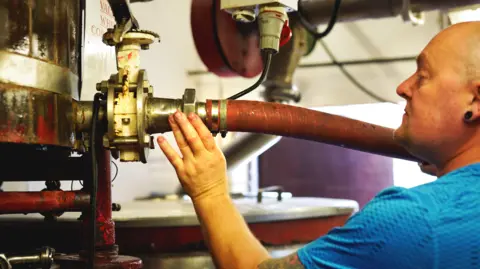
 Matt CurtisAl Wall has worked at breweries across the UK and has most recently on taken a brewery in his hometown
Walking down the streets of Burton-upon-Trent 30 years ago, Al Wall could smell different aspects of the beer brewing process through the day - but those moments are now few and far between.
He is the head brewer at the oldest and largest independent brewery remaining in the town that once produced a quarter of British beer, with more than 30 breweries at its peak.
These days the brewing scene in Burton is a shadow of its former self, and the town is not alone.
Across the UK 320 businesses shut last year, Companies House data shows. Yet only 170 opened, resulting in a net loss of 150.
In addition, the beer industry estimates that around two pubs closed a day in the first quarter of 2026.
The net loss has continued this year. As of April, the number of UK beer brewing companies fell to 2,320. It peaked at 2,594 in 2022.
Tim Webb, from the Campaign for Real Ale (CAMRA), explained the domination of big brands is one of the main issues.
"The big problem that breweries have got, and it is getting worse, is access to market," he said.
"The problem, which is really happening everywhere across Europe, is large brewery companies owning the draught lines in pubs."
Smaller breweries are also blocked from supermarket sales due to price undercutting.
Webb said some closures are due to the lingering impacts of Covid, but consumer habits are also key.
Less than a decade ago, England's beer businesses were booming. In 2017 alone, 317 breweries were incorporated – more than double last year's figure.
While England still accounts for the vast majority of the UK's beer-brewing businesses, its total has fallen below 2,000 this year for the first time since 2018.
Of the 1,965 remaining, 95 are in the process of administration, insolvency or liquidation.
The South East's oldest brewery, based on the year of incorporation, is Oxfordshire's Hook Norton.
James Clarke is the fifth generation of his family to run the company and has been brewing for over 30 years.
He has seen a large change in "consumption, attitudes and lifestyle".
"Back in the early nineties, we brewed three beers, a mild, a bitter and Old Hooky," he said.
"I think beer consumption in the UK was about double the volume that it is now."
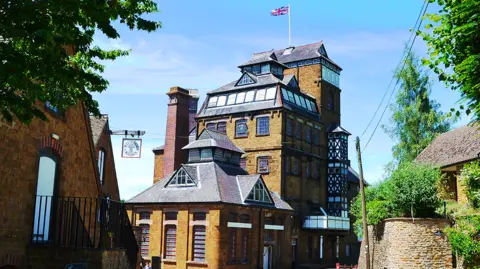 Hook NortonHook Norton Brewery has remained independent since 1849
Hook Norton is brewing half the amount of beer it was 15 years ago, but a wider variety, and Clarke believes there is a "small renaissance in the traditional styles of beer".
Webb added: "The part of the beer market that's holding up or growing is the interesting part.
"So you've got heritage beers, craft beers, in some cases very strange wacky new types of beer - those are all doing fine."
"What is slowly but surely contracting, and has been for decades now, is the bright, shiny, frothy top, see-through lager market."
A crucial part of continued success for Hook Norton has been finding ways to diversify.
Clarke said: "We were probably the first with a visitor centre of any scale and we were one of the first with a microbrewery within the main brewery."
Andy Slee, chief executive of the Society of Independent Brewers and Associates (Siba), said many of its members are looking to diversify, with some opening taprooms that allow breweries to serve beer directly to customers.
"In order to survive, you just can't stay doing what you were doing before," he added.
"Although the beer market has been in consistent decline, demand for independent beer is relatively strong."
However, breweries are facing a "suffocating level of taxation" and Siba wants to see a tax reduction on draught beer in pubs.
"When a brewery or a pub dies, something in that community dies," Slee said. "A place to meet, a place of employment, a place that pays local tax."
London is the only English region which didn't see a net loss of companies last year.
In the West Midlands, the home to the former capital of beer brewing, nine companies were started up but 21 were dissolved - a loss of 12.
Back in Burton, Al Wall and Emma Cole, brewery manager at Burton Bridge and Heritage Brewing Company, hope to preserve their history and be a "bastion of independence".
"It is about hope," Cole said. "People see us carrying on and it gives hope that beer isn't going to die in Burton."
The breweries rely on selling beers through its taproom. Cole added: "There's so many pubs we just cannot sell to at all."
She explained that breweries are facing rising costs, from business rates to "astronomical" fuel prices, but the consumer doesn't expect their beer to go up in price.
Where are breweries thriving?
At its peak, Burton-upon-Trent was home to 30 breweries - now there are just eight according to Camra data .
While a far cry from 30 in a single town, there are still some dense clusters of breweries in the UK.
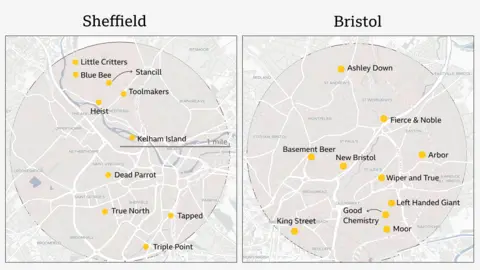 Open Street Map/BBC analysis of Camra dataBoth Sheffield and Bristol have ten open breweries within a mile radius from each other
Triple Point Brewery is one of ten locations within a mile radius in Sheffield.
Co-founder George Brook said: "One of the reasons why I love this city, and also Bristol, both are so much more accepting of independents than anywhere else I have been or lived.
"The culture of drinking local beer is one of the things that makes Sheffield great."
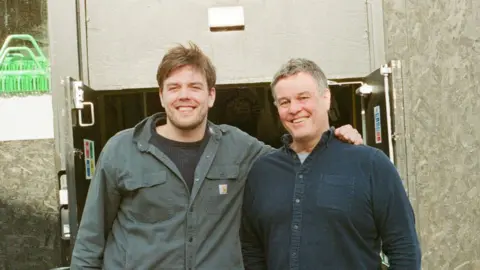 Triple Point BreweryGeorge Brook (left) started the Sheffield brewery in 2019 with his father Mike (right) and head brewer Alex Barlow
Although the brewery has "grown every year", success has not come easily.
"We just accept that it's going to be harder next year to make the same amount of money as we did the year before," the Brook said.
"I think we would be very tight if we had to rely just on the brewery. If someone came and shut down our taproom tomorrow, we would be in a serious pickle."
But there may be hope on the horizon for independent breweries.
The goverment has recently reviewed the beer market to "determine barriers preventing small breweries from accessing pubs" and launched a £4.3 billion business rates support package.
"We know the vital role independent breweries and pubs play in local communities, supporting jobs and growth across the UK," a spokesperson said.
Additional reporting by Lauren Woodhead and Jonathan Fagg
Hook NortonBurton-upon-TrentCamraBeerSheffield