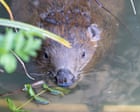
 A beaver released a year ago in Dorset, as part of the first official reintroduction of the mammals to England since they were hunted to extinction 400 years ago. Photograph: Mark SingletonA beaver released a year ago in Dorset, as part of the first official reintroduction of the mammals to England since they were hunted to extinction 400 years ago. Photograph: Mark SingletonBeavers ‘breathe new life’ into Dorset as dams built and biodiversity returns
National Trust says one year after reintroduction they are enriching habitats and may be having kits this summer
They were released this time last year with fanfare, much hope and also, perhaps, a little trepidation.
Twelve months on, there have been ups and downs for the first beavers to be (officially) reintroduced into the wild in England since the semiaquatic mammals were hunted to extinction 400 years ago.
Providing an end-of-year report, the National Trust, which is in charge of the project, said it was thrilled the beavers had been reshaping their new home in Dorset, where they have felled trees to construct a 35-metre dam, slowing the flow of a stream and creating a deep, wildlife-rich pool.
By coppicing trees they have allowed more light in and improved habitats for plants, insects, amphibians, birds and bats – and may help stop a nearby road from flooding.
Trail cameras have picked up an otter fishing in the pond as well as a barn owl hunting there, and volunteers have spotted birds including redpolls and water rails.
The cameras also captured footage of two of the beavers mating, which is being taken as a sign they have settled in their new home and that there could be kits this summer.
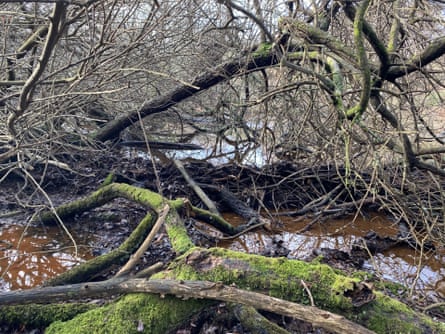 The beavers built a dam on the Isle of Purbeck in Dorset. Photograph: Cathy Lewis
But there have been hitches. Two pairs of beavers were released into Little Sea, a freshwater lake on the Isle of Purbeck in Dorset, one on the western side, the other on the eastern.
The western female beaver promptly upped and left Little Sea, ending up in the seaside town of Swanage several miles away, possibly after swimming across Swanage Bay.
She was trapped and taken back. Later she and her mate turned up at a Wessex Water treatment works. The area was fenced off to discourage them.
They returned to the area around Little Sea and set up base in an area of wet woodland a little way from the lake, where they have been busy doing their engineering work and, hopefully, making a family.
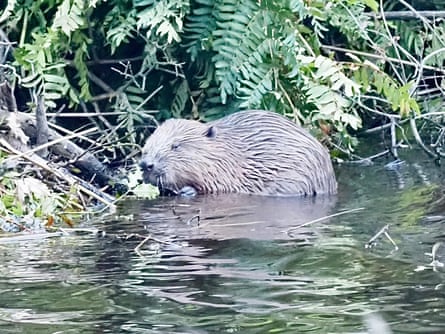 A beaver spotted at Little Sea. Photograph: Pam Ballam
Sadly, however, the male released into the eastern side was found dead in Swanage Bay, possibly of salt water poisoning, and there have been no recent positive sightings of the female.
Gen Crisford, the National Trust’s wetlands project officer, said setbacks were inevitable. “You’re not controlling all of the factors in the environment and wild animals do have a hard existence sometimes, especially with climate change,” she said.
Crisford said the western pair had clearly had some adventures. “But we may be having a happy ever after moment now. We hope to see some kits from them later in the year and will keep following what they’re up to.
“Just to see beavers doing what beavers do and really having an engineering impact on the habitat is fantastic. The effect on the ecosystem in a relatively short time is astonishing. From dense tangled woodland, the beavers have created a light and airy wetland teeming with life above and below the water.
“We can’t wait to see what wildlife appears this spring and summer – from dragonflies, diving beetles and butterflies to frogs and newts – and of course, all the animals that feed off them.
“Not only have the beavers breathed new life into the landscape, but there are also indications that by slowing the flow of the stream, they are helping prevent the nearby road from flooding in heavy rain.”
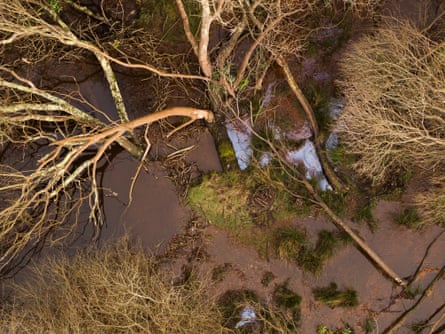 An aerial view of a Dorset dam. Gen Crisford says the engineering impact the animals are having on the habitat is ‘fantastic’. Photograph: James Beck
The new beavers joined another pair on the lake, which arrived there by unknown means a few months before the UK government licence for the National Trust beavers was granted. That pair have raised three kits and constructed two large lodges, one each side of the 33-hectare (82 acre) lake.
Ben McCarthy, the head of nature conservation at the National Trust, said the effect on the landscape had been remarkable.
He added: “This reintroduction demonstrates how positive political action can result in tangible ecological recovery in a really short space of time.”
The project allows for the release of 10 to 25 adult beavers and the next release is expected to take place this autumn.
Explore more on these topicsShareReuse this content