Get the world’s most fascinating discoveries delivered straight to your inbox.
Become a Member in Seconds
Unlock instant access to exclusive member features.
Contact me with news and offers from other Future brands Receive email from us on behalf of our trusted partners or sponsors By submitting your information you agree to the Terms & Conditions and Privacy Policy and are aged 16 or over.You are now subscribed
Your newsletter sign-up was successful
Want to add more newsletters?
Join the club
Get full access to premium articles, exclusive features and a growing list of member rewards.
Explore An account already exists for this email address, please log in. Subscribe to our newsletter 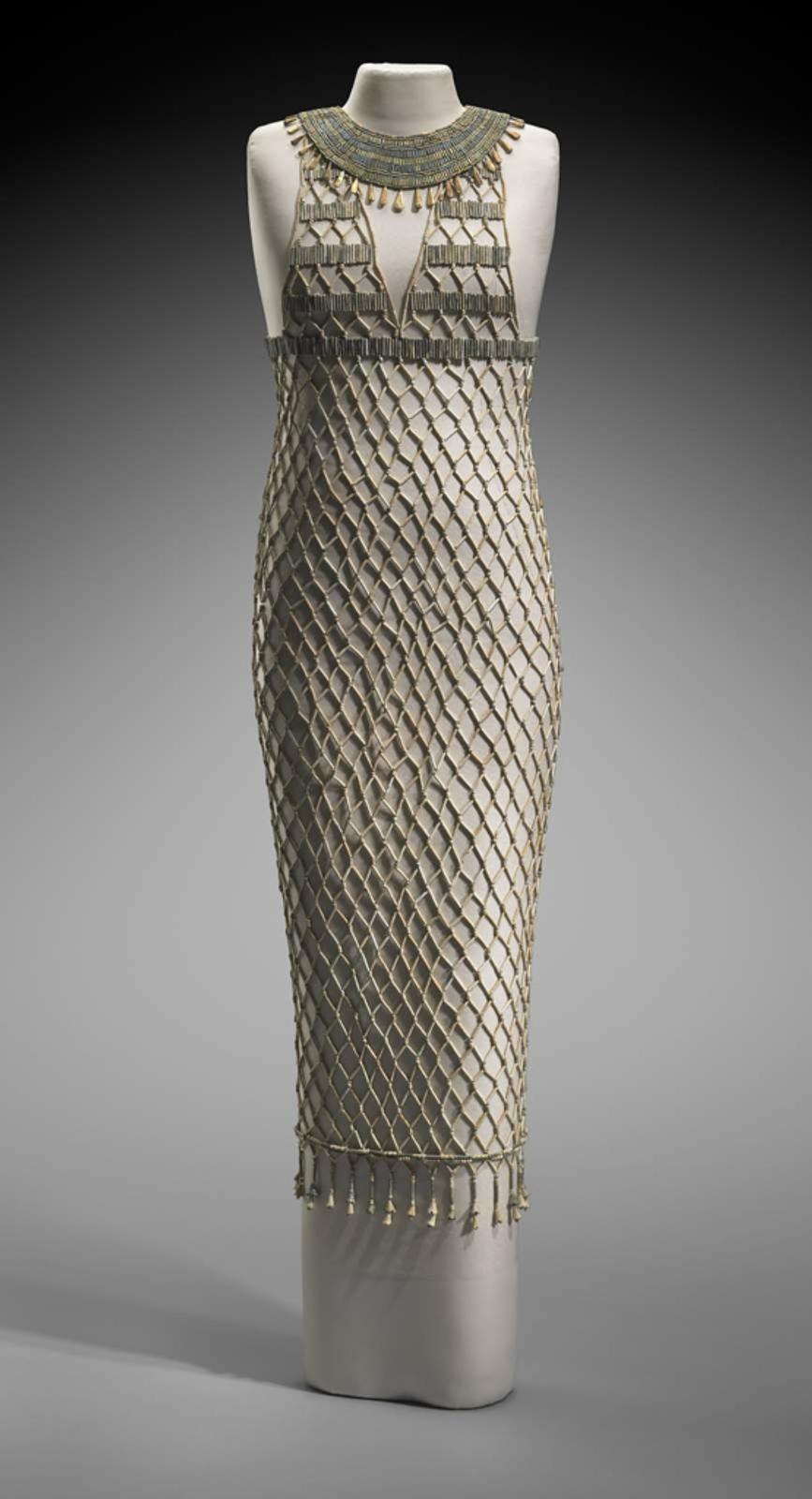
Name: Beadnet dress
What it is: A beaded funeral dress
Where it is from: Giza, Egypt
When it was made: Circa 2551 to 2528 B.C.
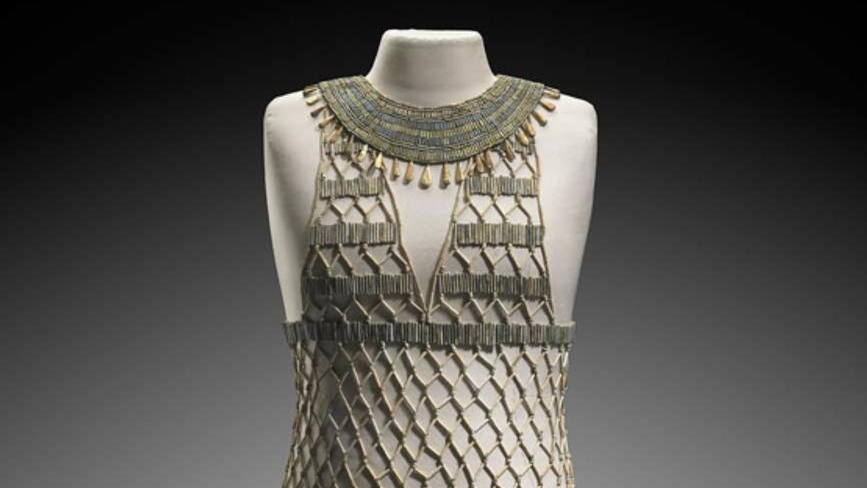
According to the Museum of Fine Arts, Boston, which has this dress and several other examples of beadnet objects in its collection, the net was made from linen string and faience — a glazed ceramic made from finely crushed quartz. In this case, before firing, the faience paste was mixed with copper, which turned the beads blue and blue-green to mimic the semiprecious stones lapis lazuli and turquoise.
The midi-length beadnet features a diamond-patterned skirt and an empire-waist bodice made with rows of vertically strung faience beads. The dress is topped with a neckline of beads in concentric circles, and the bottom features a beaded fringe of mitre shells (sea snails). The completed beadwork net was likely draped over a linen dress or sewn directly onto it, rather than worn by itself.
Since Egyptian faience beads are quite fragile, the dress may have been worn only on special occasions, or it might have been made specifically for the woman's funeral, according to Tom Hardwick, an Egyptologist at the Houston Museum of Natural Science. The blue and green on the dress may symbolize the Nile River and springtime, both of which were tied to the Egyptian idea of resurrection in the afterlife, according to Hardwick.
MORE ASTONISHING ARTIFACTS—Urfa Man: An 11,500-year-old life-size statue of a man holding his penis
This beadnet dress is the earliest surviving example of the style, according to MFA Boston. Only about two dozen beadnet dresses exist in museums around the world. Two have been reconstructed at MFA Boston, and one has been reconstructed at the Petrie Museum at University College London. When ancient Egyptian clothing specialist Janet Johnstone, a clothing consultant who specializes in the interpretation and construction of ancient Egyptian clothing, reconstructed the Petrie Museum beadnet dress, she discovered that it was far too heavy to be worn regularly. (For anyone who wants to test their own beadnet sewing skills, Johnstone has provided a basic DIY guide.)
In the New Kingdom period (1550 to 1070 B.C.), the beadnet dress appears to have gone out of fashion while simpler beaded nets rose in popularity as grave goods. These "bead cloaks" have been found on top of New Kingdom mummies, revealing that beaded accessories remained an important part of ancient Egyptian funeral rituals for centuries.
For more stunning archaeological discoveries, check out our Astonishing Artifacts archives.
Sign up for the Live Science daily newsletter nowContact me with news and offers from other Future brandsReceive email from us on behalf of our trusted partners or sponsors TOPICS Kristina KillgroveStaff writer
Kristina Killgrove is a staff writer at Live Science with a focus on archaeology and paleoanthropology news. Her articles have also appeared in venues such as Forbes, Smithsonian, and Mental Floss. Kristina holds a Ph.D. in biological anthropology and an M.A. in classical archaeology from the University of North Carolina, as well as a B.A. in Latin from the University of Virginia, and she was formerly a university professor and researcher. She has received awards from the Society for American Archaeology and the American Anthropological Association for her science writing.
View MoreYou must confirm your public display name before commenting
Please logout and then login again, you will then be prompted to enter your display name.
Logout LATEST ARTICLES 1'This generation's moment': How the Artemis missions will reframe humanity's relationship with the moon
- 2Diabetes rates are lower in high-altitude environments — and scientists may have discovered why
- 3Antarctica hides huge caches of gold, silver, copper and iron. As the ice melts, countries may race to harvest them.
- 4Shroud of Turin, claimed to be Jesus' burial cloth, contaminated with carrot and red coral DNA
- 5NASA telescope uncovers new mystery in supernova first spotted by Chinese astronomers 2,000 years ago — Space photo of the week