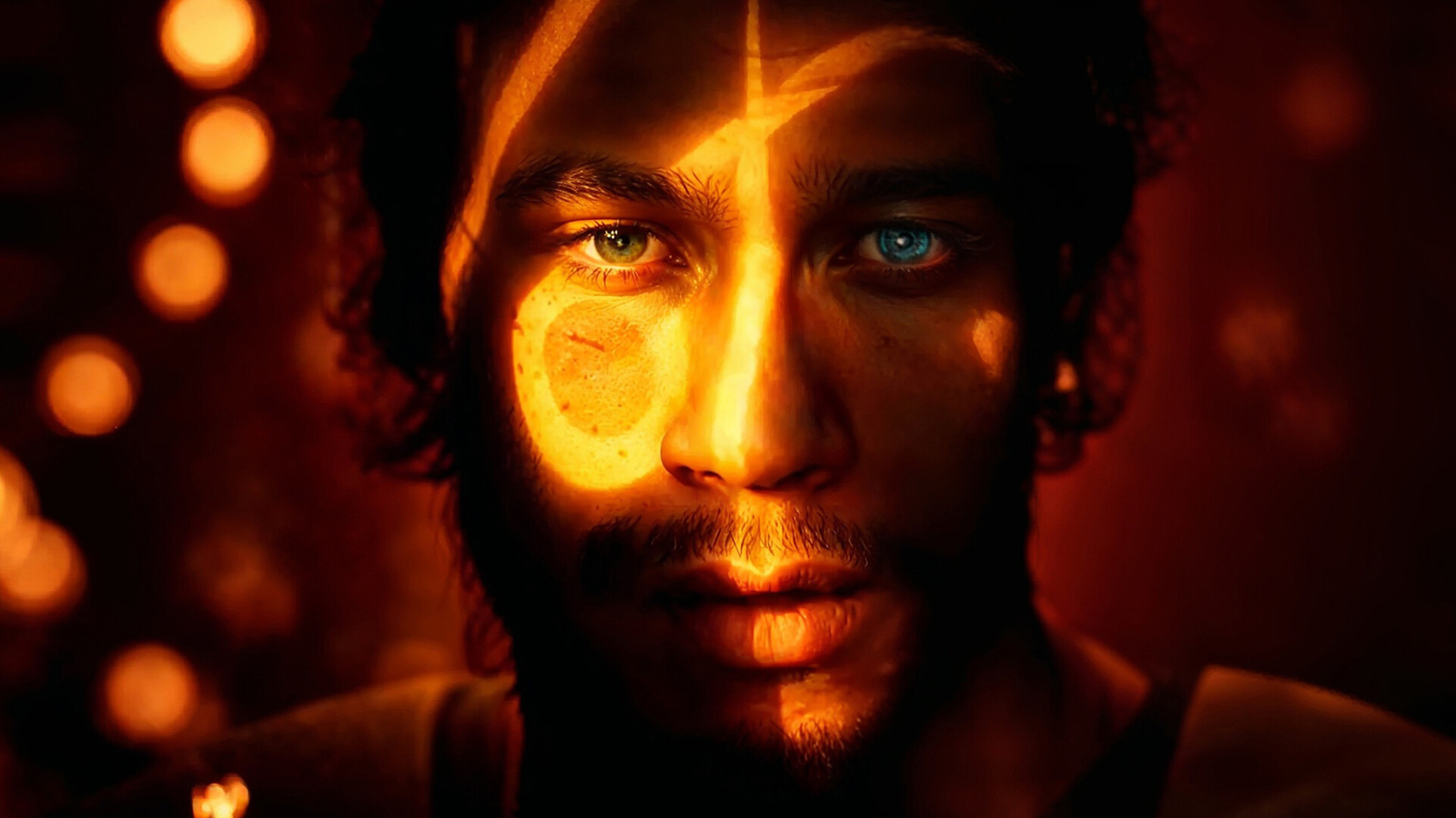
The 20-year-old filmmaker Kane Parsons has risen to the top so fast that he’s had zero time to process how far he’s come.
“It's been go, go, go,” Parsons tells WIRED. “Even the tiniest bit of a break,” he says, would give him some better perspective on everything that’s happened over the past few years. But for the moment, he’s soaking up the limelight—and thinks it’ll be at least another month before he has the space to reflect on his big break.
Backrooms, a moody horror piece that stars Chiwetel Ejiofor and Renate Reinsve, is a cerebral expansion of Parsons’ atmospheric YouTube web series of the same name. It marks his feature debut as A24’s youngest director to date, at the helm of a movie long anticipated by a huge and hungry internet fan base. You could hardly ask for a better kick start to summer blockbuster season.
Yet Parsons makes his meteoric success sound like something of an accident. “I never went into making that first short or making the series with the intention of, ‘I want to do this so I can prove to Hollywood that this is an engine that is viable for a film,’” he says.
That original nine-minute video, titled “The Backrooms (Found Footage)” and uploaded by Parsons in 2022, was inspired by—of all things—a sinister 4chan meme that spawned a collaborative mythology. The 2019 post on the notorious image board’s /x/ forum included a disquieting photo of an empty hallway bathed in sickly light. An anonymous user described being transported into “the Backrooms, where it’s nothing but the stink of old, moist carpet, the madness of mono-yellow, the endless background noise of fluorescent lights at maximum hum-buzz, and approximately six hundred million square miles of randomly segmented empty rooms to be trapped in.”
“God save you if you hear something wandering around nearby, because it sure as hell has heard you,” the 4chan user added.
Other people took up the concept, creating spinoff imagery and stories on various social platforms. Parsons encountered these, as well as then-popular memes about surreal liminal spaces—the Backrooms being a paranormal extension of this phenomenon. He was intrigued by what this material evoked but felt it hadn’t been fully explored.
“It was clearly scratching something that I didn't really see much other media scratching,” he says. “I think there was an element of like, I wish there was more for me to engage with here.”
To that end, Parsons decided to see whether he could conjure an immersive vision of the Backrooms with Blender 3D graphics software and Adobe After Effects. That initial video, in which a person is chased through the Backrooms by a malevolent life-form, went massively viral, with viewers marveling at Parsons’ technical skill and the chilling suspense he’d created. Fans excitedly speculated on the larger mythology of the uncanny setting. Within a month, studios were approaching Parsons with hopes for a full-length movie.
Although still a teenager at the time, Parsons knew enough to be wary of the offers. “I was very distrustful of pretty much everything that was happening, just because I feel like it's a very common experience for that sort of event to turn into nothing,” he says. “Or you end up with less than nothing.”
Ultimately, however, he got what a young filmmaker dreams of: the chance to pursue his vision, in this case with top talent at his side. The feature film has a script by Homeland and Westworld writer Will Soodik, and its producers include horror maestros Osgood Perkins and James Wan.
Backrooms is vivid, self-assured, and richly suffused with fluorescent dread. Ejiofor plays Clark, a problem-drinking divorcé who lives in his failing furniture store in San Jose, California, nursing a sense of victimhood that masks volcanic anger. In sessions with his therapist Mary (Reinsve), he tries to understand the patterns of behavior that have gotten him stuck in life—the wrong turns that led to the end of his marriage and thwarted his dreams of becoming an architect. Clark doesn’t know it, but Mary is also trapped in her memories. As a child, her agoraphobic mother kept her locked inside, with yellowing newspaper pasted over the windows.
Late one night, when the lights in Clark’s store are on the fritz as usual, he walks downstairs to his showroom to investigate the faulty circuit breaker. That’s when he notices a glowing seam in the wall that defies any rational explanation. To his astonishment, he finds it marks a spot where he can walk right through the plaster and into another, even more purgatorial world: a labyrinth of never-ending rooms, many of them containing objects and structural features that look familiar on first glance—but are somehow off. Mesmerized, he returns regularly, trying to map out the endless sprawl and find any sign of life. (Suffice to say, he is not alone in there.)
Parsons’ great challenge was to make a movie that could both satisfy obsessive fans and draw newcomers into the paradox at the heart of his ongoing narrative. “Online, there's often a very avid community—and you know mine is this way—but I feel like you have to be careful not to lean too hard into it,” he says, noting that these “problem-solvers” and “puzzle-oriented people” build up huge theories that can end up weighing an idea down.
That’s probably why Backrooms withholds any big answers and leaves you with a discomfiting mystery. It’s set in the 1990s, which also means that Clark can’t go to Google with his questions, nor can he upload videos of the rooms to YouTube and solicit opinions on what the hell he’s experiencing. (“And he can't fly a drone down there,” Parsons adds.) The absence of the internet as we know it in a tale collectively conjured across social media is a curious and clever inversion.
Diehards will still have plenty to chew on—including Clark’s own eerie hypothesis about these confounding passageways. In their impossible geometry, the Backrooms owe something to the Overlook Hotel of The Shining, keeping viewers locked inside long after the movie has ended, searching for a hidden meaning.
Most importantly, of course, Backrooms is genuinely frightening. As I left my screening and walked to my car in a silent underground parking garage, I realized I was reflexively looking over my shoulder, expecting the echo of footsteps somewhere behind me.
The movie is tracking for a massive opening weekend (one that will blow past A24’s current box office record), which has some talking about it as a landmark moment for Hollywood, where studios are increasingly scouting YouTube for the next breakout horror auteurs. But another reason for all the buzz could be that Backrooms is that vanishing cinematic rarity: a wholly original film.
Parsons feels that growing up online, as part of overlapping communities of creatives and commentators, helped him figure out what was missing from the artistic landscape. “What people are looking for, it feels like usually they're ignored or neglected,” he says. “I think there's definitely a power in feeling like you're tapped into that conversation—and actually having a conversation with everyone else.”