
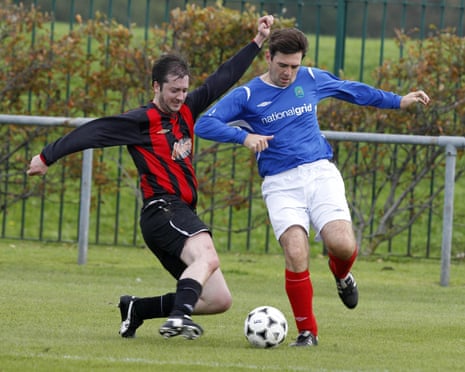
 ‘Very, very competitive.’ Andy Burnham plays football for the Labour party parliamentary team against the press lobby in 2011. Photograph: PA Images/Alamy‘Very, very competitive.’ Andy Burnham plays football for the Labour party parliamentary team against the press lobby in 2011. Photograph: PA Images/AlamyBack on the pitch: how Burnham’s chief of staff pick reunites late-90s Labour football team
Some worry choosing James Purnell, former Demon Eyes teammate, would show Labour struggling for new talent
The most powerful football team in the country is getting back together.
Andy Burnham’s decision to appoint James Purnell as his chief of staff should he become prime minister will reunite not only two old friends and former Labour ministers but two of the linchpins of the famous Demon Eyes team set up in the late 1990s.
Burnham’s pick for chief of staff led firm that advised BP, Apple and AmazonRead moreThat team, whose members have included Burnham, Purnell, the former shadow chancellor Ed Balls and the former foreign secretary David Miliband, was originally formed by New Labour advisers in the early years of the Blair government.
Many of its players would reach the heights of ministerial office, though in the intervening years most have left Westminster politics for other careers.
But the reunification of Burnham and Purnell at the heart of what is likely to be the next government shows how Labour’s modern history is still being written by those who first propelled it to power in 1997.
As for their skills on the pitch, Patrick Hennessy, a former Labour adviser and now a senior director at Hanover Communications, said: “Andy was technically a good player, a fast attacker with good finishing.”
 James Purnell: ‘a decent centre-back’. Photograph: PA Images/Alamy
Hennessy, who captained a rival team of political journalists, added: “James was a decent centre-back – he wasn’t the most physical, but he was very, very dogged. Those two were at the core.
“But the main thing about the team is it was very, very competitive. You knew when you were playing against them it was going to be a hard match – they were determined to win.”
One former teammate joked that the positions Purnell and Burnham played on the pitch would be reflected in their roles in the coming government: Purnell, a determined but un-showy defender; Burnham, an attacker who seemed to enjoy the attention he got from scoring goals.
The team, which was set up in 1998 and named after the Conservative attack poster depicting Tony Blair with devilish red eyes, played its home matches in the Labour heartland of north London.
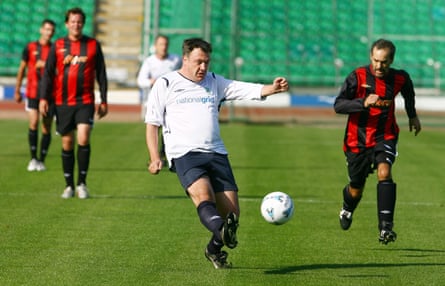 Ed Balls also played for the Demon Eyes team. Photograph: PA Images/Alamy
It was set up by Purnell and Tim Allan, who went on to be Keir Starmer’s director of communications. Its early incarnations included Purnell, Allan, Miliband, Balls and the journalists David Goodhart and Liam Halligan.
Other prominent New Labour figures involved included Blair’s former speechwriter Philip Collins, Gordon Brown’s adviser Ed Richards, and Dan Corry, who went on to be Brown’s head of policy. Neal Lawson, the director of the leftwing group Compass and another big Burnham ally, took over from Goodhart in goal.
The team was known for its will to win, its occasionally blokeish repartee and its unusual dressing room conversation topics.
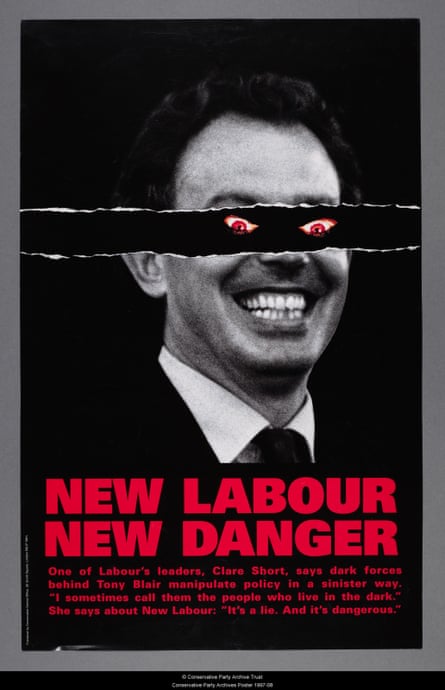 The Conservative party’s campaign poster depicting Tony Blair with demonic eyes inspired the name of the team. Photograph: The Conservative Party Archive/Getty Images
“It is the only football team I’ve been in where the chat in the changing rooms was all about politics,” said one former player. “Eventually though that was diluted a bit when we had to recruit some non-Blairites in an effort to get people who could actually play football.”
Another former player added: “We were more like Gareth Southgate England or [Mikel] Arteta’s Arsenal [teams built around a solid defence] than anything more freeflowing.”
Blair himself embraced football as a cultural sign of Britain’s growing soft power, though he was not as steeped in it as some of his younger colleagues.
Keir Starmer, an Arsenal supporter, is perhaps the most committed football fan to become prime minister, and in Burnham he is likely to be succeeded by a passionate Evertonian.
But it is indicative of their differing statuses within the Labour party that while Burnham was a core member of Demon Eyes, as well as the Labour and parliamentary teams, Starmer has always preferred to play with a smaller group of non-political friends.
Once Burnham had become a senior Labour MP and Purnell was working at a senior level at the BBC, a younger generation came through the ranks, including the current justice minister, Jake Richards.
However, some worry that the fact the Labour party is still dominated at a senior level by people who not only all came through the Blairite system together but even played for the same football team suggests a problem with the party’s flow of new talent.
“Thirty years on we are still talking about that one team,” said one former player. “You would have thought we might have moved on by now.”
Explore more on these topicsShareReuse this content


