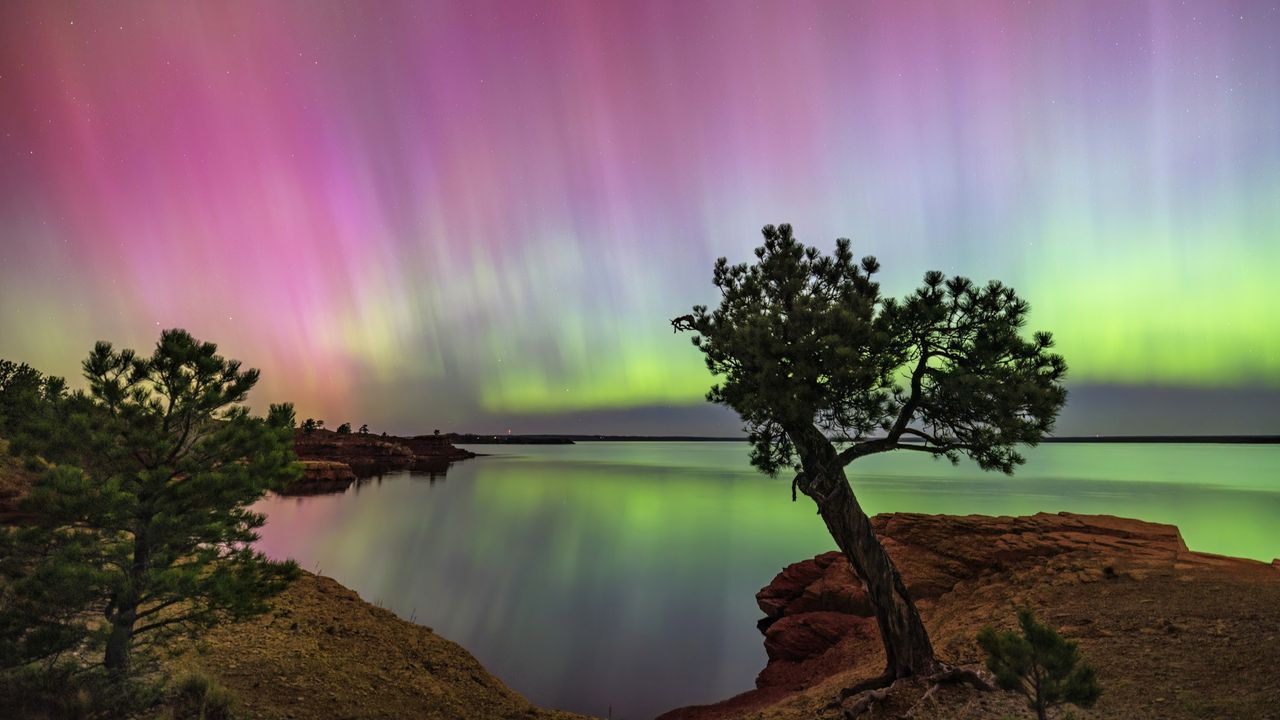
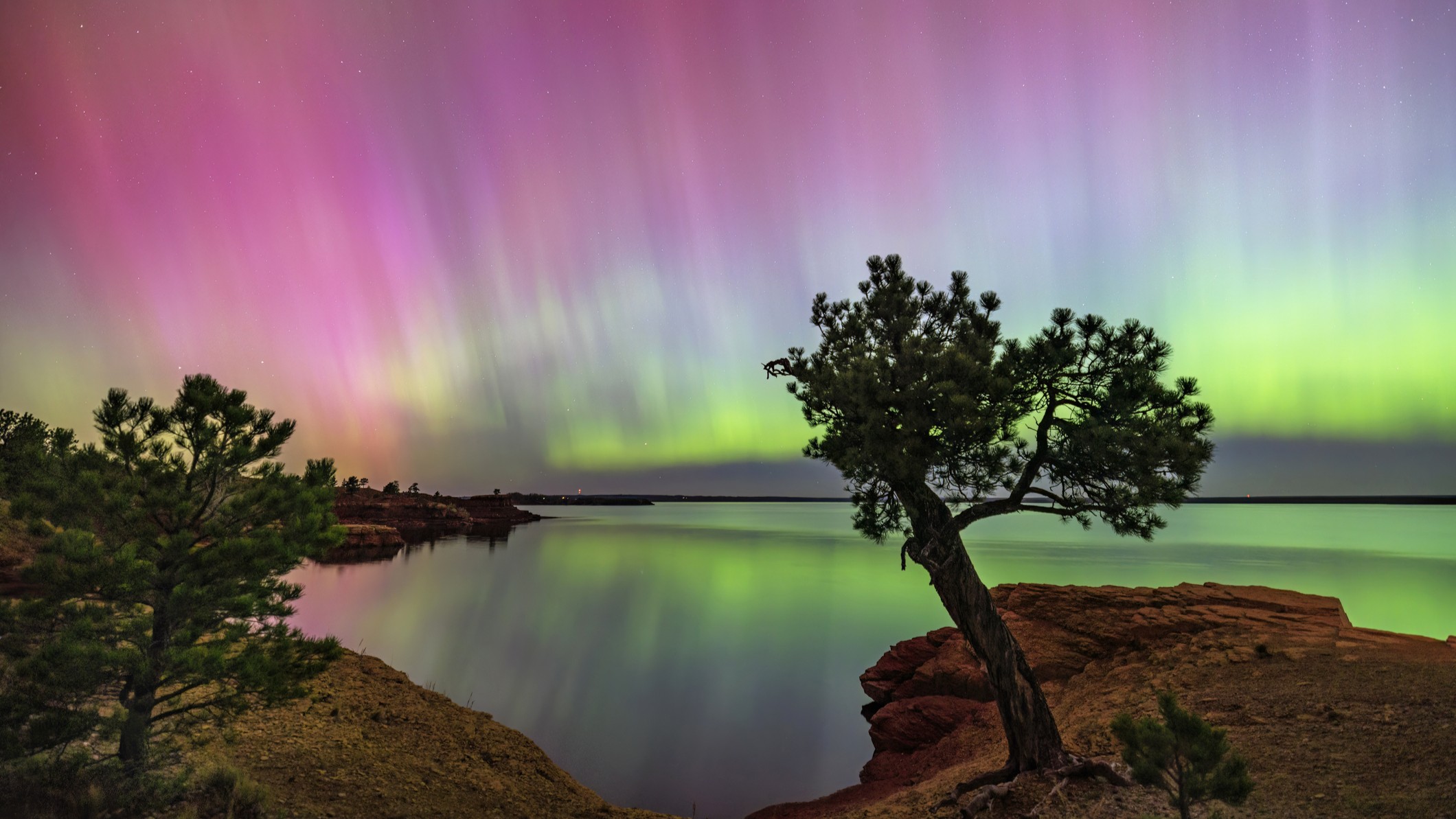
 The northern lights dancing above Glendo Reservoir in Glendo State Park, Wyoming, U.S. (Image credit: lightphoto via Getty Images) Share this article 0 Join the conversation Follow us Add us as a preferred source on Google Newsletter Get the Space Newsletter
 Breaking space news, the latest updates on rocket launches, skywatching events and more!
Contact me with news and offers from other Future brands Receive email from us on behalf of our trusted partners or sponsors By submitting your information you agree to the Terms & Conditions and Privacy Policy and are aged 16 or over.You are now subscribed
Your newsletter sign-up was successful
Want to add more newsletters?
An account already exists for this email address, please log in. Subscribe to our newsletterThe National Oceanic and Atmospheric Administration's (NOAA) Space Weather Prediction Center (SWPC) has issued a G2 geomagnetic storm warning for March 19 (UTC) — which could translate to late March 18 in North America — with G1 conditions likely to continue into March 20, as multiple coronal mass ejections (CMEs) head toward Earth. Geomagnetic storms are classified using a G-scale, which ranks their intensity from G1 (minor) to G5 (extreme).
While the initial forecast focused on a single CME launched during an M2.7 solar flare on March 16, forecasters now say at least four CMEs may impact Earth in quick succession, potentially extending and complicating geomagnetic activity through March 20-21.
Article continues belowThis is great news for aurora chasers as the predicted G2-level storm could bring northern lights as far south as New York and Idaho, but NOAA's SWPC says there is a chance that G3 levels could be reached, which could lead to aurora sightings deep into mid-latitudes such as Illinois and Oregon.
When will the solar storm hit?
The possible arrival time for the incoming solar storms is still evolving, and depends on which of the multiple CMEs strike Earth and what effect they have.
According to NOAA's latest forecast, the first impacts could begin as early as 11 p.m. EDT March 18 (0300 GMT March 19), with moderate (G2) geomagnetic storm conditions most likely between 2:00 a.m. and 8 a.m. EDT (0600-1200 GMT).
However, other models, including those cited by the U.K. Met Office, suggest the main CME could arrive later on March 19 or even early March 20, prolonging auroral activity through the weekend.
Because multiple eruptions are involved, geomagnetic activity could persist for 24-48 hours or longer, rather than peaking in a single short burst. So make sure your camera batteries are charged! We could be in for multiple nights of aurora shows down at mid-latitudes.
There are decent chances for some geomagnetic storming this weekend and auroral displays further equatorward than usual. NOAA SWPC has a G2 / moderate storm watch for Thursday March 19 and a G1 / minot storm watch for Friday March 20. This is in response to at least FOUR CMEs… pic.twitter.com/o7tGTUKrjTMarch 18, 2026
Will auroras actually be visible?
Even during strong geomagnetic storms, aurora visibility is never guaranteed.
While G2 conditions can push the auroral oval southward, how far auroras are visible depends on factors like magnetic field orientation, storm timing and local weather conditions.
Auroras are also highly dynamic, often intensifying during short-lived bursts known as substorms — meaning the best displays may last only minutes at a time.
Clear, dark skies and timing your viewing around peak geomagnetic activity will be key.
But if there is even a chance you might get a good show and your weather forecast is looking clear, I'd definitely be heading outside and keeping an eye out, as you never really know!
Seasonal boost to auroras
This week's storm watch comes at an especially exciting time for aurora hunters, with many regarding March as one of the best months to see the northern lights.
Around the spring and autumn equinoxes, Earth's orientation in space makes it easier for its magnetic field to connect with the magnetic field carried by the solar wind and incoming CMEs. This seasonal boost in geomagnetic activity is known as the Russell-McPherron effect, first described by geophysicists Christopher Russell and Robert McPherron in 1973.
During the equinoxes, the sun shines directly over Earth's equator, giving both hemispheres equal day and night. This geometry also helps incoming solar wind interact more effectively with Earth's magnetic field.
For most of the year, Earth's tilt reduces this interaction, helping to deflect some of the incoming charged particles. But around the equinoxes, that natural shield becomes more open to incoming solar wind. As a result, space weather events such as fast solar wind from coronal holes or CMEs can deliver a stronger impact, increasing the chances of auroras.
NOAA's geomagnetic storm watch issued for March 19 (UTC), 2026. (Image credit: NOAA's Space Weather Prediction Center)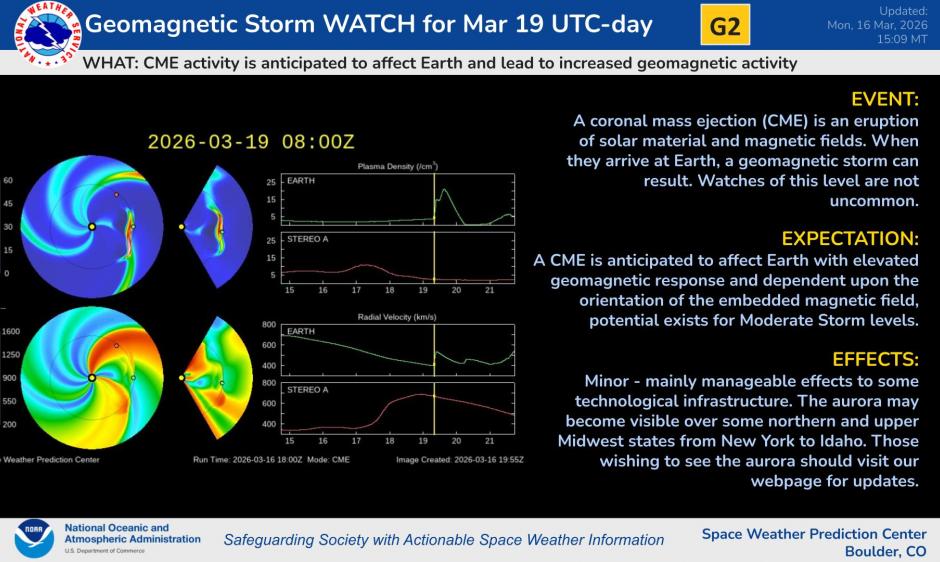
Stay tuned!
Keep up to date with the latest space weather news with our aurora forecast live blog. For real-time forecasts based on your location, consider using a space weather app. A great option is "My Aurora Forecast & Alerts" (available for iOS and Android). For a deeper dive into space weather conditions, "Space Weather Live" is another excellent choice (available for iOS and Android)
Northern Hemisphere aurora forecast courtesy of the U.K. Met Office
Editor's note: This article has been updated with the latest forecasts from NOAA and the U.K. Met Office, including revised storm timing, updated geomagnetic storm levels and new information indicating multiple coronal mass ejections (CMEs) are now expected to impact Earth.
 Daisy DobrijevicReference Editor
Daisy Dobrijevic joined Space.com in February 2022 having previously worked for our sister publication All About Space magazine as a staff writer. Before joining us, Daisy completed an editorial internship with the BBC Sky at Night Magazine and worked at the National Space Centre in Leicester, U.K., where she enjoyed communicating space science to the public. In 2021, Daisy completed a PhD in plant physiology and also holds a Master's in Environmental Science, she is currently based in Nottingham, U.K. Daisy is passionate about all things space, with a penchant for solar activity and space weather. She has a strong interest in astrotourism and loves nothing more than a good northern lights chase!
View MoreYou must confirm your public display name before commenting
Please logout and then login again, you will then be prompted to enter your display name.
Logout MORE FROM SPACE... 1Watch live today: NASA astronauts conducting spacewalk delayed by ISS medical evacuation
- 2X-ray spacecraft watches monster black hole wake up and fire cosmic bullets at starburst galaxy
- 3Dune: Part Three teaser: Five talking points from Denis Villeneuve's return to Arrakis
- 4Where are all the aliens? Maybe they just don't want to talk to us
- 5Ryugu asteroid sample contains all five key components of DNA, scientists find