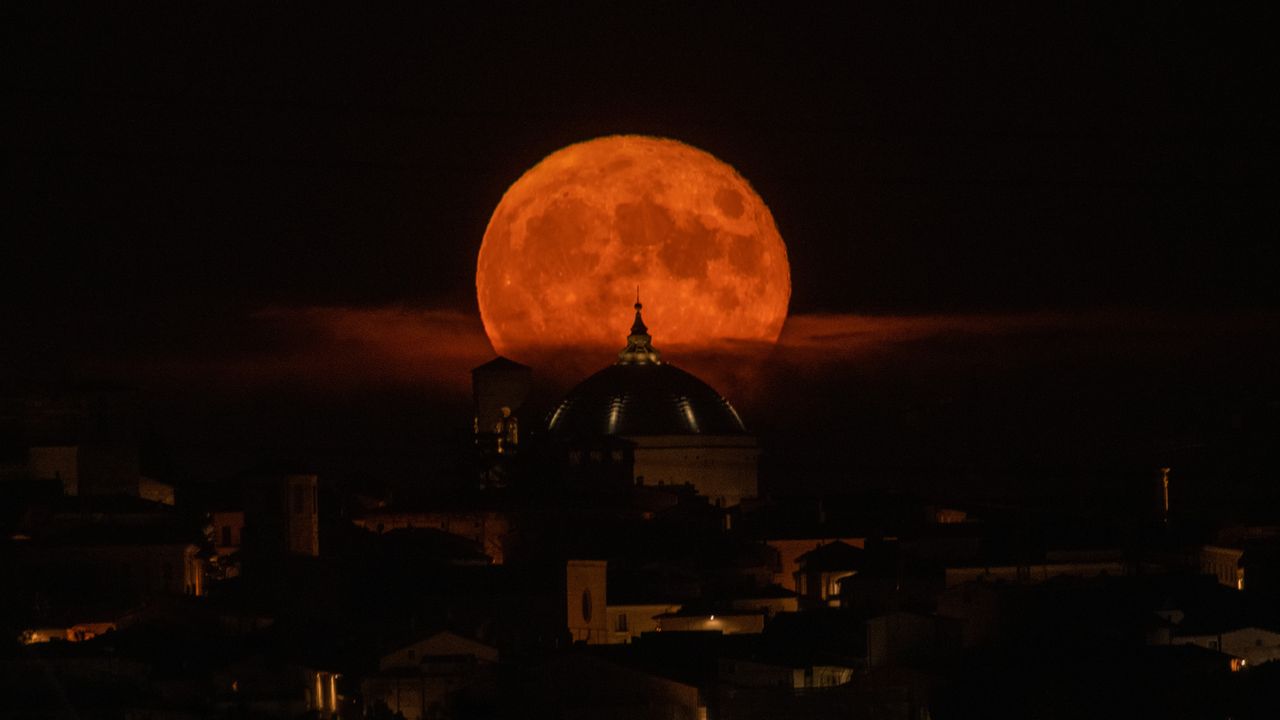
The full moon of August 2026 will occur at 12:18 a.m. (0416 GMT) on Aug. 28, as the lunar disk shines directly opposite the sun in Earth's sky.
Its arrival will trigger a breathtaking lunar eclipse late in the month, which will be visible across the Americas and parts of Africa and Europe as Earth passes between the sun and moon to bathe the lunar disk in shadow.
August's full moon is often referred to as the Sturgeon moon — a Native American name that reflects the time of year that the giant fish are most easily pulled from the waters of the North American Great Lakes and Lake Champlain, according to the Old Farmer's Almanac.
When to see the August full moon
Stargazers in the U.S. will see the Sturgeon Moon rise over the eastern horizon at sunset on Aug. 27. You may notice the moon adopt a yellow-orange hue in the hour following moonrise, as the blue wavelengths of its light are scattered by Earth's atmosphere by an effect called Rayleigh scattering.
The lunar disk may also appear subtly larger while close to the horizon thanks to a phenomenon known as the "Moon Illusion". This optical illusion tricks our brains into thinking that the moon is bigger than it really is when it shines close to foreground objects, as opposed to when it's higher in the sky.
Earth's shadow will already be visible darkening the lunar surface by the time the moon rises for viewers on the west coast of the U.S. in cities like Los Angeles, while those viewing from east coast cities like New York will have to wait a few hours after sunset until our planet's umbral silhouette begins to darken the lunar disk.
Earth's shadow covers the moon during the partial phase of a lunar eclipse. (Image credit: Photo by KIRILL KUDRYAVTSEV/AFP via Getty Images)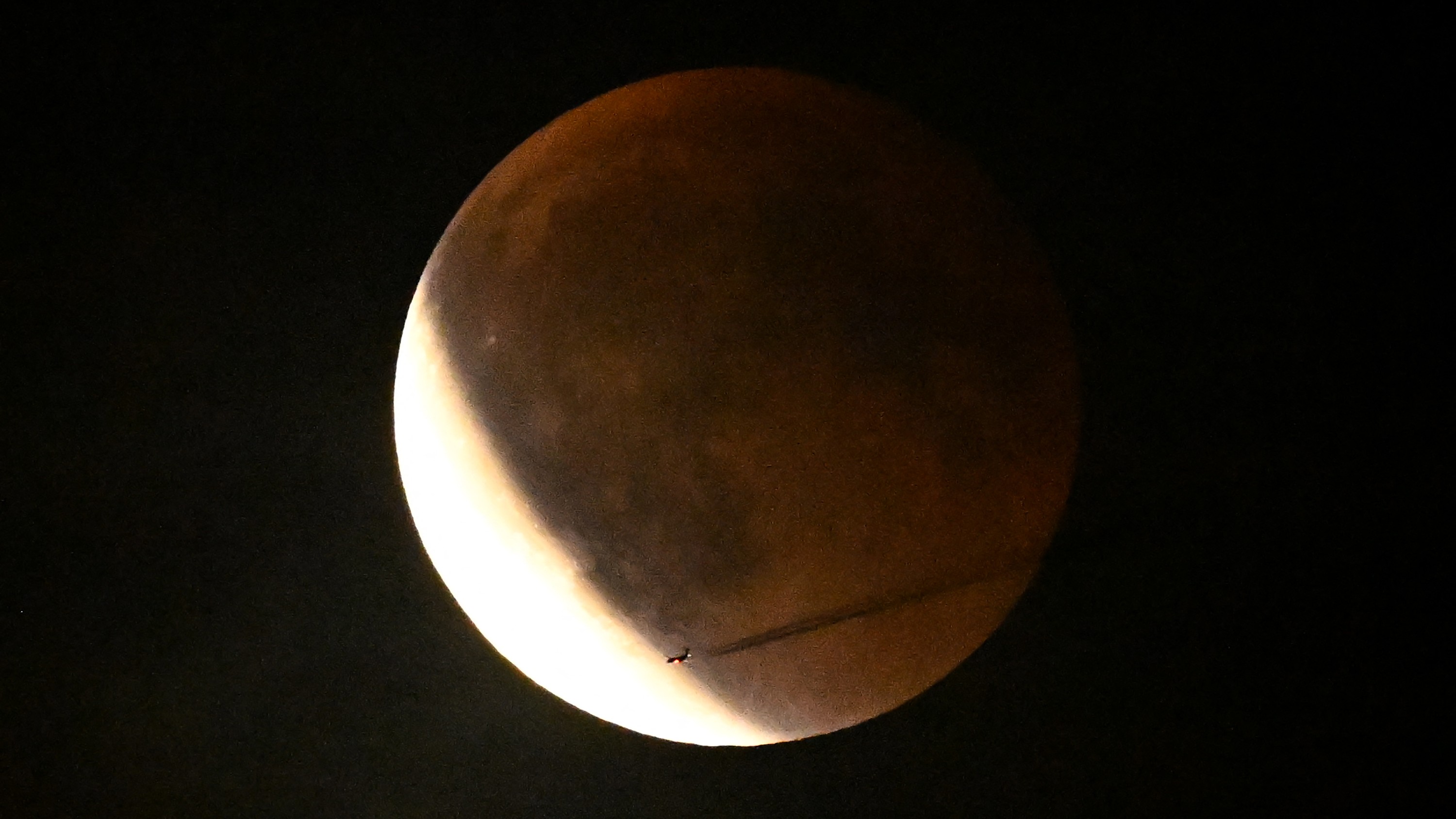
Those in Europe and Africa will see the orbital ballet unfold in the early hours of Aug. 28. Up to 96% of the lunar disk will be immersed in Earth's inner shadow at the point of maximum eclipse. This will turn it a gorgeous blood red as light filtered through our atmosphere falls on its surface, while leaving a thin silvery crescent visible on its outer edge.
The table below details local full moon timings for when the moon is 100% illuminated for a selection of cities spread across the globe (local moonset and moonrise times will vary based on your location):
Local full moon timings for August 2026.
Local full moon timings for August 2026City
Local time
New York
00:18 a.m. EST on Aug. 28
London
5:18 a.m. BST on Aug. 28
Beijing
12:18 p.m. CST on Aug. 28
Tokyo
1:18 p.m. JST on Aug. 28
Sydney
2:18 p.m. AEDT on Aug. 28
Why it's called the Sturgeon Moon
The August full moon is often called the Sturgeon Moon, in reference to the freshwater fish that are easily caught around the time that it rises. It's also known as the Flying Up Moon by North America's indigenous Cree people, to evoke the time when young birds take flight for the first time.
Other indigenous peoples know it as the Corn Moon, Harvest Moon and Ricing Moon, to reflect the time when various crops are ready to be reaped and collected. The English also sometimes call it the Lightening moon, in reference to the intense storms that can manifest during the late summer months, according to Time and Date.
The Aug. 28 full moon also coincides with the Hindu celebration of Raksha Bandhan, which celebrates the bonds between brothers and sisters with exchanges of gifts, promises and the tying of a symbolic silk string by sisters around their brother's wrists, per the City of Parramatta Research and Collections website.
What else to see in the sky around the full moon
The Sturgeon Moon won't be the only wonder on display that night. Sweep your eyes up from the lunar disk to find the trio of magnificent stars that form the Summer Triangle, whose light easily cuts through the glare of the full moon.
The lowest two stars are Altair and Deneb, which mark the tails of the great eagle and swan in the constellations Aquila and Cygnus, respectively. Vega shines at the apex of the cosmic triangle in the constellation Lyra. Together they are an invaluable anchor in the summer night sky, which helps veterans and newcomers alike find their way across the sea of stars.
Next, turn to the west to spot the steady light of Venus glowing less than 10 degrees above the horizon — roughly the equivalent of your clenched fist held at arm's length against the sky. The twinkling point of light to the moon's upper left is the binary star system Alpha Virginis, also known as Spica, which shines as the brightest point in the constellation Virgo. The pair will set less than two hours after sunset, so try and find a clear view to the west to ensure that you spot the fleeting pair before they disappear!
Saturn will rise as a bright "evening star" to the lower left of the Sturgeon Moon a few hours after sundown, with the four stars of the Square of Pegasus asterism shining above. The gas giant's majestic rings are finally opening back up to Earthbound observers following its ring plane crossing in March last year, when it appeared as little more than a thin line bisecting its banded cloud disk.
Early risers will also be treated to a mesmerizing sight in the predawn hours of Aug. 28, as Jupiter shines low in the eastern sky with the red light of Mars above, glistening amongst the stars of the constellation Gemini. The familiar stars of the constellation Orion will glow nearby, offering a sneak peak at the constellations that reign during the long winter nights.
Observing tips
The August full moon presents a rare opportunity to see the orbital mechanics of the solar system laid bare, as Earth's shadow rolls across the lunar disk, highlighting the motion of the solar system at a truly magnificent scale.
Why not also try to capture the moon using a DSLR camera and a telephoto lens in the weeks that follow and track how the shifting shadows alter its appearance? Be sure to make use of our expert guide to photographing the moon, along with our picks of the best cameras and lenses for astrophotography, if you want to upgrade your equipment.
Top tips to photograph the moon
- Use a tripod to keep your camera as steady as possible.
- Use a remote shutter/timer to prevent camera wobble.
- A smartphone stargazing app can help you find the exact point of moonrise on your local horizon.
- A lens with a focal length of 12-50 mm is useful for landscape photography, while a focal length of at least 400 mm is advised for capturing more detailed views of the lunar surface.
- The moon can be made to appear particularly large while close to the horizon next to foreground objects, where it may take on an orange-yellow appearance thanks to Rayleigh scattering. A cleaner, more "classic" view can be captured as it soars high overhead.
Month
Full moon name
Date and time
September
Corn Moon
12:49 p.m. EDT (1649 GMT Sept. 26)
October
Hunter's Moon
11.12 p.m. EDT on Oct. 25 (0312 GMT) on Oct. 26
November
Beaver Moon
9:53 a.m. EDT (1453 BST) on Nov. 24
These times mark the exact instant of full illumination. Your specific moonrise or moonset may be hours earlier or later, depending on your location. For the best viewing plan, use an app such as Stellarium or Sky Safari 7 Pro to find your local moonrise time.
Editor's Note: Did you capture a beautiful picture of the moon and want to share it with Space.com's readers? Then please send your photo(s), comments, and your name and location to [email protected].