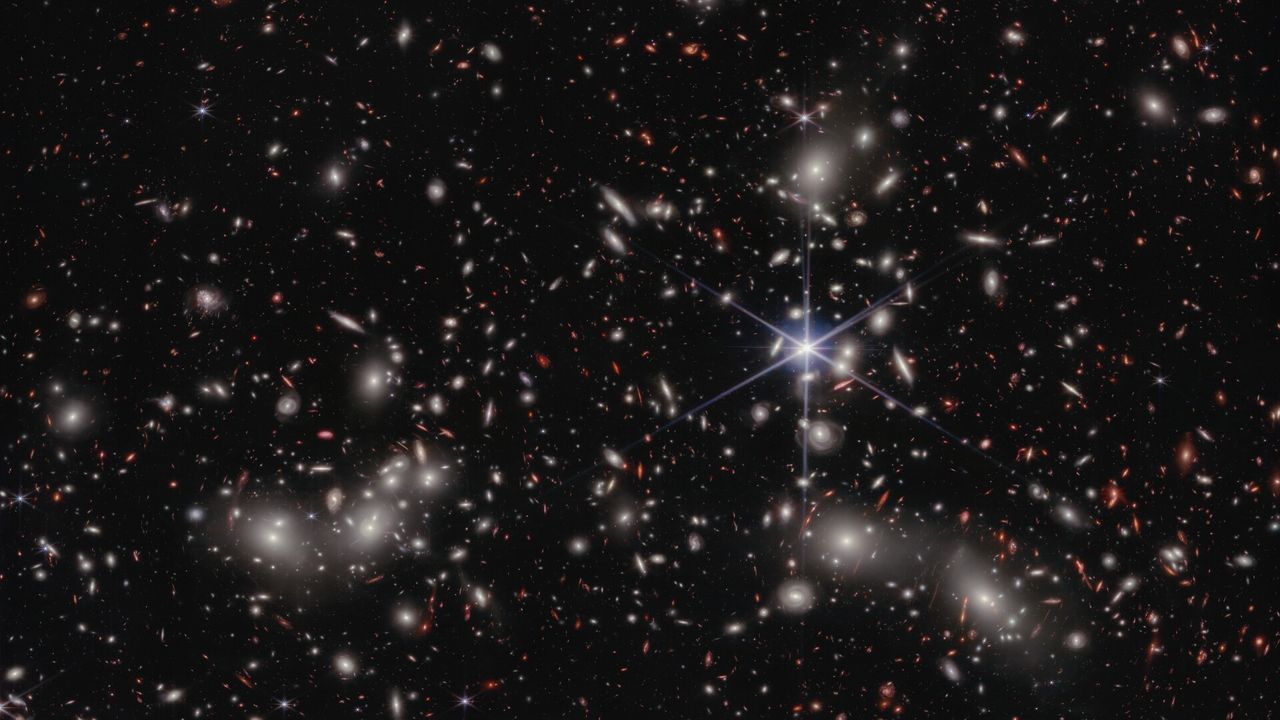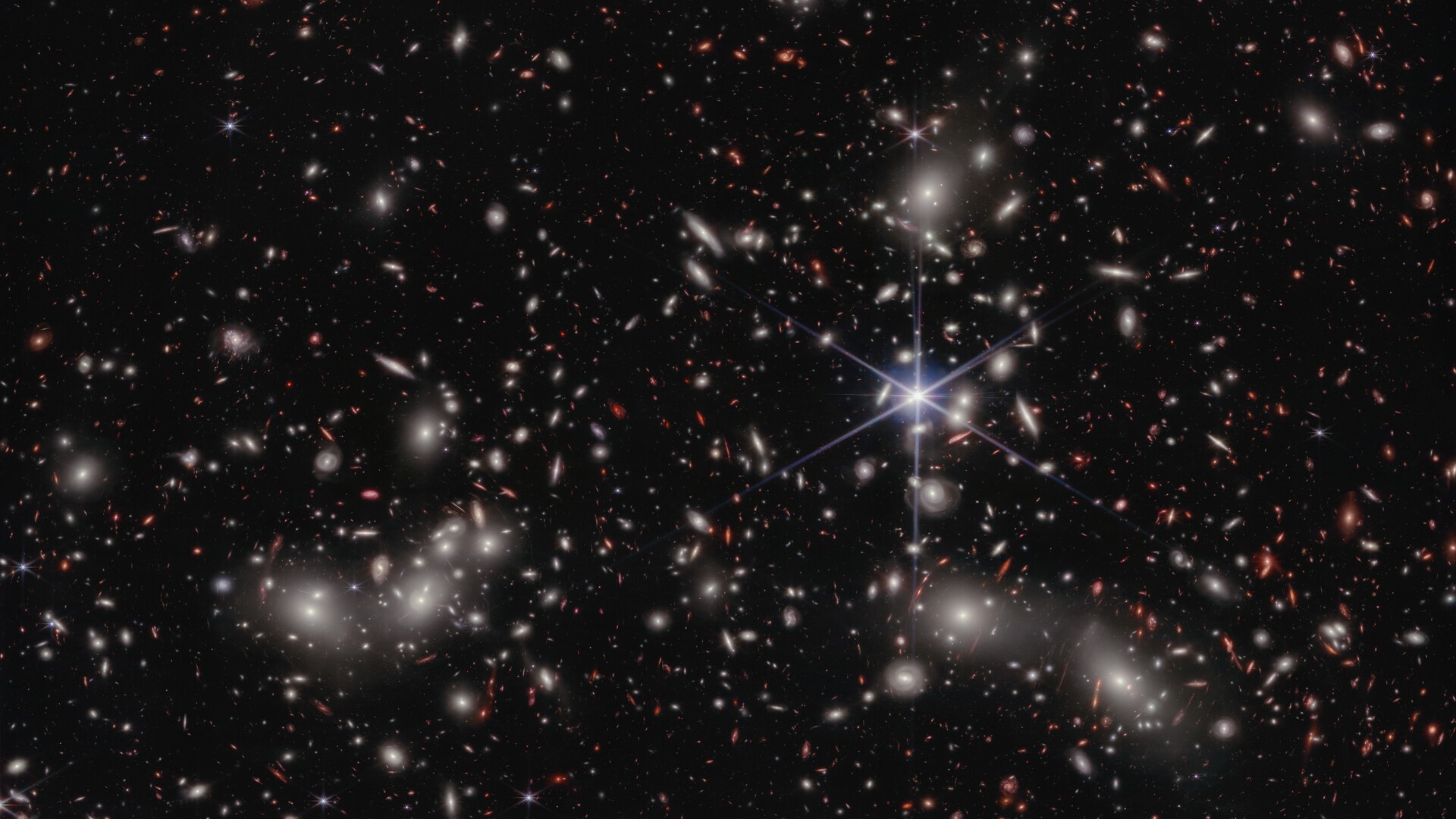
The galaxy cluster Abell 2744, imaged here by the James Webb Space Telescope, magnifies the light of some of the most distant galaxies and black holes in the known universe. New research uncovers the secrets of one such black hole. (Image credit: NASA, ESA, CSA, I. Labbe (Swinburne University of Technology), R. Bezanson (University of Pittsburgh), A. Pagan (STScI)
Share this article Join the conversation
Follow us Add us as a preferred source on Google Newsletter Subscribe to our newsletter
Astronomers have found the most extreme example yet of a black hole outweighing its own galaxy, and it may be hiding clues to how the supermassive black holes seen today formed in the early universe.
In a new study, astronomers directly measured the mass of a black hole sitting in a "little red dot" seen when the universe was just 700 million years old. The results suggest that the black hole is much too massive for its host galaxy — meaning it may have formed before the galaxy itself had a chance to develop.
Little red dots (LRDs) are a mysterious class of objects detected in the early universe. The LRD in question, Abell2744-QSO1 (or just "QSO1"), was discovered in James Webb Space Telescope (JWST) images in 2023. It was compact and strongly lensed — appearing three times in the image as its light was warped by powerful gravitational effects — and showed telltale signs of an actively feeding black hole at its center. Indirect estimates of the black hole's mass, based on the spectral properties, relied on assumptions calibrated in the local universe and have been heavily debated. Some researchers argue that little red dots are so puzzling that standard assumptions from the local universe cannot explain them, and that exotic phenomena may be at play.
In the new study, published May 27 in the journal Nature, astronomers took a more direct approach and mapped how fast gas rotates at different distances from the center to estimate the black hole's mass. The findings suggest that the methods astronomers use to study black holes in the nearby universe may work just as well for these little red dots.
"This measurement is the first of its type in a Little Red Dot, at least for now," Ignas Juodžbalis, a doctoral candidate at the Kavli Institute for Cosmology at the University of Cambridge and first author of the study, told Live Science in an email.
When the "stars" aligned
Earlier indirect estimates had placed black hole QSO1’s mass at around 40 million solar masses — remarkably high for such a compact, young system. The larger and more isolated the black hole is relative to its surroundings, the bigger its sphere of influence — the region where its gravity dominates over the stars, gas and dark matter around it. A high-mass black hole, therefore, makes it easier to detect its gravitational influence in the motions of nearby gas.
Adding to this, the galaxy cluster Abell 2744 — located between us and QSO1 — is so massive that its gravity acts as a magnifying glass. Through this effect, known as gravitational lensing, astronomers can see QSO1 brightening by a factor of six and stretching it spatially by a factor of 3.5.
Sign up for the Live Science daily newsletter now
Get the world’s most fascinating discoveries delivered straight to your inbox.
Contact me with news and offers from other Future brandsReceive email from us on behalf of our trusted partners or sponsors
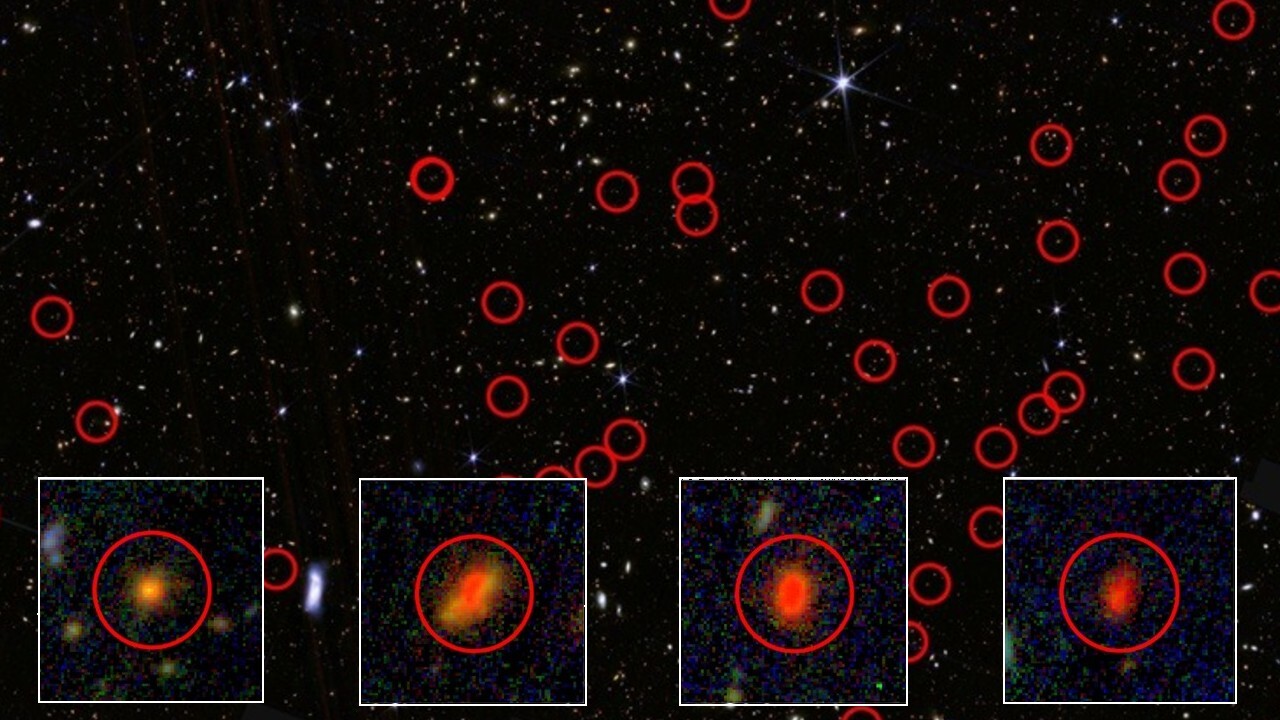
The James Webb Space Telescope has detected dozens of peculiar ‘little red dots’ in the early universe. The new study hints that some of them may be ancient black holes that took shape even before galaxies formed around them.
(Image credit: Bangzheng "Tom" Sun)
Overall, these conditions were favorable to make the kind of measurement the researchers were aiming for.
The measurement technique relied on the principle that gas orbiting a black hole moves faster the closer it gets to it. By mapping how fast gas moves at different distances from the center of QSO1, the team could work backward to calculate the mass of whatever sat at the center.
The team used JWST's Near-Infrared Spectrograph to extract maps of hydrogen emission line gas, tracking which parts of QSO1 were moving toward us and which were moving away. But the object was so small and distant that the rotation signal in the inner regions fell below what JWST could directly resolve.
So they used spectroastrometry, a technique that measures tiny positional shifts in the light emitted by glowing gas across different wavelengths. This method can recover spatial information far below the telescope's nominal resolution. "This way, we were able to reconstruct the rotation curve below the instrumental resolution of JWST," Juodžbalis explained.
Not too exotic
The results were then fitted with different mass models. A point mass, where all the mass is concentrated at a single location as in a black hole, fit the data well, while a compact yet extended mass distribution, such as a tightly packed cluster of stars matched it poorly. As an independent check, co-author Cosimo Marconcini, a doctoral candidate in astronomy and physics at the University of Florence, ran the full dataset through a 3D framework he developed that models both the movement of the gas and instrumental effects of the telescope, and arrived at the same result. Juodžbalis said the independent confirmation was what gave the result its weight.
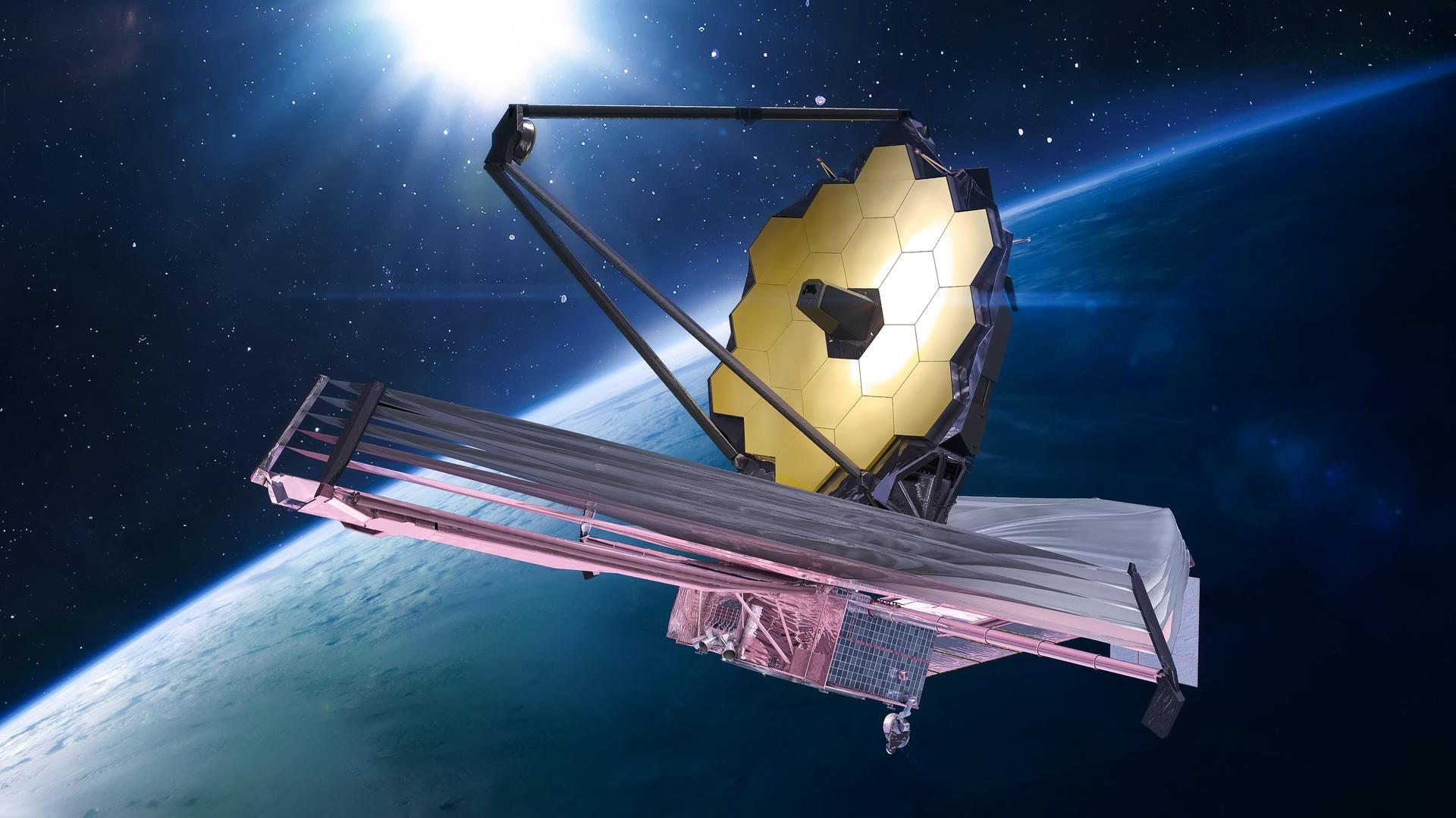
The James Webb Space Telescope’s infrared instruments can see farther and fainter light sources than any observatory in history.
(Image credit: NASA)
Analysis showed that the observations are best explained by a a black hole of around 50 million solar masses. The team is "reasonably confident" that this is indeed a black hole rather than other alternatives. If you were to try to explain their results with a star cluster with a solid edge, Juodžbalis said, it would be far more exotic and difficult to justify than a black hole.
Interestingly, the new measurement lined up closely with the earlier indirect estimate. Juodžbalis cautioned that a single object does not represent an entire population. However, the result suggests the standard indirect black hole mass measurements developed for the local universe may work for little red dots, too. "There may be no need to invoke anything too exotic to explain the properties of Little Red Dots," he said.
"Naked" black hole
The team placed an upper limit on the mass of the stars in the host galaxy at around 20 million solar masses. This means the black hole significantly outweighs its entire host galaxy. Astronomers call such objects "naked" black holes, and QSO1 appears to be the most massive of this kind ever found.
With its massive black hole and its near-absent host galaxy, QSO1 appears to be a massive black hole seed caught in the very first stages of growth, before its galaxy had a chance to develop around it. This finding challenges the standard picture in which black holes grow together with their galaxy over billions of years.
Related stories
The team considered two exotic origin scenarios for this black hole: direct collapse black holes, which form when massive clouds of pristine gas collapse straight into a black hole without forming stars first, and primordial black holes, which would have formed in the first second after the Big Bang.
"Both scenarios are exotic, and the current data and theory are not quite able to distinguish them," Juodžbalis said.
The team plans to use upcoming ground-based observations to probe the black holes within similar objects that have been found in the local universe.
Article Sources
Juodžbalis, I., Marconcini, C., D’Eugenio, F. et al. A direct black-hole mass measurement in a little red dot at high redshift. Nature 653, 1017–1021 (2026). https://doi.org/10.1038/s41586-026-10579-4
See how much you know about black holes with our black hole quiz!
TOPICS
 Shreejaya Karantha
Live Science contributor
Shreejaya Karantha is a science writer specializing in astronomy, covering topics such as the sun, planetary science, stellar evolution, black holes, and early universe cosmology. Based in India, she works as a writer and research specialist at The Secrets of the Universe, where she contributes to scripts for research-based and explainer videos. Shreejaya holds a bachelor's degree in science and a master's degree in physics with a specialization in astrophysics.
View More
You must confirm your public display name before commenting
Please logout and then login again, you will then be prompted to enter your display name.
Logout