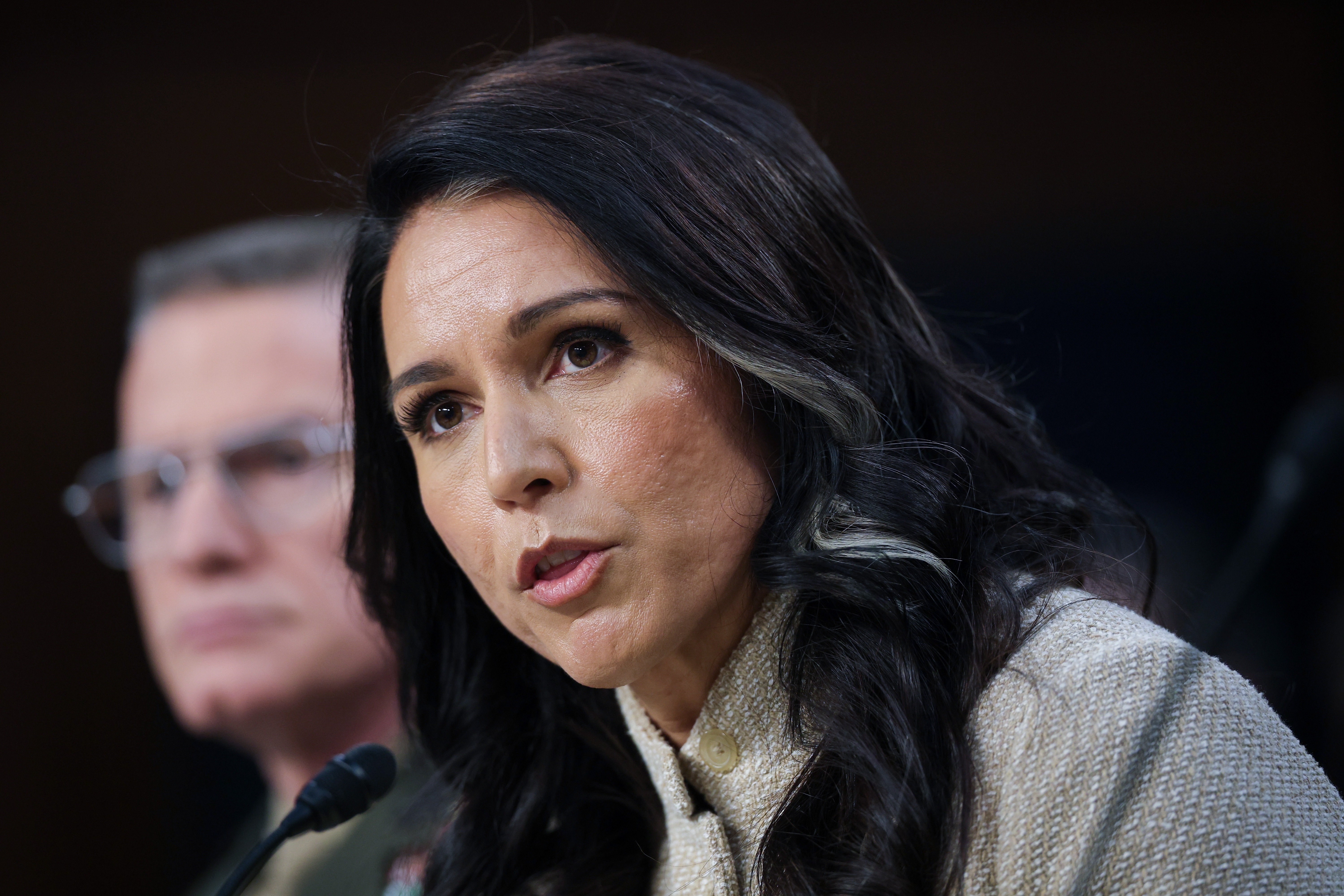


Director of National Intelligence Tulsi Gabbard testifies during a Senate Intelligence Committee hearing on worldwide threats on March 18. A closed session immediately followed the hearing. Kevin Dietsch/Getty Images hide caption
toggle caption Kevin Dietsch/Getty ImagesDuring the Senate Select Committee's annual worldwide threat assessment hearing on Wednesday, Director of National Intelligence Tulsi Gabbard described how tactics of foreign Islamist terrorist groups have shifted since the peak of ISIS and al-Qaida activity a decade ago.
"Increasingly we are seeing less indicators of large-scale organized, complex threats or attacks," Gabbard said, "and instead [have seen] efforts focused on individuals either who have been radicalized by Islamist propaganda and may not have ever had contact with ISIS or al-Qaida, for example; and others who have had contact, of which we are able to have more indications of."
But Gabbard's remarks largely skirted a question that has arisen in the wake of several violent incidents on American soil this month: Has U.S. involvement in fighting in Iran increased potential threat from those very entities?
Two of the incidents, an attempted attack on anti-Muslim protesters outside the New York City mayor's mansion, and an attack that killed one student at Old Dominion University in Norfolk, Va., are being investigated by the FBI as acts of terrorism. A third, at a synagogue in a Detroit suburb, has been labeled an act of targeted violence.

National
The FBI says it's taking over the Michigan synagogue attack investigation
"We have seen the calls for violence coming from Iran, coming from its proxies. We have seen the calls for violence coming from other designated terrorist organizations, from the so-called Islamic State to al-Qaida and others," said Michael Masters, national director and CEO of the Secure Community Network, which monitors threats and provides security training to the Jewish community across North America. "We know that people are working to answer that call and that they are answering it at a quicker pace."
While the U.S.-Israeli offensive against Iran may not directly tie to motives behind each of the recent instances, Masters said it has clearly provided a narrative opening that foreign terrorist entities are exploiting. He and other experts say that this, combined with tech companies' retreat from content moderation over the last year, have created dangerous conditions for violent extremists to amplify their message and increase their reach.
"The loss of content moderation is a significant concern across the ideological spectrum," said William Braniff, executive director of the Polarization and Extremism Research and Innovation Lab (PERIL) at American University. "The internet is becoming a more and more dangerous place, and AI is accelerating that trend as resources are being pulled back from not just content, moderation, but all the different ways one can make a platform a safer place."

Middle East conflict
In a small Lebanese town, grief and fear follow the Michigan synagogue attack
An Israeli strike in Lebanon, then an attack at a Detroit-area synagogue
Investigators have not said what may have motivated a naturalized Lebanese-American citizen to fire a weapon, then crash a vehicle into a synagogue in West Bloomfield, Mich., on Thursday. According to the FBI, the suspect, 41-year old Ayman Mohamad Ghazali, died by suicide at the scene. But Ghazali had recently lost family members in his hometown of Mashghara, Lebanon. According to Iskandar Barakeh, the mayor of Mashghara, two of Ghazali's brothers, and a niece and a nephew, died in an Israeli air strike earlier this month. His parents and sisters-in-law also were hospitalized with injuries.
According to the Israel Defense Forces, one of Ghazali's brothers was a Hezbollah commander. Hezbollah is an Iranian-backed militia group and political organization in Lebanon, which has been designated a terrorist organization by the United States.
The synagogue attack has accentuated a continual escalation in threat toward American Jews over recent years. Last year, two Israeli embassy staffers were killed outside the Capitol Jewish Museum in Washington, D.C., by a man who allegedly said he "did it for Gaza." Also last year, an Egyptian national firebombed a group in Boulder, Colo., that was holding a vigil for Israeli hostages who had been taken by Hamas on Oct. 7, 2023. But Masters said the start of the conflict in Iran marked an unprecedented rise in antisemitic threats on social media.
"On an average week we're looking at somewhere around 3,000 violent posts directed towards the Jewish community," he said. "Since the conflict began, we've seen a 95% increase in those numbers."
But others note that the climate of intolerance and hatred toward Jews in the U.S. has been building for the better part of the past decade.
"This is not new since Oct. 7, 2023. This has been going on now for years in our community," said Eric Fingerhut, president and CEO of the Jewish Federations of North America. "Go back to Oct. 27th, 2018, when you had the most violent attack on Jews in the history of the United States of America, in Pittsburgh."
The 2018 attack at the Tree of Life synagogue in Pittsburgh killed 11 worshipers. It was carried out by a man whose social media posts indicated hostility toward immigrants and belief in the far right, antisemitic "Great Replacement" conspiracy theory.
Fingerhut said regardless of whether the violence is committed by someone inspired by homegrown white nationalism, by foreign terrorist groups or by overseas conflicts, the impact on the Jewish community is the same.
"We have now built a full-time professional security program in every single community, every synagogue and event that we have to have physical security at," he said. "Our community is spending over … $760 million a year on security. That's money not being spent on schools and camps and caring for the needy and the hungry and the seniors."
A pivot and an opening for ISIS recruitment
In 2025, there were seven ISIS-inspired plots and attacks in the U.S., according to research from the Institute for Strategic Dialogue, a research organization that studies extremism, disinformation and online threats. The number is roughly the same as it was in the prior year, according to Matthew Ivanovich, senior research manager at the ISD, and accounts for a small proportion of overall domestic violent extremist activity in this country.


