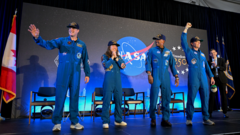
The four astronauts of Artemis II say their mission gave the world a sense of hope and unity at a time when both feel in short supply.
At their first Nasa news conference since returning last Friday, Reid Wiseman, Victor Glover, Christina Koch and Jeremy Hansen said they left as friends and came back as something closer - bound by an experience that no earthly language can fully contain.
More than the technical milestones, the mission reminded them of what being human actually means: laughter, joy, tears, and an instinct toward one another that transcends borders.
And their message was clear: Landing on the Moon is not the distant dream it once seemed.
"We wanted to go out and try to do something that would bring the world together, to unite the world," Wiseman told reporters at Nasa's Johnson Space Center in Houston.
"We were certainly hooked on this mission, but when we came home, we were shocked at the global outpouring of support, of pride, of ownership of this mission... we want to thank the world. Thank you for tuning in."
He singled out the Orion spacecraft - named Integrity - and the Space Launch System as a symbol of what international partnership can still produce.
"Thank you to every single person that had a hand in building that machine," he said, "because it was a magnificent machine."

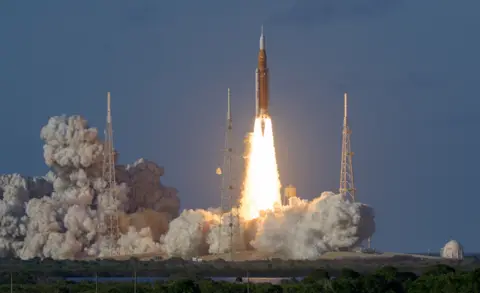 NASA/Bill IngallsNASA's Space Launch System rocket carries the Artemis II crew into orbit and then toward the Moon
Artemis II carried its crew further from Earth than any humans have ever gone, swinging around the far side of the Moon in just over nine days. Victor Glover became the first black astronaut to reach deep space; Christina Koch the first woman; Jeremy Hansen the first Canadian.
For Koch, the scale of what they had done only became clear through others' eyes when her husband told her on a video call that the mission had cut through divisions and united people. She found herself undone.
"When my husband looked me in the eye on that video call and said, 'No, really, you've made a difference'," she told reporters, "it brought tears to my eyes, and I said, that's all we ever wanted."
Glover talked about it being an experience shared by the entire world.
"I think something that we all feel and we try to share is how much we want to reflect back to you all how we did this, not we as a crew, we as countries and as humans did this," he said.
Thinking about that, he said, brought to mind "the picture of the Earth as we started to go farther" as they traveled close to the moon and how they talked about "looking at you and how beautiful Earth is".
Hansen found that returning to Earth had deepened his faith in people.
"We don't always do great things. We're not always in our integrity, but our default is to be good and to be good to one another," he said. "What I've seen has brought me more joy, but more hope for our future."
Some experiences cannot be processed through rational thought. Wiseman described the moment the Sun passed behind the Moon - an eclipse seen from 250,000 miles away - as something that overwhelmed the capacity of the human mind.
Back on the recovery ship, he sought out the chaplain, needing a way to express what he had experienced that science had not given him.
"I'm not really a religious person," he said, "but there was just no other avenue for me to explain anything or to experience anything. So I asked for the chaplain on the Navy ship... and I broke down in tears.
"I don't think humanity has evolved to the point of being able to comprehend what we're looking at right now, because it was otherworldly."
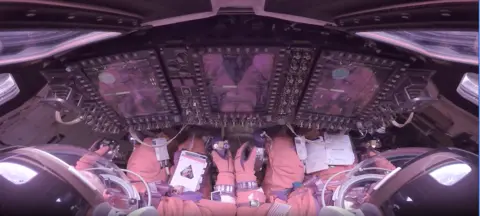 NASATwo Artemis II astronauts in orange pressure suits sit at the controls inside the Orion crew module
Beyond the emotional weight, there was sheer visual wonder. Hansen found himself transfixed by the depth of space, as though seeing it for the first time. "We just saw so many amazing things," he said. "I kept seeing this depth to the galaxy that I just had never experienced before."
He described feeling "infinitesimally small, but yet this very powerful feeling as a human being, like as a group."
As the news conference wore on, the room filled with laughter. Koch described being so conditioned by weightlessness that back on Earth she had dropped a shirt expecting it to float - and was startled when it fell.
"I put a shirt in the air and it went - it actually surprised me," she said.
Not everything ran smoothly. The crew were candid about a persistent blockage in the toilet's primary vent line, saying it got "clogged up".
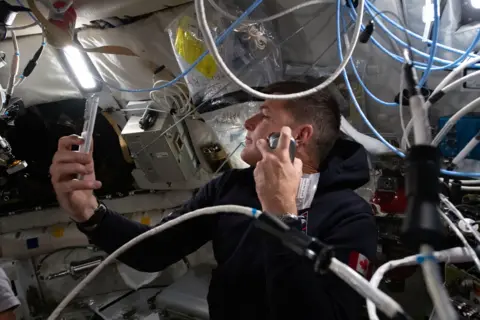 NASAShaving in space: Jeremy Hansen maintaining a clean cut look as he makes history looping the Moon
The Orion capsule, though, impressed its crew profoundly. And Wiseman, reflecting on how close they had come to the lunar surface, made a remark that will resonate in every Nasa planning room.
"If we had a first flight lander on board that thing," he said, "I know at least three of my crewmates would have been in it, trying to land on the Moon."
He chose his next words carefully, perhaps leaving out the word "giant" as a nod to the first words spoken on the lunar surface.
"It is not the leap I thought it was," he said. "Once we're around the Moon, in the vacuum of space, we've got a vehicle that's handling great. If you had given us two keys to the lander, we would have taken it down and landed on that Moon."
Time and again, the missions that matter most put a human face on the cosmos, allowing those watching from Earth to feel they too were along for the ride. Artemis II did that, through four people willing to cry in public, laugh about kicking each other in their sleep, and say that what they found out there was hope.
President John F Kennedy said America chose to go to the Moon "not because it was easy but because it was hard". This crew fits right in with the Apollo heritage.
"All of the what-ifs," said Koch, "all of the just coming up with every possible operational workaround for anything you might encounter - accomplishing the near impossible is exactly what we do, and what we just showed that we can do."
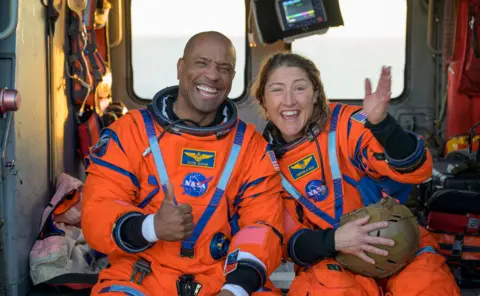 NASA/Bill IngallsVictor Glover and Christina Koch; the first black man and woman to travel to the MoonArtemisScience & EnvironmentNasaHuman spaceflightThe MoonSpace exploration


