Breaking space news, the latest updates on rocket launches, skywatching events and more!
Contact me with news and offers from other Future brands Receive email from us on behalf of our trusted partners or sponsors By submitting your information you agree to the Terms & Conditions and Privacy Policy and are aged 16 or over.You are now subscribed
Your newsletter sign-up was successful
Want to add more newsletters?
An account already exists for this email address, please log in. Subscribe to our newsletter Earth shines above the lunar crescent in the viewport of the Artemis 2 Orion spacecraft. (Image credit: NASA)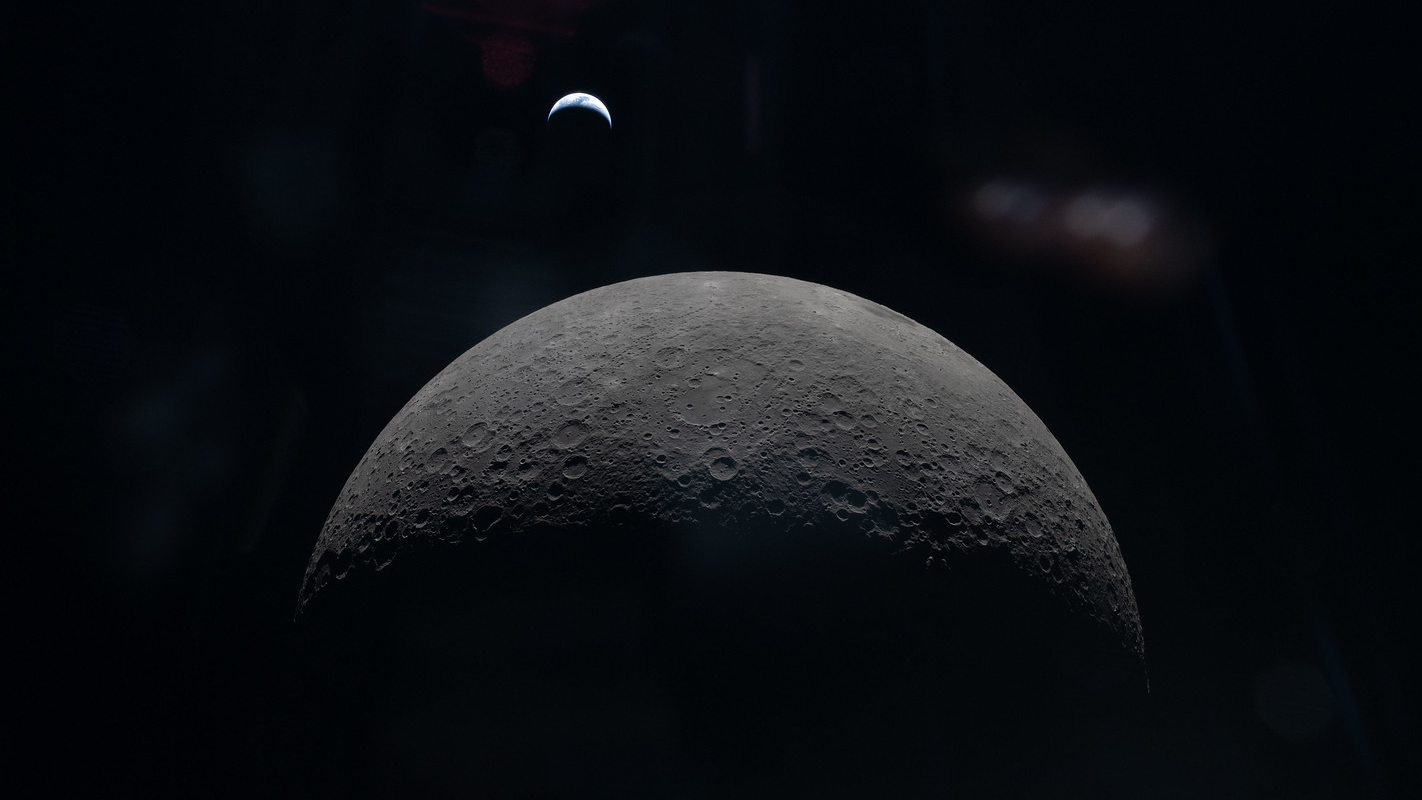
The Artemis 2 crew captured a spellbinding photo of the crescent Earth shining above the moon's horizon on Flight Day 6 of their mission, shortly before our planet was lost behind the lunar horizon.
What is it?
White clouds can be seen swirling on Earth's sunlit arc above the line separating night from day while the cratered expanse of the lunar disk stretches out below. The 590-mile-wide (950-kilometer-wide) Orientale basin can be seen darkening the upper right of the lunar crescent, while prominent features such as the Chebyshev, Vavilov and Hertzsprung impact sites dominate the shadowed lunar far side in the lower half of the image.
An annotated view of the moon's far side captured by the crew of Artemis 2, labelled with the locations of prominent impact craters. (Image credit: NASA, annotations made by Anthony Wood in Canva)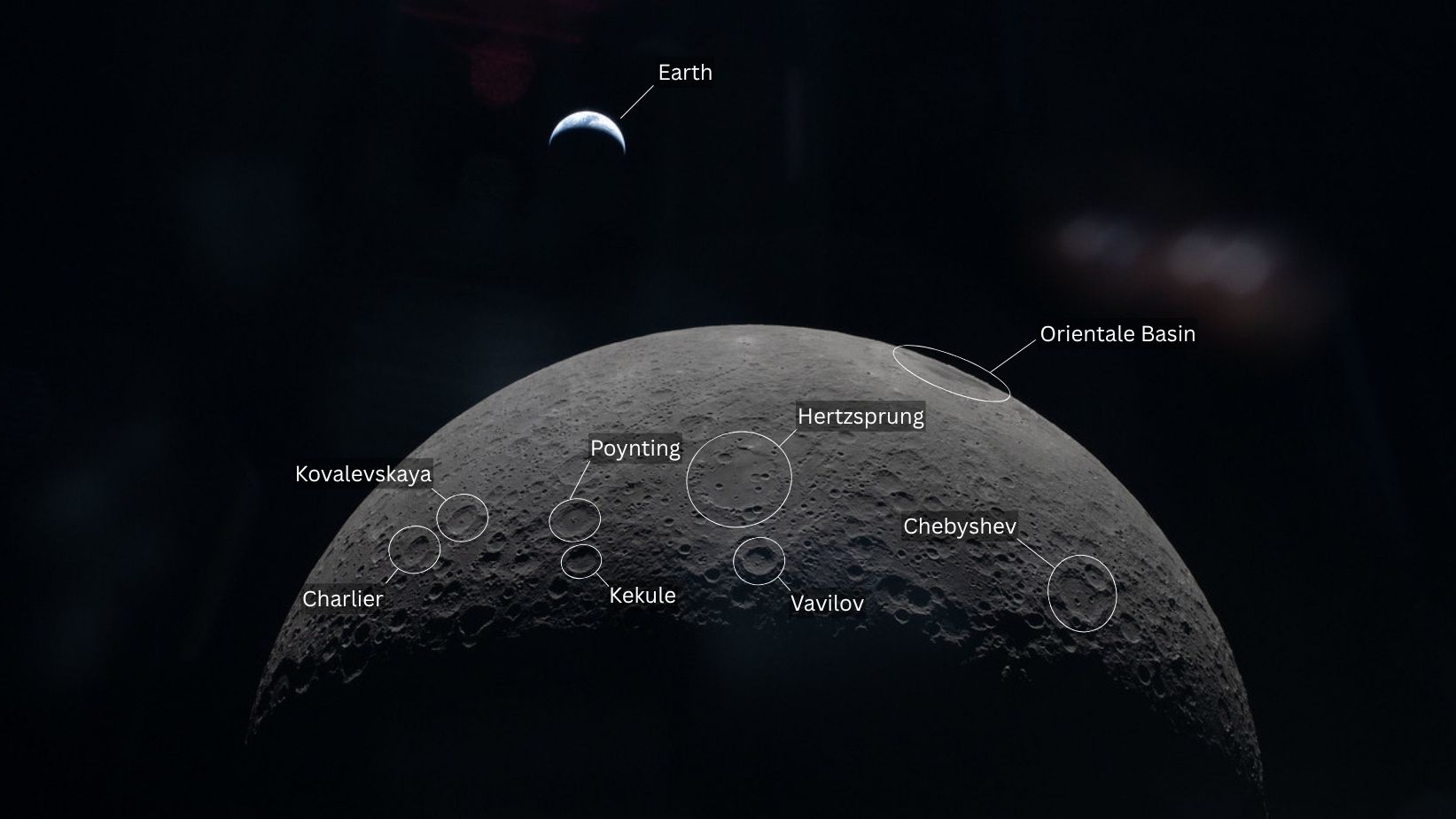
The photo was captured on Monday (April 6), as Artemis 2's Reid Wiseman, Victor Glover, Christina Koch and Jeremy Hansen executed their successful flyby of the lunar far side. The mission marked the first time astronauts had visited lunar space since Apollo 17 departed in 1972. Artemis 2 also set a new record for the most distant crewed mission in the history of spaceflight, surpassing the previous record set by the crew of Apollo 13 in April 1970.
Article continues belowWhy is it incredible?
Every human being that has ever lived is contained within the scope of this single image, with the exception of the four crewmembers of the Artemis 2 Orion capsule "Integrity".
Prior to Artemis 2, only 24 people — the astronauts of Apollo 8 through Apollo 17 — have had the privilege of seeing the far side of the moon with their own eyes. That number has now risen to 28, with NASA's Christina Koch making history by becoming the first woman to join the ranks, while Victor Glover became the first Black man to perform the feat.
Artemis 2's Orion spacecraft is now racing towards Earth on a return journey that will see the four-person crew splash down off the coast of San Diego at 8:07 p.m. EDT on April 10 (0007 GMT on April 11), and you can watch it unfold live right here at Space.com.
Be sure to stay up to date with all the latest news with our Artemis 2 liveblog and discover the answers to all your Artemis program questions with our in-depth explainer article!
Get the Space.com NewsletterContact me with news and offers from other Future brandsReceive email from us on behalf of our trusted partners or sponsors Anthony WoodSkywatching Writer
Anthony Wood joined Space.com in April 2025 after contributing articles to outlets including IGN, New Atlas and Gizmodo. He has a passion for the night sky, science, Hideo Kojima, and human space exploration, and can’t wait for the day when astronauts once again set foot on the moon.
View MoreYou must confirm your public display name before commenting
Please logout and then login again, you will then be prompted to enter your display name.
Logout MORE FROM SPACE... 1Ripples in spacetime may have revealed 1st evidence of tiny black holes born in the Big Bang
- 2Watch NASA's Artemis 2 astronauts return to Earth live online today (April 10)
- 3Where will NASA's Artemis 2 moon mission land today?
- 4What time is NASA's Artemis 2 moon mission landing today? Full schedule
- 5Artemis 2 moon astronauts splash down today — What to expect at each stage of reentry & landing (timeline)