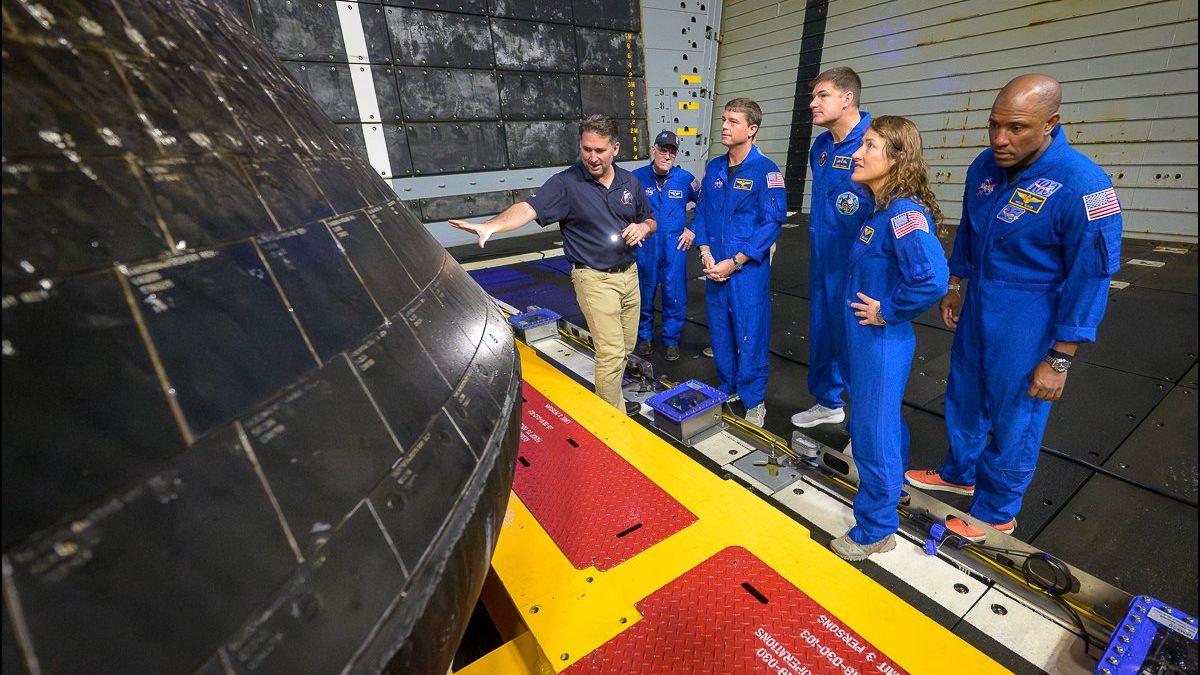
 The four Artemis 2 astronauts (at right) inspect their Orion capsule “Integrity” in the well deck of the USS John P. Murtha on April 11, 2026, in the Pacific Ocean off the coast of California. Integrity splashed down a day earlier, ending the 10-day Artemis 2 moon mission. (Image credit: NASA/Bill Ingalls) Share this article 0 Join the conversation Follow us Add us as a preferred source on Google Newsletter Get the Space.com Newsletter
 Breaking space news, the latest updates on rocket launches, skywatching events and more!
Contact me with news and offers from other Future brands Receive email from us on behalf of our trusted partners or sponsors By submitting your information you agree to the Terms & Conditions and Privacy Policy and are aged 16 or over.You are now subscribed
Your newsletter sign-up was successful
Want to add more newsletters?
An account already exists for this email address, please log in. Subscribe to our newsletterArtemis 2's return to Earth went a lot more smoothly than some folks had feared.
The heat shield on Artemis 2's Orion capsule, which the crew named "Integrity," was the topic of considerable discussion in the lead-up to the mission's April 10 splashdown — for several years before that, in fact.
And it wasn't just because moon missions come back to Earth at blistering speeds and experience blistering temperatures — in the neighborhood of 5,000 degrees Fahrenheit (2,800 degrees Celsius) — when they hit our planet's atmosphere. There was also some disconcerting history to consider.
That history concerns Artemis 1, which sent an uncrewed Orion to lunar orbit and back to Earth in late 2022. The mission was a success, but Orion's 16.5-foot-wide (5 meters) heat shield — the largest of its kind ever flown — suffered more damage than expected during its return trip through Earth's atmosphere.
After a great deal of analysis and discussion, NASA decided to stick with the same heat shield design for Artemis 2, a decision that drew objections from some in the spaceflight community. The agency did tweak the mission's reentry trajectory, however, bringing Integrity into the atmosphere at a steeper angle so that it spent less time in the extreme temperature regimes that scarred Artemis 1's Orion so markedly.
Closeup views of Orion's heat shield after Artemis 1 in late 2022. (Image credit: NASA Office of Inspector General)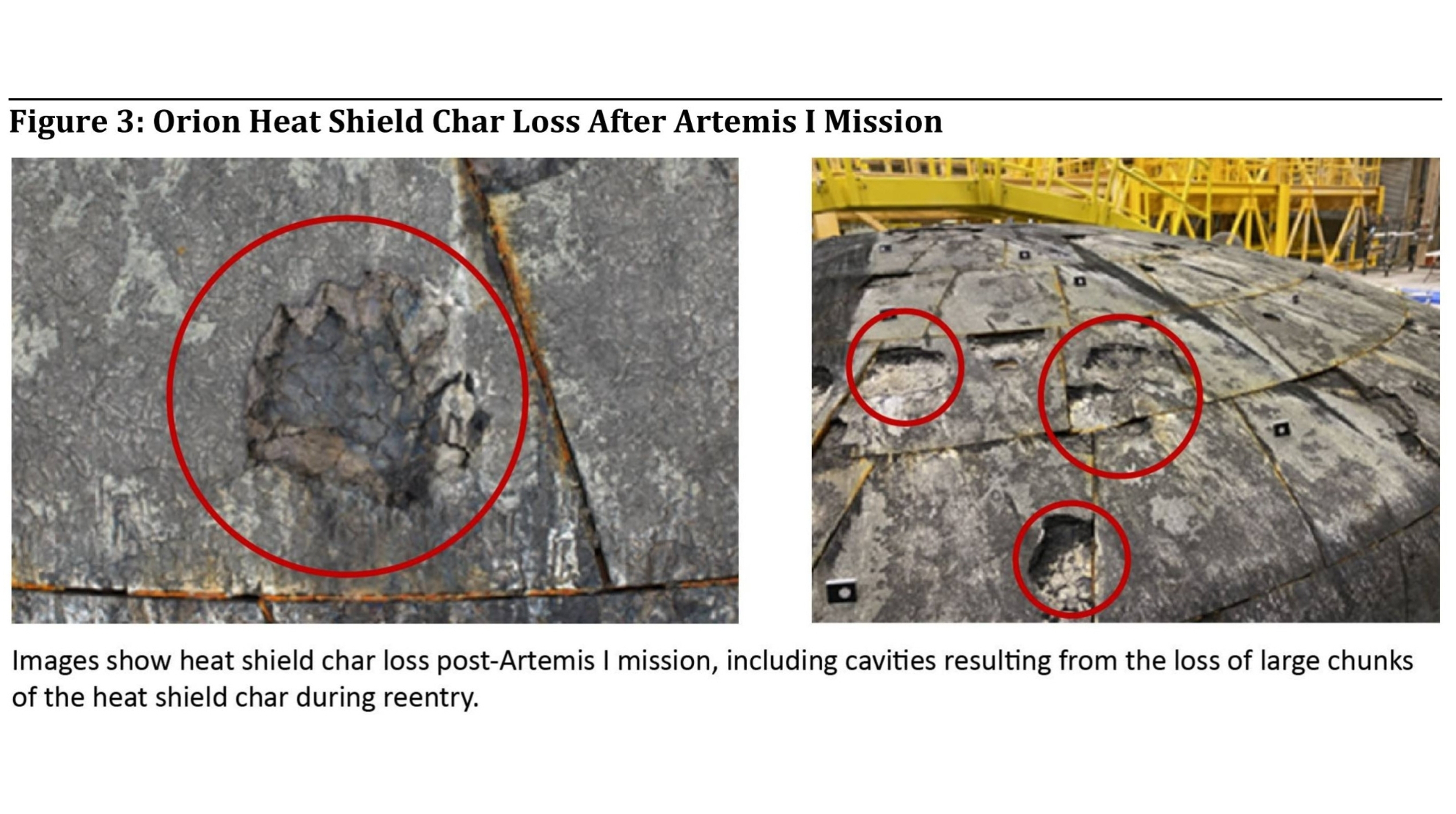
This adjustment apparently did the trick, for Integrity's heat shield survived its trial by fire in good shape, according to Artemis 2 commander Reid Wiseman.
He and his crewmates — NASA astronauts Victor Glover and Christina Koch and the Canadian Space Agency's Jeremy Hansen — inspected Integrity shortly after the capsule's April 10 splashdown. And the vehicle passed that eye test, according to Wiseman.
Get the Space.com NewsletterContact me with news and offers from other Future brandsReceive email from us on behalf of our trusted partners or sponsors"Certainly when we went up to the vehicle, there was a little bit of char loss on what's called the shoulder, which is kind of where the heat shield meets the structure of the cone shape of the spacecraft," he said.
"But the bottom — we leaned under and looked at the bottom of that thing, and for four humans just looking at the heat shield, it looked wonderful to us," Wiseman added. "It looked great."
"The ride back down to Earth was really amazing," he said. "It was a very smooth ride."
Wiseman's observations are quite preliminary, of course; NASA will doubtless have a lot more to say about the heat shield and its performance in the coming weeks and months.
And Artemis 2 was the swan song for this particular heat shield design; NASA has said it will change things up on future Artemis missions.
The next one up likely won't experience conditions as extreme as those Artemis 1 and Artemis 2 dealt with. Artemis 3 will stay in Earth orbit, testing docking procedures using Orion and one or both of the Artemis program's privately developed lunar landers (SpaceX's Starship and Blue Origin's Blue Moon).
But Artemis 4 will go far afield, and come back hot: It will use one of those landers to put boots down near the lunar south pole, then bring them home from the moon aboard Orion.
 Mike WallSpaceflight and Tech Editor
Michael Wall is the Spaceflight and Tech Editor for Space.com and joined the team in 2010. He primarily covers human and robotic spaceflight, military space, and exoplanets, but has been known to dabble in the space art beat. His book about the search for alien life, "Out There," was published on Nov. 13, 2018. Before becoming a science writer, Michael worked as a herpetologist and wildlife biologist. He has a Ph.D. in evolutionary biology from the University of Sydney, Australia, a bachelor's degree from the University of Arizona, and a graduate certificate in science writing from the University of California, Santa Cruz. To find out what his latest project is, you can follow Michael on Twitter.
View MoreYou must confirm your public display name before commenting
Please logout and then login again, you will then be prompted to enter your display name.
Logout MORE FROM SPACE... 1Interstellar invader comet 3I/ATLAS made a startling transformation as it passed the sun
- 2This giant telescope could discover habitable exoplanets and secrets of our universe — if it gets its funding
- 3Landing astronauts on the moon 'is absolutely doable, and it's doable soon,' NASA's Artemis 2 commander says
- 4'That was a wonderful toilet': Artemis 2 commander defends mission's lunar loo
- 5Fantasy RPG 'Crimson Desert' lets you stab your way up to space, showcasing a remarkably detailed cosmos