Breaking space news, the latest updates on rocket launches, skywatching events and more!
Contact me with news and offers from other Future brands Receive email from us on behalf of our trusted partners or sponsors By submitting your information you agree to the Terms & Conditions and Privacy Policy and are aged 16 or over.You are now subscribed
Your newsletter sign-up was successful
Want to add more newsletters?
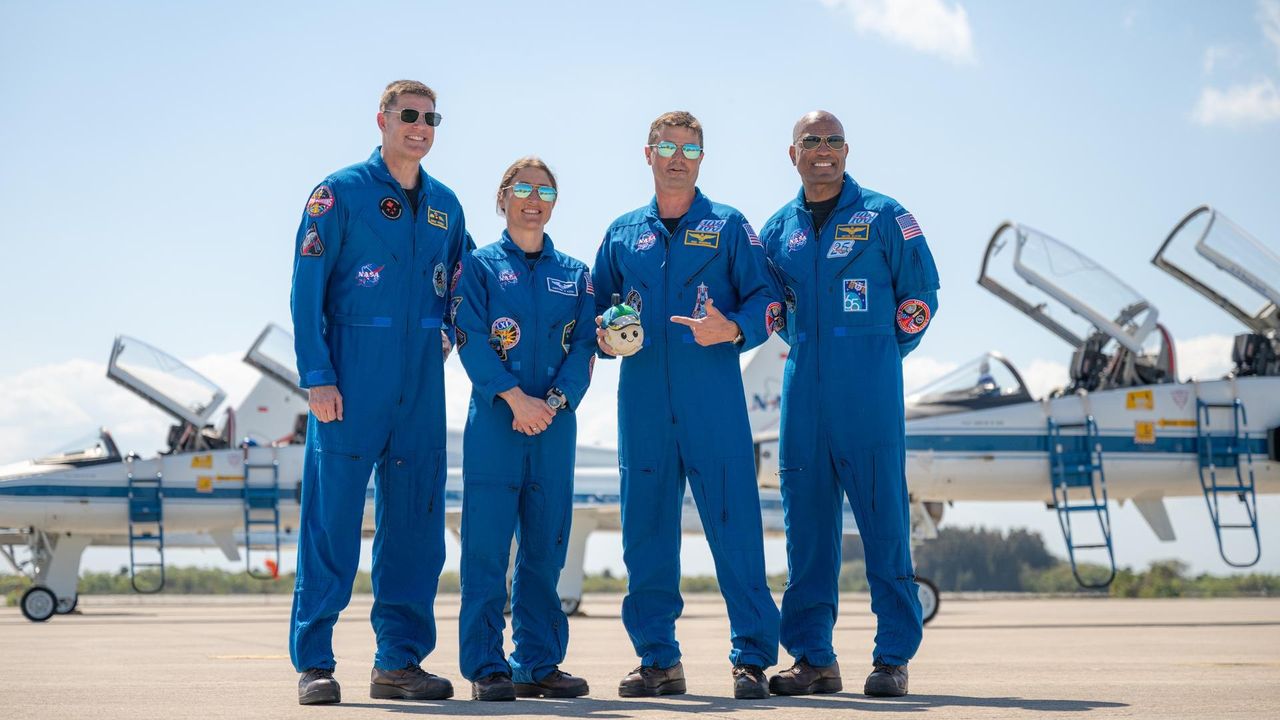
An account already exists for this email address, please log in. Subscribe to our newsletter The Artemis 2 astronauts pose for a photograph alongside their zero gravity indicator on March 27, 2026 after arriving at NASA's Kennedy Space Center in Florida. (Image credit: NASA/John Kraus)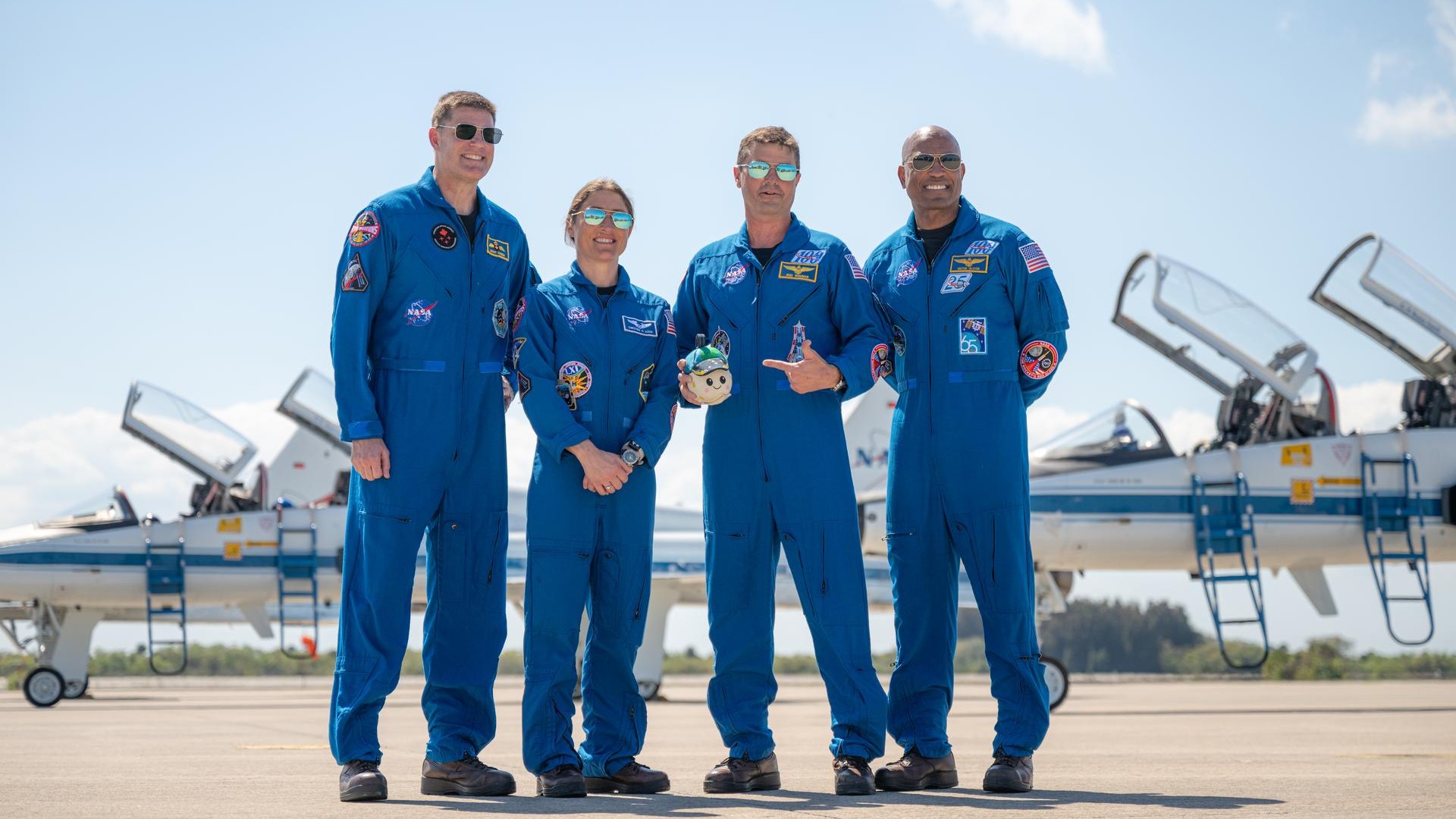
The four astronaut's of NASA's Artemis 2 mission arrived in style ahead of their historic moon mission.
What is it?
NASA astronauts Victor Glover, Christina Koch and Reid Wiseman, and the Canadian Space Agency's Jeremy Hansen landed their T-38 jets at the Launch and Landing Facility at NASA's Kennedy Space Center (KSC) in Florida on Friday (March 27).
The crew of four landed at KSC shortly before unveiling their zero gravity indicator, "Rise." Zero gravity indicators are small stuffed items that accompany crews into space to serve as a visual signal that they've left Earth's gravity as they begin to float around their spacecraft.
Article continues belowRise consists of a smiling moon, wearing a cap decorated to resemble Earth, featuring a brim covered in stars.
Rise was designed by second-grader Lucas Ye of Mountain View, California, and was inspired by the iconic Earthrise moment from the Apollo 8 mission, according to a statement from NASA. The agency opened a call for submissions for the Artemis 2 mission's zero-g indicator last year and received over 2,600 submissions from over 50 countries.
Why is it amazing?

Artemis 2 will be the first crewed mission to lunar space in over 50 years, since the Apollo 17 mission in 1972. The flight will test the Orion spacecraft and see the crew carry out experiments that will help NASA prepare for further Artemis program missions.
The overall goal of the Artemis program is to establish a sustained human presence on the lunar surface, including building permanent moon bases.
Get the Space.com NewsletterContact me with news and offers from other Future brandsReceive email from us on behalf of our trusted partners or sponsorsNASA is currently 'go' to launch Artemis 2 as early as Wednesday, April 1, at 6:24 p.m. EDT (2224 GMT). Follow along with the latest updates on our Artemis 2 mission live blog.
 Brett TingleyManaging Editor, Space.com
Brett is curious about emerging aerospace technologies, alternative launch concepts, military space developments and uncrewed aircraft systems. Brett's work has appeared on Scientific American, The War Zone, Popular Science, the History Channel, Science Discovery and more. Brett has degrees from Clemson University and the University of North Carolina at Charlotte. In his free time, Brett enjoys skywatching throughout the dark skies of the Appalachian mountains.
View MoreYou must confirm your public display name before commenting
Please logout and then login again, you will then be prompted to enter your display name.
Logout MORE FROM SPACE... 1April's full moon decides the date of Easter — here's how it works
 - 2NASA's Artemis 2 pilot Victor Glover listens to 'Whitey on the Moon' every Monday. This is why.
- 3Why won't NASA's Artemis 2 astronauts land on the moon when they get there?
- 4Northern lights could be visible in 16 states tonight March 31 as a speedy CME barrels toward Earth
- 5Huge solar flare no threat to Artemis 2 astronaut launch to the moon, NASA says