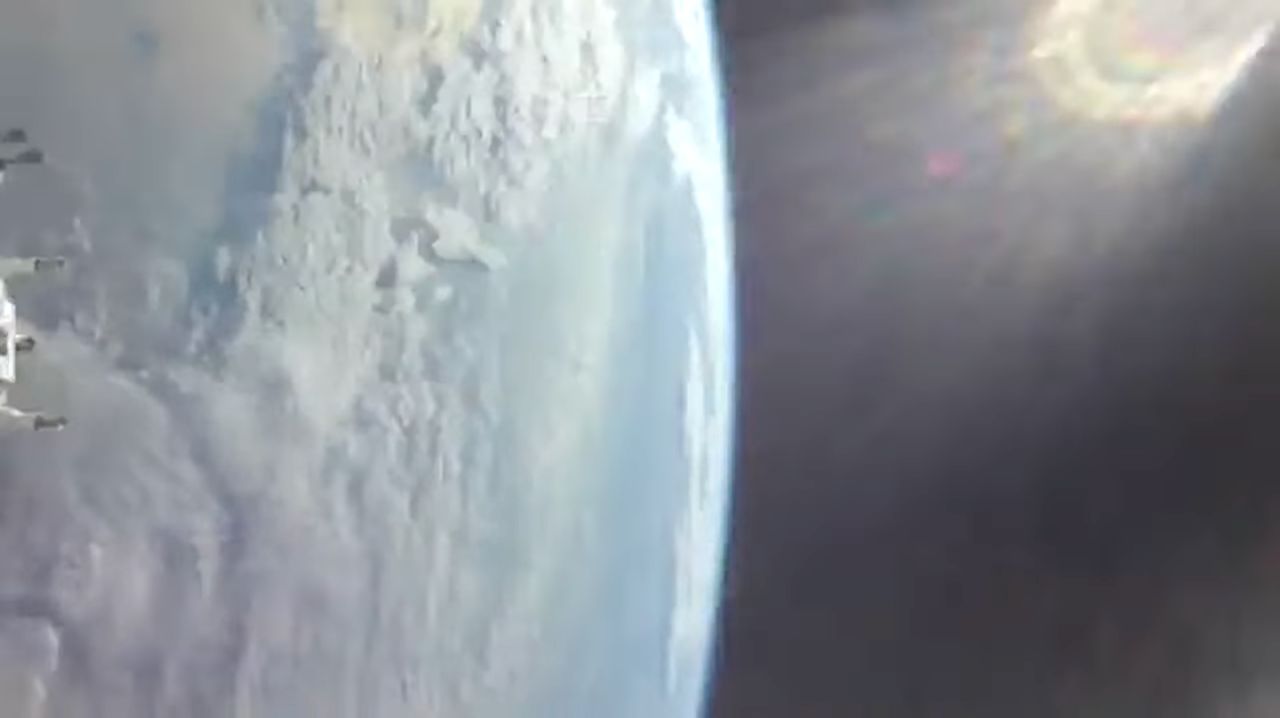
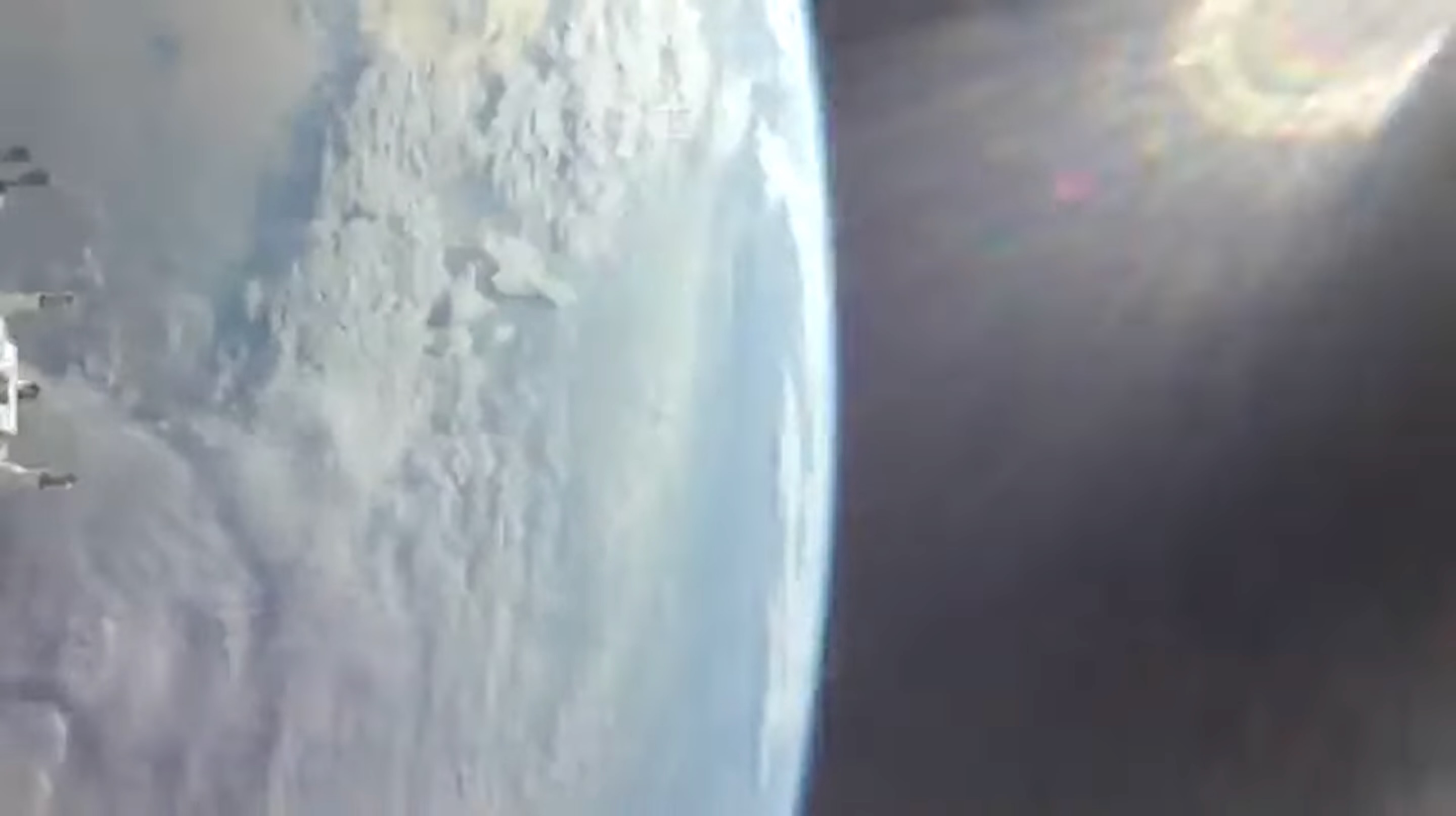
 The view from NASA's Artemis 2 Orion capsule during the mission's crucial translunar injection burn on April 2, 2026. (Image credit: NASA) Share this article 0 Join the conversation Follow us Add us as a preferred source on Google Newsletter Get the Space.com Newsletter
 Breaking space news, the latest updates on rocket launches, skywatching events and more!
Contact me with news and offers from other Future brands Receive email from us on behalf of our trusted partners or sponsors By submitting your information you agree to the Terms & Conditions and Privacy Policy and are aged 16 or over.You are now subscribed
Your newsletter sign-up was successful
Want to add more newsletters?
An account already exists for this email address, please log in. Subscribe to our newsletterArtemis 2 is on its way to the moon.
"With that successful TLI, the crew is feeling pretty good up here on our way to the moon, and we just wanted to communicate to everyone around the planet who's worked to make Artemis possible that we firmly felt the power of your perseverance during every second of that burn," Artemis 2 astronaut Jeremy Hansen, of the Canadian Space Agency, said just after the maneuver.
"Humanity has once again shown what we are capable of, and it's your hopes for the future that carry us now on this journey around the moon," he added.
Artemis 2 launched Wednesday evening (April 1) from NASA's Kennedy Space Center in Florida, sending four astronauts aloft on the first-ever crewed flight of Orion and its Space Launch System (SLS) rocket. The duo had flown together just once before, on the uncrewed Artemis 1 mission to lunar orbit in 2022.
Orion and its occupants — Hansen and NASA's Reid Wiseman, Victor Glover and Christina Koch — stayed in Earth orbit for more than 24 hours, checking out the capsule's various systems ahead of its planned plunge into deep space.
Get the Space.com NewsletterContact me with news and offers from other Future brandsReceive email from us on behalf of our trusted partners or sponsorsThis afternoon, Artemis 2's mission management team declared the spacecraft fit for this giant leap, greenlighting the TLI burn. So, starting at 7:49 p.m. EDT (2349 GMT), Orion fired its main engine for five minutes and 50 seconds, putting it on a trajectory to loop around the moon and then head back to Earth — without the need for any other major maneuvers.
"Our TLI burn, the burn that gets us going to the moon, is also our deorbit burn," Koch said in a NASA interview before launch. "As soon as we take that burn, we have bought off on basically the rest of the mission."
The TLI burn used Orion's main orbital maneuvering engine, which was salvaged from NASA's space shuttle program and upgraded for an Artemis trip to the moon. The engine has flown in space 19 times before on three different space shuttles. If you strapped it to a car, it would accelerate you from zero to 60 mph (97 kph) in 2.7 seconds.
(Orion has three primary methods of propulsion: its main engine and a set of eight smaller auxiliary engines, which are on its European Service Module, and a set of reaction control thrusters on the capsule itself.)
The major milestones of the Artemis 2 moon mission. (Image credit: NASA)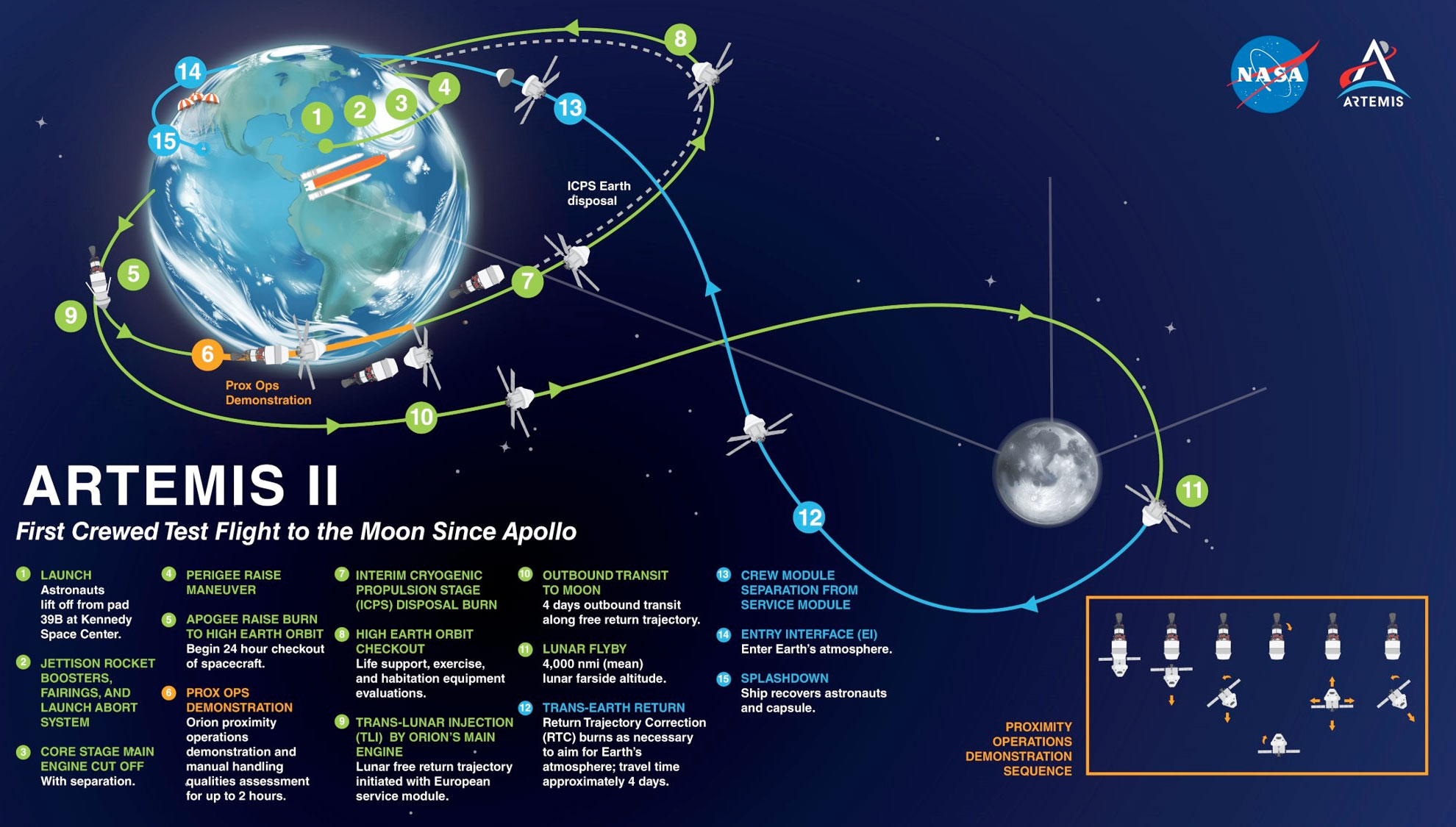
Artemis 2 is now on track to become the first crewed mission to visit the moon since Apollo 17, which landed on the lunar surface in December 1972. Koch is the first woman ever to leave low Earth orbit, and Glover and Hansen are the first person of color and the first non-American, respectively, to do so. (The Apollo astronauts were all white men.)
Orion will loop around the moon on Day 6 of the mission — about five days, one hour and 30 minutes after liftoff. The Artemis 2 quartet will set another record in the process, getting farther away from Earth than any humans ever have before. They'll beat the mark set by the Apollo 13 astronauts, who traveled a maximum of 248,655 miles (400,171 kilometers) from our planet after suffering an in-flight anomaly that derailed their moon-landing plans.
Artemis 2 will come home on Day 10 of the mission, splashing down in the Pacific Ocean off the coast of San Diego. Full success on this test mission will help pave the way toward the Artemis program's first crewed moon landing, on Artemis 4 in 2028, and the construction of a lunar base a few years after that, if all goes according to plan.
 Mike WallSpaceflight and Tech Editor
Michael Wall is the Spaceflight and Tech Editor for Space.com and joined the team in 2010. He primarily covers human and robotic spaceflight, military space, and exoplanets, but has been known to dabble in the space art beat. His book about the search for alien life, "Out There," was published on Nov. 13, 2018. Before becoming a science writer, Michael worked as a herpetologist and wildlife biologist. He has a Ph.D. in evolutionary biology from the University of Sydney, Australia, a bachelor's degree from the University of Arizona, and a graduate certificate in science writing from the University of California, Santa Cruz. To find out what his latest project is, you can follow Michael on Twitter.
View MoreYou must confirm your public display name before commenting
Please logout and then login again, you will then be prompted to enter your display name.
Logout MORE FROM SPACE... 1Lucky airplane passengers capture NASA's Artemis 2 moon launch from the sky
- 2In honor of "Project Hail Mary"'s Rocky, we celebrate 17 sci-fi aliens who look nothing like humans
- 3Watch comet C/2026 A1 plunge toward the sun online this week
- 4'The universe shall quake in my shadow' — 'Masters of the Universe' looks like the summer's most metal movie
- 5'Supergirl' goes full John Wick to save her dog Krypto in new trailer