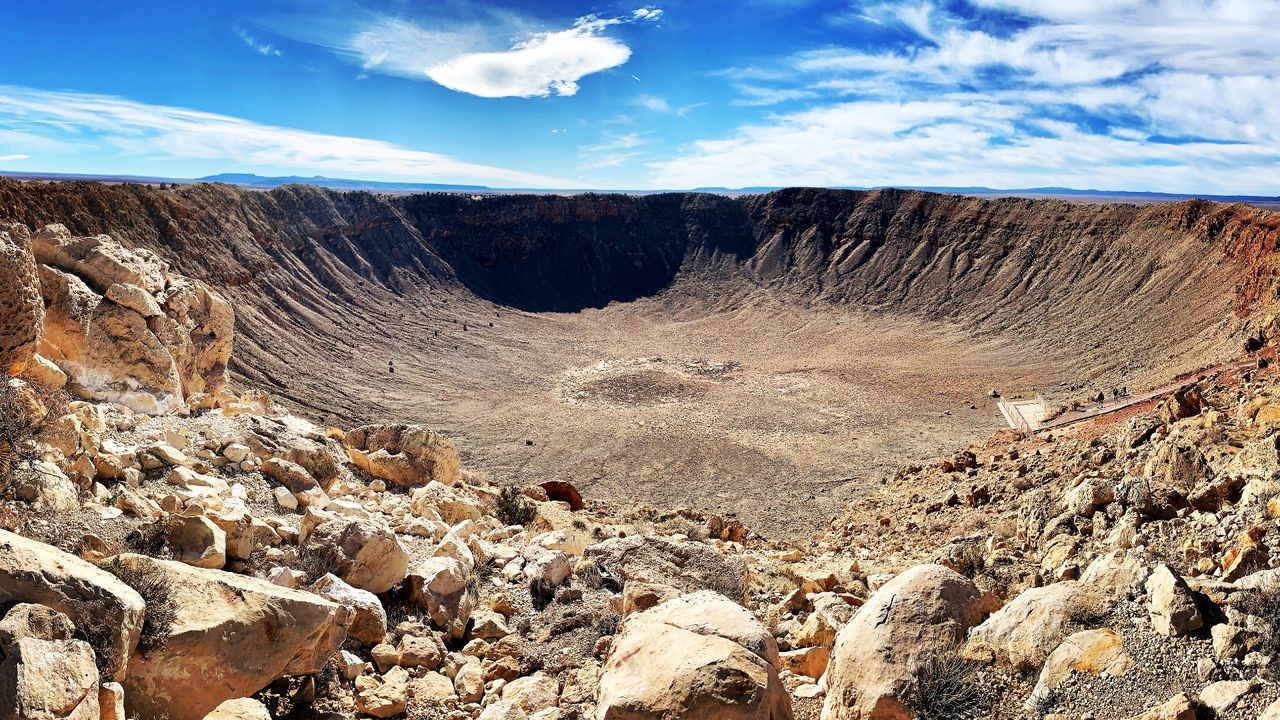
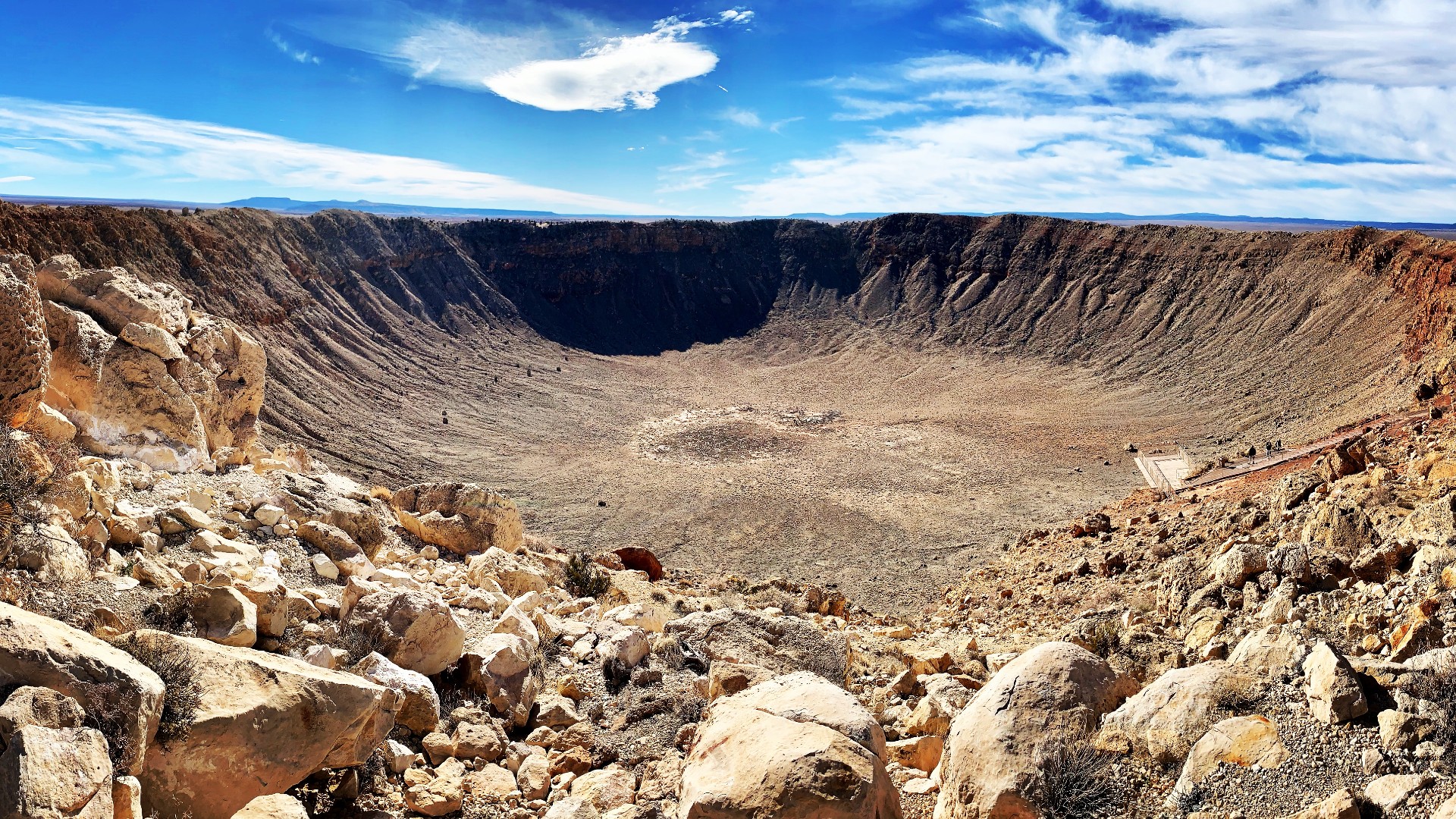
 A panoramic view of Meteor Crater in Arizona. (Image credit: Joel Alvarez/Getty Images) Share this article 0 Join the conversation Follow us Add us as a preferred source on Google Newsletter Get the Space Newsletter
 Breaking space news, the latest updates on rocket launches, skywatching events and more!
Contact me with news and offers from other Future brands Receive email from us on behalf of our trusted partners or sponsors By submitting your information you agree to the Terms & Conditions and Privacy Policy and are aged 16 or over.You are now subscribed
Your newsletter sign-up was successful
Want to add more newsletters?
An account already exists for this email address, please log in. Subscribe to our newsletterArizona's Meteor Crater and other scars leftover from collisions with space rocks continue to serve up their secrets.
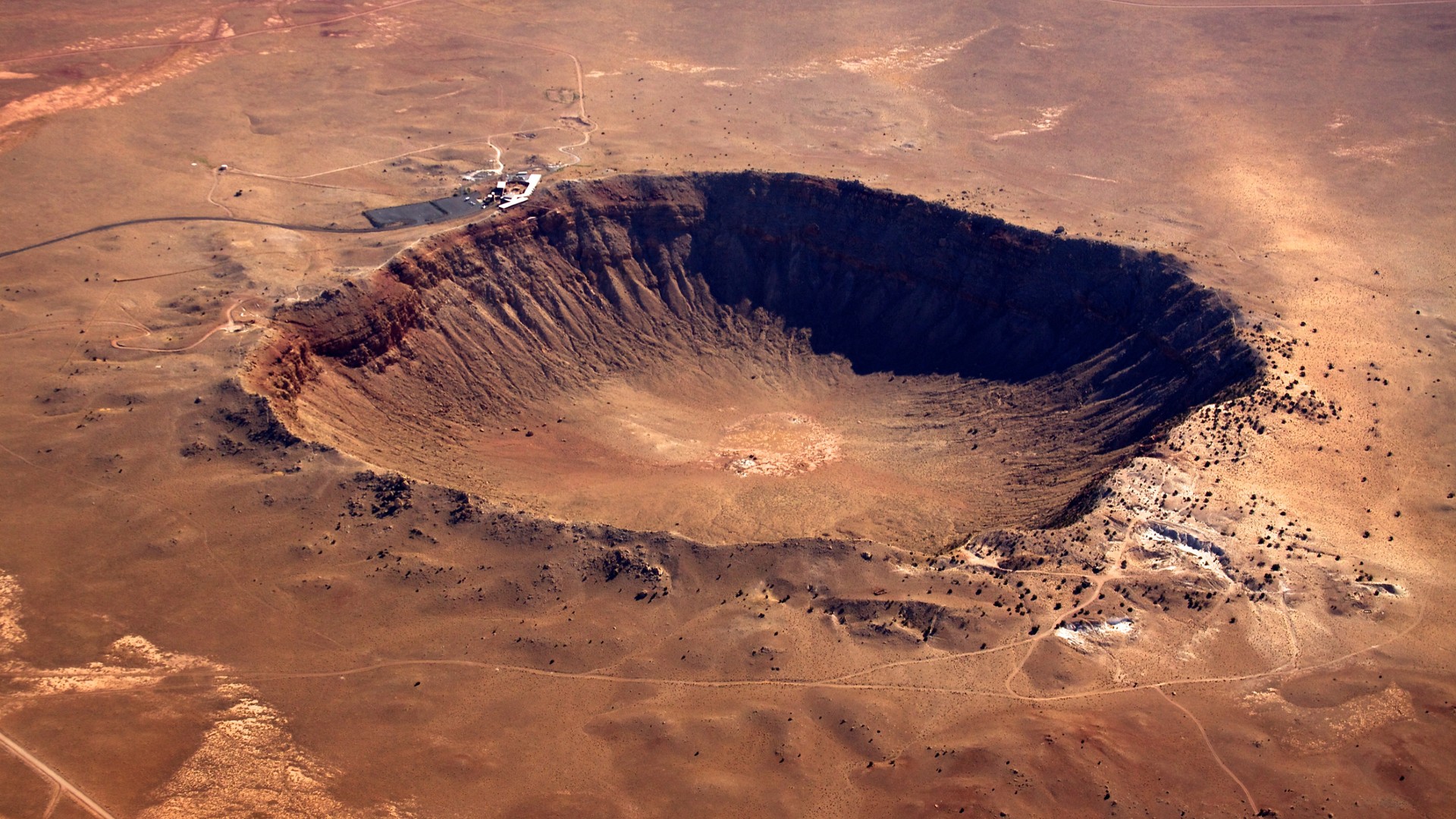
Meteor Crater formed some 50,000 years ago. It represents the best preserved meteor impact site in the world, measuring some 700 feet deep (213 meters), more than 4,000 feet across (1,219 meters), and 2.4 miles (3.9 kilometers) in circumference.
Article continues belowNatural laboratory
A recurring visitor to the crash site is Dan Durda, a research scientist at the Southwest Research Institute (SwRI) in Boulder, Colorado.
"Meteor Crater is the best-preserved and exposed impact crater on Earth," Durda tells Space.com. "That makes it the perfect natural laboratory for impact crater studies. The crater is still providing new insights every year, so continued studies there are really important."
Similar in view is Christian Koeberl at the Department of Lithospheric Researchwithin the University of Vienna in Austria. He chairs the Barringer Crater Company (BCC) scientific advisory committee. The Barringer Crater Company has introduced grants to support students and early career researchers who study terrestrial impact craters, for better understanding of these craters and their formations, and also to encourage students to go into such important research directions.
"Barringer Crater — also known as Meteor Crater — was one of the first, if not the first, crater recognized on Earth as being of impact origin in the early 20th century," Koeberl tells Space.com.
Get the Space.com NewsletterContact me with news and offers from other Future brandsReceive email from us on behalf of our trusted partners or sponsorsThe recognition of impact craters on the Earth is difficult, said Koeberl, because active geological and atmospheric processes on our planet tend to obscure or erase the impact record in geologically short time periods.
"Despite limited information about the early impact record we know that impacts had severe effects on the geological and biological evolution on Earth," said Koeberl. For example, a large impact event on Earth marks the transition from the Cretaceous to the Paleogene eras, about 66 million years ago, he added.
The most iconic species that has fallen victim to an impact, the dinosaurs, "literally had no chance," Koeberl said.
Read more: 10 Earth impact craters you must see
High-energy geological event
Morphological and geophysical surveys are important for the recognition of anomalous subsurface structural features, Koeberl said, which may be deeply eroded craters or impact structures entirely covered by post-impact sediments.
"Detailed investigations involve confirmation of either shock metamorphic effects in minerals and rocks, and/or the presence of a meteoritic component in these rocks. In nature, shock metamorphic effects are uniquely characteristic of shock levels associated with hypervelocity impact," Koeberl said.
Impact cratering is a short-time, high-energy geological event in which conditions are created that exceed conditions of nuclear bomb explosions.
These kinds of studies have led to the identification of, so far, of about 200 confirmed impact craters on Earth, Koeberl said. "Impact crater studies have actually grown in importance over the years and are an interdisciplinary effort. We encourage young researchers from all over the world to submit grant proposals," he said.
Barringer Family Fund applications and awards are administered by The Meteoritical Society and are due by April 1.
 Leonard DavidSpace Insider Columnist
Leonard David is an award-winning space journalist who has been reporting on space activities for more than 50 years. Currently writing as Space.com's Space Insider Columnist among his other projects, Leonard has authored numerous books on space exploration, Mars missions and more, with his latest being "Moon Rush: The New Space Race" published in 2019 by National Geographic. He also wrote "Mars: Our Future on the Red Planet" released in 2016 by National Geographic. Leonard has served as a correspondent for SpaceNews, Scientific American and Aerospace America for the AIAA. He has received many awards, including the first Ordway Award for Sustained Excellence in Spaceflight History in 2015 at the AAS Wernher von Braun Memorial Symposium. You can find out Leonard's latest project at his website and on Twitter.
View MoreYou must confirm your public display name before commenting
Please logout and then login again, you will then be prompted to enter your display name.
Logout MORE FROM SPACE... 1Hubble and NASA space telescopes track 'game-changing' gamma-ray burst back to neutron star collision in 'forbidden' region of the universe
- 2Sci-fi shooter 'Marathon' comes to life in hilarious marketing prank (video)
- 3Russia aims to reclaim Soviet space glory with 2036 launch of ambitious Venus mission
- 4'Disclosure Day': Release date, plot, cast, & everything else we know about Spielberg's sci-fi return
- 5The March full moon glows red through Saharan dust in eerie composite view