 The answer of whether humans are more closely related to cats or dogs depends on how you look at the question. (Image credit: Anastasiia Krivenok via Getty Images) Share this article 0 Join the conversation Add us as a preferred source on Google Newsletter Subscribe to our newsletter
 They sleep on our beds, steal our food, and generally rule the house. Between them, cats and dogs make up two-thirds of pet ownership worldwide. But which of the two companion animals are we more closely related to?
The answer depends on how you look at the question.
Sign up for our newsletter! 
Sign up for our weekly Life's Little Mysteries newsletter to get the latest mysteries before they appear online.
Cats, dogs and humans are all mammals. In the mammalian family tree, which maps out how different mammal species are related to one another, both cats and dogs belong to the order Carnivora, while humans are primates. These two groups split from a common ancestor about 90 million to 95 million years ago, Springer said. Meanwhile, cats and dogs split from each other much later, around 55 million years ago.
In terms of common ancestry, "dogs and cats are more closely related to mammals such as pangolins, horses, cows, whales, bats, shrews and moles than they are to humans," Springer said. And "humans are more closely related to colugos [flying lemurs], tree shrews, rabbits, rats, and mice than they are to cats and dogs."
Genetic ties
Another way of deciding which species we are more closely related to is through a genetic lens.
If you measure how much the DNA code has changed over time, humans are about equally related to cats and dogs, William Murphy, a comparative genomicist at Texas A&M University, told Live Science in an email.
However, scientists also compare how DNA strands are organized within chromosomes. Here, a difference emerges.
Murphy explained that the ancestors of modern-day dogs went through extensive chromosome rearrangements over evolutionary time. (Such rearrangements are not unique to dogs; they occur across different animal and plant species, though scientists don't fully understand why some lineages rearrange faster than others.) Cats, on the other hand, retained a genome organization that's closer to ours. "In terms of how genes are arranged within chromosomes, humans and cats are twice as similar to each other as humans are to dogs," he said.
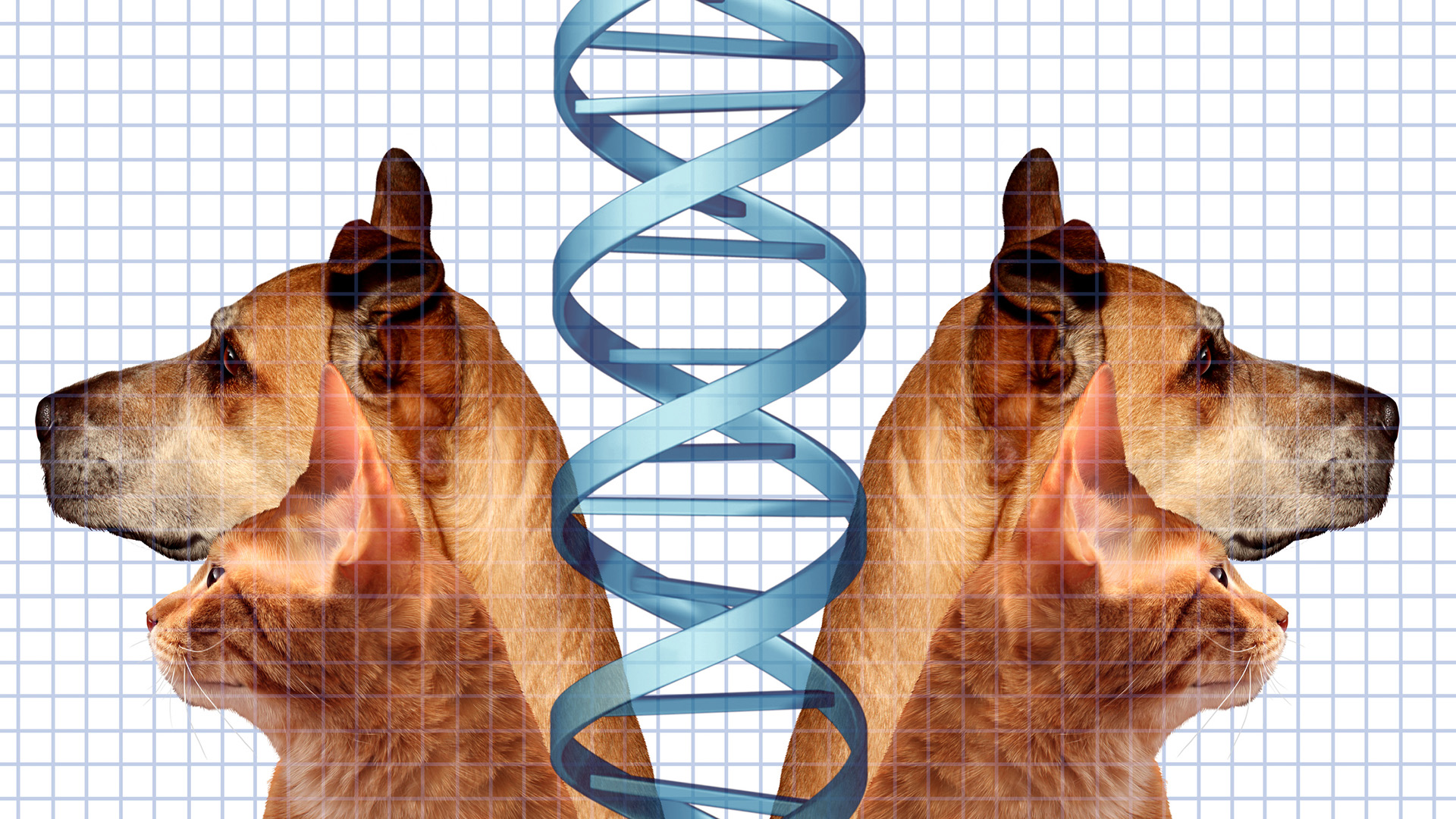
Humans and cats are twice as similar to each other as humans are to dogs in terms of how genes are arranged within chromosomes.
(Image credit: wildpixel via Getty Images)Because the way DNA is organized affects how genes are switched on and off, cats may be a better model than dogs for understanding human gene regulation, Murphy said.
That also makes them useful for studying genetic diseases. For example, polycystic kidney disease occurs in both humans and cats, and treatments developed for cats could help inform therapies for people.
Cats may also provide clues about cancer. A recent study found that cancer-related genes in cats are strikingly similar to those in humans, both in number and variety. One notable example involves a gene called FBXW7, which was mutated in more than half of the feline mammary tumors studied. In humans, mutations in the same gene are linked to worse outcomes in breast cancer
Related mysteries- Are cats or dogs smarter?
- Do humans and chimps really share nearly 99% of their DNA?
- Why do cats' claws retract but dogs' claws don't?
That said, dogs are also used to model and analyze human illness, including Alzheimer’s disease, idiopathic epilepsy, eye disease and heart disease.
Although cats may share more similarities with humans in gene regulation, to date more research has focused on dogs. This may be due in part to the fact that the complete feline genome became available later than the canine genome, as well as historical bias — cats have long been perceived as less cooperative in research settings.
So, which are we more closely related to? From an evolutionary standpoint, it's a tie, but genetically, at least in terms of genome structure, we are closer to cats.
How much of a cat fan are you? Find out by taking our cat quiz!
TOPICS Clarissa BrincatLive Science Contributor
Clarissa Brincat is a freelance writer specializing in health and medical research. After completing an MSc in chemistry, she realized she would rather write about science than do it. She learned how to edit scientific papers in a stint as a chemistry copyeditor, before moving on to a medical writer role at a healthcare company. Writing for doctors and experts has its rewards, but Clarissa wanted to communicate with a wider audience, which naturally led her to freelance health and science writing. Her work has also appeared in Medscape, HealthCentral and Medical News Today.
View MoreYou must confirm your public display name before commenting
Please logout and then login again, you will then be prompted to enter your display name.
Logout