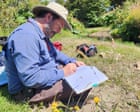
 Claudio Latorre said that on the discovery of the Monte Verde site the idea of the population of the Americas going from north to south was ‘chucked out of the window’. Photograph: Instituto de Ecología y Biodiversidad (IEB), Pontificia Universidad Católica de Chile.Claudio Latorre said that on the discovery of the Monte Verde site the idea of the population of the Americas going from north to south was ‘chucked out of the window’. Photograph: Instituto de Ecología y Biodiversidad (IEB), Pontificia Universidad Católica de Chile.Archaeological site in Chile upends theory of how humans populated the Americas … again
Discovery at Monte Verde puts north-to-south expansion theory back at centre of heated debate on continent’s human history
A groundbreaking new study may have once again upended our understanding of human prehistory in the Americas.
For years, the predominant theory of how humans arrived in the western hemisphere centred around the Clovis culture, which crossed the Beringia land bridge from Asia between 13,400 and 12,800 years ago, and spread south.
That version was challenged in 1977 when a site in southern Chile was first excavated. Monte Verde, near the city of Puerto Montt, was found to be about 14,500 years old – a true outlier that appeared to prove that there had been human populations in the far south of the hemisphere long before the arrival of the Clovis people.
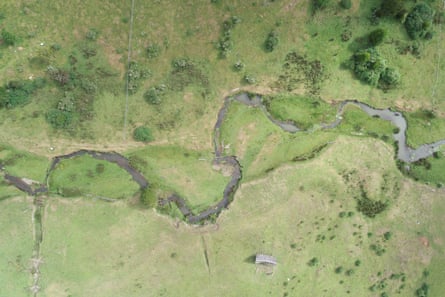 Monte Verde from above. Academics previously thought that the site was about 14,500 years old. Photograph: Instituto de Ecología y Biodiversidad (IEB), Pontificia Universidad Católica de Chile.
Now, the theory has changed again.
A team of archaeologists have found that Monte Verde could actually be less than half the age previously thought, placing the north-to-south expansion theory back at the centre of a heated debate over the human history of the Americas.
Dr Todd Surovell, from the department of anthropology at the University of Wyoming and the lead author of the study published on Thursday in Science, said: “Monte Verde was the anchor for the idea that people were in South America before we see the appearance of the Clovis complex in North America – and for the entirety of my career that has been the case.”
Surovell has harboured a fascination for the Monte Verde site since Tom Dillehay, who first excavated the site, spoke about his findings to his graduate class at the University of Wisconsin. Those findings were later verified by a multidisciplinary team.
But as his career progressed, Surovell became sceptical of Monte Verde, the great anomaly that had shifted the paradigm on how and when human beings arrived in the Americas.
The new research concludes that Monte Verde was misdated as the result of soil erosion which placed more recent archaeological evidence in older geological strata – meaning that the site is in fact only between 6,000 and 8,000 years old.
Dr Claudio Latorre, a paleoecologist at the Universidad Católica’s biological sciences faculty in Santiago, said: “When it was discovered, Monte Verde turned the entire story of the population of the Americas on its head.
“All of a sudden you had a site in southern Chile that’s 1,500 years older than the oldest sites in North America, and there was this huge gap in our knowledge – the understanding that the population of the Americas would have come from north to south was basically chucked out of the window.”
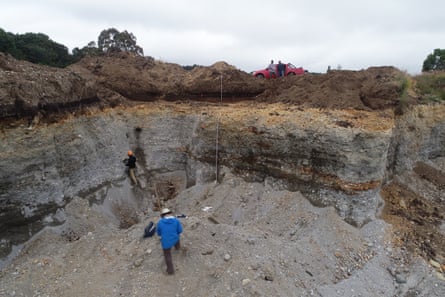 The archeologists behind the new study think that Monte Verde was misdated as a result of soil erosion. Photograph: Instituto de Ecología y Biodiversidad (IEB), Pontificia Universidad Católica de Chile.
Monte Verde was first excavated between 1977 and 1985 by Dillehay and his colleagues, who retained permits for the site.
But now, after the first independent survey of the site since initial excavations, Surovell and his team, having secured permission to study it in a brief window when the original permits expired, believe they have quashed the Monte Verde anomaly.
Other more recent pre-Clovis sites in the Americas have been discovered and excavated, from Mexico down to north-west Argentina and Uruguay, but none has yet been verified.
Surovell said that these should be examined in order for our understanding of American prehistory to evolve.
“I want to have the second set of eyes on these sites, but I don’t want to be the archaeological angel of death,” he said. “I much prefer to be in the business of knowledge production, which our work at Monte Verde does by erasing this one data point.”
Explore more on these topicsShareReuse this content