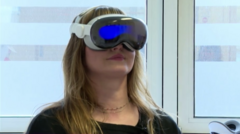

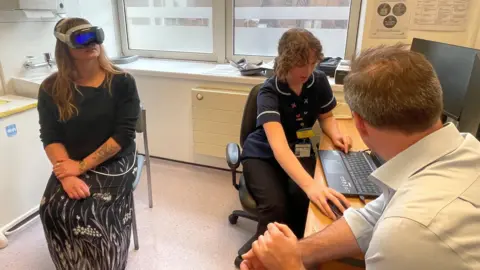
 BBCChelsea and Westminster Hospital is the first to offer this AR experience
Aga Mizgala has spent about seven years living with suspected endometriosis, enduring pain she describes as feeling like "a million little needles."
Now the 34-year-old is among the first patients to try a new augmented reality (AR) system at Chelsea and Westminster Hospital, designed to help people understand a condition that is invisible yet life altering.
The hospital is using augmented reality, a technology that overlays digital images onto the real world, during pre-surgical consultations to let patients view anatomically precise 3D models through a headset and see what might be happening inside their bodies.
The visual tool, developed by Medical iSight, aims to help patients make sense of complex procedures.
Virtual reality helps patients prepare for endometriosis surgeryAga said: "I think it's very helpful to actually see what the surgeon is talking about."
According to the World Health Organization, one in 10 women live with the incurable condition, which occurs when tissue similar to the lining of the womb grows elsewhere in the body.
Doctors say the technology enables them to show precisely which areas of endometriosis may be removed during surgery.
The aim is that this shared virtual view will make complex medical information easier for patients to understand and support them to feel more confident and informed when making decisions about their treatment.
Aga told BBC News how the symptoms have shaped her life.
"It started from pain in my pelvis every day since I wake up until I go to sleep. It just never goes away really," she said.
"I can't focus on my work. I had to take time off from work due to pain and I'm just miserable."
She underwent a diagnostic laparoscopy in 2023, but it provided no answers.
Since then, she has tried multiple treatments from medication to acupuncture to pelvic‑floor physiotherapy - all without success.
She hopes that further surgery might offer relief.
Her experience reflects the wider challenges faced by those seeking help.
The average waiting time for an endometriosis diagnosis has now reached nine years and four months, according to a new report by the charity Endometriosis UK.
It found that 39% of respondents had to visit their GP 10 or more times before endometriosis was even suspected, while 46% of those who attended hospital were sent home without treatment.
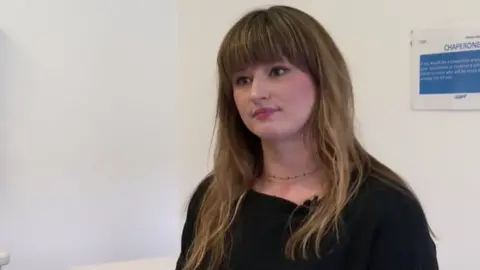 Aga Mizgala has spent about seven years living with suspected endometriosis
Aga said she often felt dismissed by the medical system: "I feel that I'm just being told 'oh it's something else, don't worry about it, it will just go away'.
"'Just take some painkillers, take some paracetamol, it's going to be OK.'
"But it was never OK."
Dr Tom Bainton, a consultant gynaecologist specialising in endometriosis at the hospital, said the condition most commonly appears in the pelvis, affecting the ovaries or the peritoneum .
He said that it can also spread to surrounding structures, including the bowel and urinary tract, and is sometimes found outside the pelvis entirely.
In rare cases endometriosis has been identified on the diaphragm and even in the chest.
Bainton said the aim of surgery is always to remove the affected tissue while preserving healthy organs, but that this can be challenging because endometriosis can cause fibrosis and may infiltrate nearby structures.
He said: "This 3D visualisation technology transforms the way we talk to patients about endometriosis.
"Rather than relying on basic drawings, we can walk through detailed anatomical changes together with patients in a collaborative consultation, helping them more clearly understand their condition and the surgery they are preparing for."
Listen to the best of BBC Radio London on Sounds and follow BBC London on Facebook, X and Instagram. Send your story ideas to [email protected]
More on this story