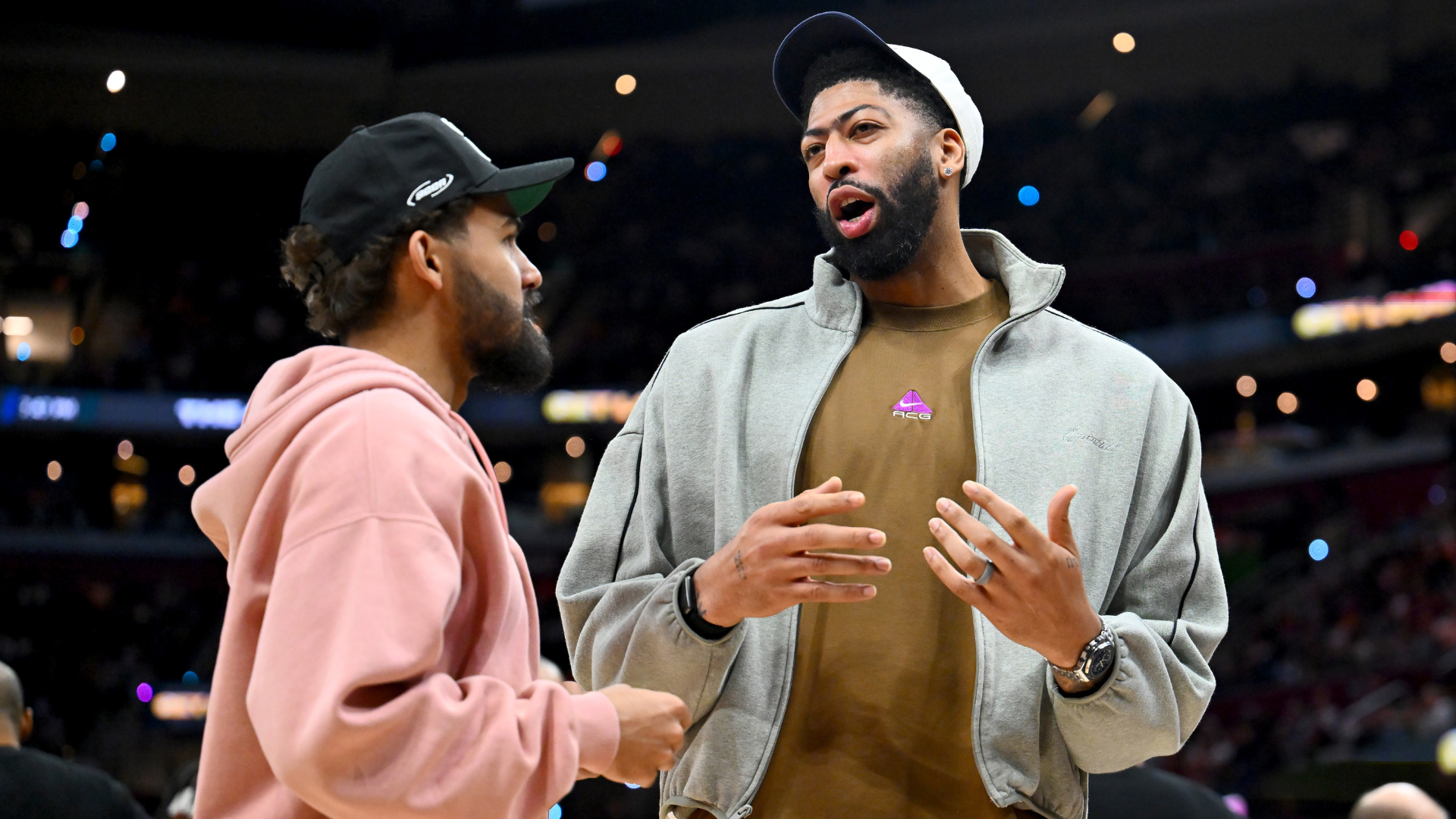
Typically, when a player gets traded, rumors about his future die down for a period. Yet Anthony Davis has seemingly become even more of a fixture in the rumor mill since joining the Washington Wizards in February than he was as a member of the Dallas Mavericks. He hasn't even suited up for Washington yet and virtually his entire Wizards tenure has been defined by questions about his future.
The buildup to his deadline deal revolved around a rumored desire for a contract extension. When the worst-in-the-NBA Wizards traded for him, there were rumblings about his preference for a contender. Chris Haynes reported in April that there was a "good chance" Davis would be moved again before the beginning of the 2027-28 season. He eventually became a central figure in the free agency of former teammate LeBron James, who was reportedly interested in reuniting with him.

 Anthony Davis WAS • C • #23 PPG20.4RPG11.1BPG1.65 View Profile
 But this week, the Wizards will have a chance to put those rumors to rest. On Thursday, Aug. 6, Davis will become eligible to sign a contract extension that would signal a mutual commitment between player and team. For Davis, the appeal is obvious. He is 33 years old and injury-prone with a chance to guarantee himself quite a bit of long-term money. The Wizards have said nothing definitive, but have hinted at the possibility of a new deal. When asked about a possible extension on the NBA Draft telecast, Wizards general manager Will Dawkins said: "We'll have that conversation in the middle of August when we can officially have that."
With Davis nearing extension eligibility, let's take a look at what sort of contract he can get, how such a deal would fit into Washington's long-term finances, and whether a trade is really off the table.
How much can Davis get? What should he get?
Davis is set to make roughly $58.5 million this season. Should he decline his player option for the 2027-28 season, he is eligible to extend for up to four more years for an estimated $275 million. Let's not get ahead of ourselves. The Wizards may be a tad reckless financially coming off their bizarre decision to give Trae Young a max contract, but the idea of anyone giving Davis that much feels entirely unrealistic.
We're talking about a 33-year-old center who has played 29 regular-season games since getting traded by the Los Angeles Lakers 18 months ago. Health was a concern for Davis even at his peak, and he's no longer at his peak. He doesn't generate quite the same degree of rim pressure he did in his 20s, and he doesn't have the jump shot or self-creation chops to compensate. The small-ball lineups he's made a career out of destroying are largely getting phased out of an NBA that is getting bigger, and most defensive metrics suggest that in his brief Dallas cameo, he had taken a step back from his All-Defense standard.
Stephen Noh's salary tool, for reference, values Davis at $29.6 million next season -- roughly half of what he'll actually make. Over the next three seasons combined, despite being eligible for $275 million, Noh's model projects he will be worth only $61.9 million in total. Obviously, there is no conversation here at that price point. Why would Davis sign for $61.9 million over three years when he already has a player option for $62.8 million in the first of those years? Davis shouldn't get $275 million, but if he does extend, it will have to be for a significant enough sum to make it worth his while.
The model here probably looks something like what Rudy Gobert did in 2024. At that point, he was owed almost $44 million for the 2024-25 season and had a player option for just under $47 million for the 2025-26 season. Instead of picking that option up, he declined it and extended for $110 million over three years. Doing so lowered his 2025-26 salary by about $12 million but bought him two extra years of security into his mid-30s. The Timberwolves, badly in need of second apron breathing room, were happy to give him that security in exchange for the pay cut.
Say we applied that same math to Davis. Gobert was due to make 30.17% of the cap on his player option, and he went down to 22.63% in the first year of his new deal. So let's drop Davis by the same 7.54% of the projected 2027-28 cap (roughly $174 million at this point) and give him 5% annual raises so as not to trigger the six-month trade restriction that comes with bigger ones. That would pay Davis roughly $132 million between the 2027-28 and 2029-30 seasons, with the $58.5 million he is already owed this year bringing his total over the next four seasons to around $190 million.
YearSalary2027-28
$51,403,367
2028-29
$53,973,535
2029-30
$56,543,703
Total
$131,922,605
Should the Wizards extend Davis?
The problem with using the Gobert model is that Davis and Gobert are different players. At his peak, Davis was better. But Gobert was more than a year younger when he signed this extension and is historically far more durable. Minnesota roughly knew what it was getting in a new Gobert deal. Davis hasn't even played for the Wizards yet. The other player they re-signed this offseason, Young, has played five games in Washington, and the most important player in the entire franchise, No. 1 pick AJ Dybantsa, hasn't even made his team debut yet. Few teams have ever needed to make an extension decision with so little information about how the player in question actually fits onto their team.
What we can say with relative comfort is that a Davis contract like this doesn't really fit onto Washington's books. Though the Wizards are primarily built around players on rookie contracts right now, that starts to shift in the 2028-29 season. That's when the rookie deals for long-term fixtures Alex Sarr and Kyshawn George expire. We don't know exactly what those contracts will be worth at that point, but the Wizards are obviously hoping it's a lot because that would suggest they've developed as hoped.
With Young on a max, Davis in the ballpark we covered above and Sarr and George making substantial salaries, there just won't be much flexibility left over. At that point, Davis will be entering his age-35 season and will almost certainly be in decline. That is the expectation for almost any player who signs a long extension in that range: you're overpaying on the backend because keeping a very good player is important to your present.
NBA Power Rankings: LeBron James vaults 76ers into top five; Spurs have early edge over Knicks Brad Botkin
That's what makes a possible Davis extension so puzzling. The Wizards are not a championship contender that needs to lock up a key piece. Their win total projection at FanDuel Sportsbook is 32.5. They're competing for a Play-In berth, not a championship. They are hoping that changes in the near future. Getting Dybantsa might open those doors. But he's 19. By the time his window opens, Davis' will be closed.
Extending Davis at any sort of substantial figure might make Dybantsa's first few NBA seasons a bit more competitive, but it will limit Washington's ability to build around him in the second half of his rookie contract. That window -- when the young player has presumably started to emerge, but is still cost-controlled by the rookie scale -- is a vital team-building resource. The Oklahoma City Thunder used it to add Isaiah Hartenstein, for instance, and several other substantial free agent signings over the past decade and change have been made possible by a young star on a rookie deal. Extending Davis on a potentially immovable deal makes it much harder for the Wizards to weaponize the surplus value on Dybantsa's contract down the line.
Is there a smaller number that might make more sense for Washington? Never say never, but that $62.8 million player option complicates all of this. Davis has leverage. If this season goes well, he can opt out and cash in as a free agent. If it doesn't, he's still secure with an option at the max. Any contract that appropriately prices in the risk of injury and age-related decline would be so small that it would simply make less sense than playing out the year with the player option in his back pocket.
These are simply two parties who should be operating on different timelines. Davis is expensive now because, at his age, most of the value he's likely to produce in the rest of his career should be expected to come now. The Wizards are, or at least should be, prioritizing winning later, and having an expensive Davis on their books when he is far less likely to live up to his contract doesn't exactly help them win later. There just does not seem to be a number here that would or should make sense to both parties. An extension doesn't really make sense here beyond getting Davis to buy into being a Wizard when he'd probably rather be a member of a team that's readier to contend. On that note...
Is a trade for Davis off the table?
The Wizards have signaled all offseason that they intend to keep Davis, and if there was a window to trade him this offseason, it has probably closed. Had Washington wanted to move him, the time to do so would have been when LeBron James was still a free agent. That's when their leverage theoretically would have been maximized, as Davis would have been a potential tool for someone other than the Philadelphia 76ers to secure James on a minimum contract. Either the Wizards never seriously engaged in talks on such a trade, or other teams were unwilling to pay a premium to get Davis just to lure LeBron. The truth is probably a combination of both.
The nature of a possible extension could take a trade off the table until at least the deadline. When a player extends for a starting salary higher than 120% of his previous salary, gets more than four total years with his existing and new contract included, or gets a raise higher than 5% in any single season, he cannot be traded for six months. As Davis is already making the max, getting more than 120% of his existing salary would be impossible, and locking him in for five total years at his age seems unrealistic. Therefore, the figure to watch here is his raise rates. They can get as high as 8% annually, but 5% is the magic number for trade purposes.
As the 2027 trade deadline is on Feb. 11, Davis and the Wizards would have less than a week after he becomes extension-eligible on Aug. 6 to sign a new deal with raises greater than 5% that would keep him eligible to get traded before the deadline. If he signs any later than Aug. 11 with those bigger raises, he wouldn't be trade-eligible again until next offseason.
Joel Embiid for Anthony Davis? Don't get your hopes up on trade to reunite LeBron James with former co-star Sam Quinn
Of course, the Wizards could simply choose not to extend Davis. That would allow them to play out the 2026-27 season and see how things go. Maybe Davis plays well enough that someone swoops in with a big offer. Remember, the Wizards gave up next to nothing to get him in the first place. One of the two first-round picks they gave up was No. 30 overall, and the other is top-20 protected. If this turns out to be an arbitrage play based around flipping Davis for more than they paid, all of this starts to make more sense for the Wizards. If he doesn't play well, the Wizards, by waiting, protect themselves from a potentially regrettable contract.
This is probably the wise choice. The Wizards really shouldn't be operating with much urgency to keep Davis. He only hurts his own market value if he lets his contract situation affect his play this season, and if they lose him for nothing next offseason, well, it's not as though they paid much to get him in the first place. There's simply more risk associated with extending a 33-year-old with his injury history on a team that's several years away from genuine contention than there is reward.
The Wizards didn't know they were getting Dybantsa when they traded for Davis. Even if they planned to make a serious win-now push upon acquisition, their circumstances have materially changed. Yet they still extended Young at the max mere months after the Atlanta Hawks decided they'd rather cap dump him than risk him picking up his player option this summer. Given how limited Young's market appeared to be during the season, it certainly seems as though the majority of the league held Atlanta's position.
The Wizards have already made one potentially reckless financial decision this offseason in the name of winning now. That at least raises the possibility that they might make a second. We'll learn for certain in the days and weeks to come.
Add CBS Sports on Google Join the Conversation comments