
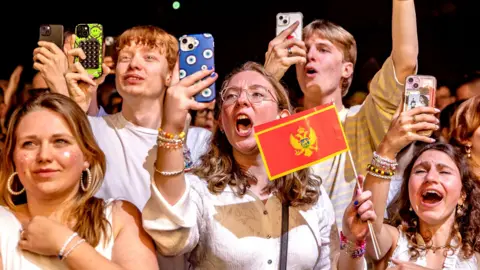
 ShutterstockFans are a huge part of the Eurovision experience - but the controversy over Israel has caused concerns amongst the community
The 2026 Eurovision Song Contest officially lands in Vienna on Sunday, with a "turquoise carpet" parade featuring competitors from all 35 nations.
It's the show's 70th anniversary, but the celebrations have been overshadowed by a ferocious row over Israel's participation.
As the delegations gather in Austria, five competition regulars will be absent, with Iceland, Ireland, the Netherlands, Slovenia and Spain all boycotting the event.
Israel's presence has sparked controversy since its government began a massive military offensive in Gaza in October 2023.
The incursion came in response to a Hamas-led attack on Israel, that killed about 1,200 people and saw 251 taken hostage, Israeli authorities say. Israel's offensive has killed 72,628 people in Gaza, according to the Hamas-led health authority.
A ceasefire deal has been in effect since 10 October 2025.
During the most recent Eurovision contests in Malmö (2024) and Basel (2025), anti-Israel protesters filled the streets and Israel's participants were given armed guards.
Last year, Yuval Raphael, a survivor of the 7 October attacks, told the BBC she had "practised being booed" during rehearsals. During the final, two protesters attempted to storm the stage as she performed her song New Day Will Rise.
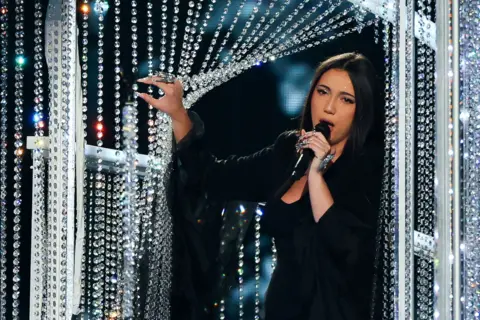 ReutersYuval Raphael came second in the 2025 Eurovision Song Contest
Things came to a head when Yuval's song unexpectedly topped the public vote (she ultimately took second place, due to a lower score from the contest's songwriting juries).
Some countries claimed the public tally had been influenced by Israeli Prime Minister Benjamin Netanyahu and his government's official social media channels, who had repeatedly urged followers to vote for New Day Will Rise - an unusual step for a government.
At a meeting last November, several countries tried to force a vote on Israel's presence at the contest. When the proposal failed, the withdrawals included Spain, one of the contest's biggest financial supporters, and seven-time winners Ireland.
It has left fans in a quandary.
'Never felt more divided'
Eurovision is uniquely intertwined with its fan community.
Fan websites and blogs are given equal billing to traditional media during the contest itself, sitting alongside organisations like the BBC and the New York Times in the press centre and attending press conferences with the acts.
Such sites post year-round updates and analysis of contestants, stagings, voting predictions and rehearsals from selection shows right up to the grand final.
"The fan base is very important for the commercial dimension of Eurovision," explains Dean Vuletic, author of the book Postwar Europe and the Eurovision Song Contest.
"When it comes to merchandising, when it comes to ticket sales, the fans are really the ones fuelling this Eurovision industry. They're the ones you can count on to attend the contest, even when it becomes mired in political controversy."
But in the wake of the boycott, some fan sites have suspended their coverage.
"The Eurovision we once knew, that shaped this community and inspired us to create this channel, just isn't the one we fell in love with all those years ago," wrote the team behind Eurovision Hub, a cross-continental fan page.
"We no longer recognise the Eurovision Song Contest we grew up with," agreed Ireland's Eirevision podcast. "A contest founded on unity, peace, and connection has never felt more divided."
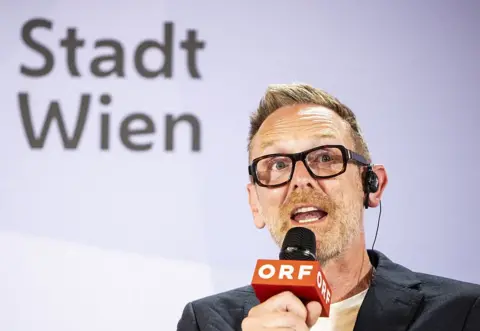 Getty ImagesBritish producer Martin Green will oversee the 2026 Eurovision Song Contest
Others have tried to find a middle ground.
Welsh Eurovision fan Philip Dore posted an excellent, empathetic article on the ESC Insight website, simply titled: "So, what do Eurovision fans do now?"
"For some people, the Eurovision Song Contest is far more than just a bunch of songs," he noted.
"Eurovision's links to LGBTQ+ identity - both on a personal and societal level - are well-documented. Rather less understood, but no less powerful is the contest's links to neurodiversity."
With that in mind, he outlined potential approaches for conflicted fans. These included everything from an outright boycott, to a "halfway" option of following the build-up and dropping out when events moved to Vienna.
"This isn't an easy situation for anyone," Dore noted. "Many people in the community are feeling a mix of sadness, anger, and loss, and I have no intention of adding judgment to anyone."
'I couldn't miss it'
Despite that, social media feeds have been filled with the usual cavalcade of Eurovision photos, jokes and interviews as the contest approaches.
Tickets for this year's nine final events in Vienna sold out in record time. Every seat at the grand final was snapped up in just 14 minutes.
"To see every single show sell out so quickly is a powerful reminder of what the Eurovision Song Contest represents - joy, togetherness and shared experience at a time when that feels more important than ever," said Eurovision's director, Martin Green.
The reality is a little more nuanced.
"It still feels exciting. It still feels like something that I couldn't miss. And, that said, it feels different," says Rob Lilley-Jones, host of the UK-based Euro Trip podcast.
"There's still that fun element but now, and for the last few years, you are going into Eurovision week with a sense of apprehension and nervous anticipation."
Heightened security and backstage tensions in Malmö made the 2024 contest "the worst it's been", he says.
Marcos Maximillian Tritremmel, president of Austria's Eurovision fan club, remembers the atmosphere vividly.
He understands why protesters object to Israel's presence. "But when you get yelled at on your way into a concert hall - 'What are you doing here? Why are you supporting the genocide?' - at that point, it stops being funny," he told Germany's Der Spiegel magazine.
Lilley-Jones says scenarios like that have made him question whether to continue his podcast, but he feels keeping going "still feels like the right thing to do" if the contest "can still bring joy to people in what is a very difficult situation around the world, not just in the Middle East".
That seems to be the prevailing attitude: It's better to remain in dialogue with one another than to foster further divisions.
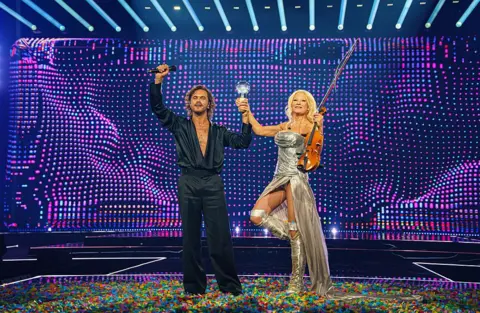 Getty ImagesFinnish duo Pete Parkkonen and Linda Lampenius are the current favourites to win the 2026 contest
With his bird's-eye view of the contest, Vuletic says the contest will weather this controversy, as it has done many times before.
"I get asked this question very often: is this the most political Eurovision ever? But when we look back, there are so many Eurovisions that have been struck by political controversies."
He cites Moscow in 2009, when police violently broke up a gay pride rally that had been timed to coincide with the contest, or Azerbaijan in 2012, when the contest was staged by a dictatorship that suppressed political dissent.
The 2012 contest's eventual winner, Loreen, of Sweden, made a point of meeting local activists, saying: "Human rights are violated in Azerbaijan every day. One should not be silent about such things."
"The media tends to sensationalise the current moment but we've always had to navigate the political context [of the contest]," says Vuletic.
"And the fans have always kept coming, no matter what."
Eurovision organisers will undoubtedly do their best to put politics in the background this week – though Austria's broadcaster has confirmed it will not ban Palestinian flags or censor any audience booing in Vienna's Wiener Stadthalle.
But viewing figures will inevitably shrink, with broadcasters in Spain, Slovenia and Ireland not airing any coverage.
And no-one's quite sure what the fallout will be if Israel wins. Their entry Michelle, by 28-year-old singer Noam Bettan, is one of this year's stronger ballads.
Fans, who've already been through the wringer, will be watching with even more trepidation than usual.
More on this story