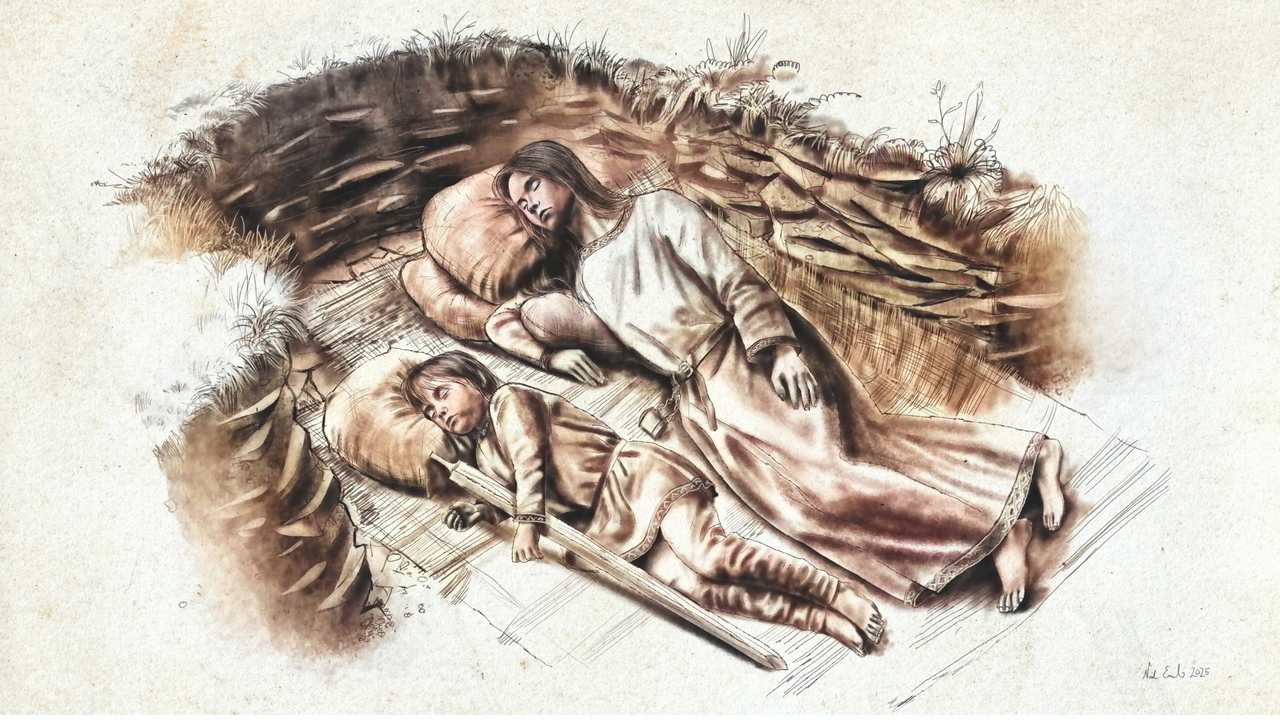
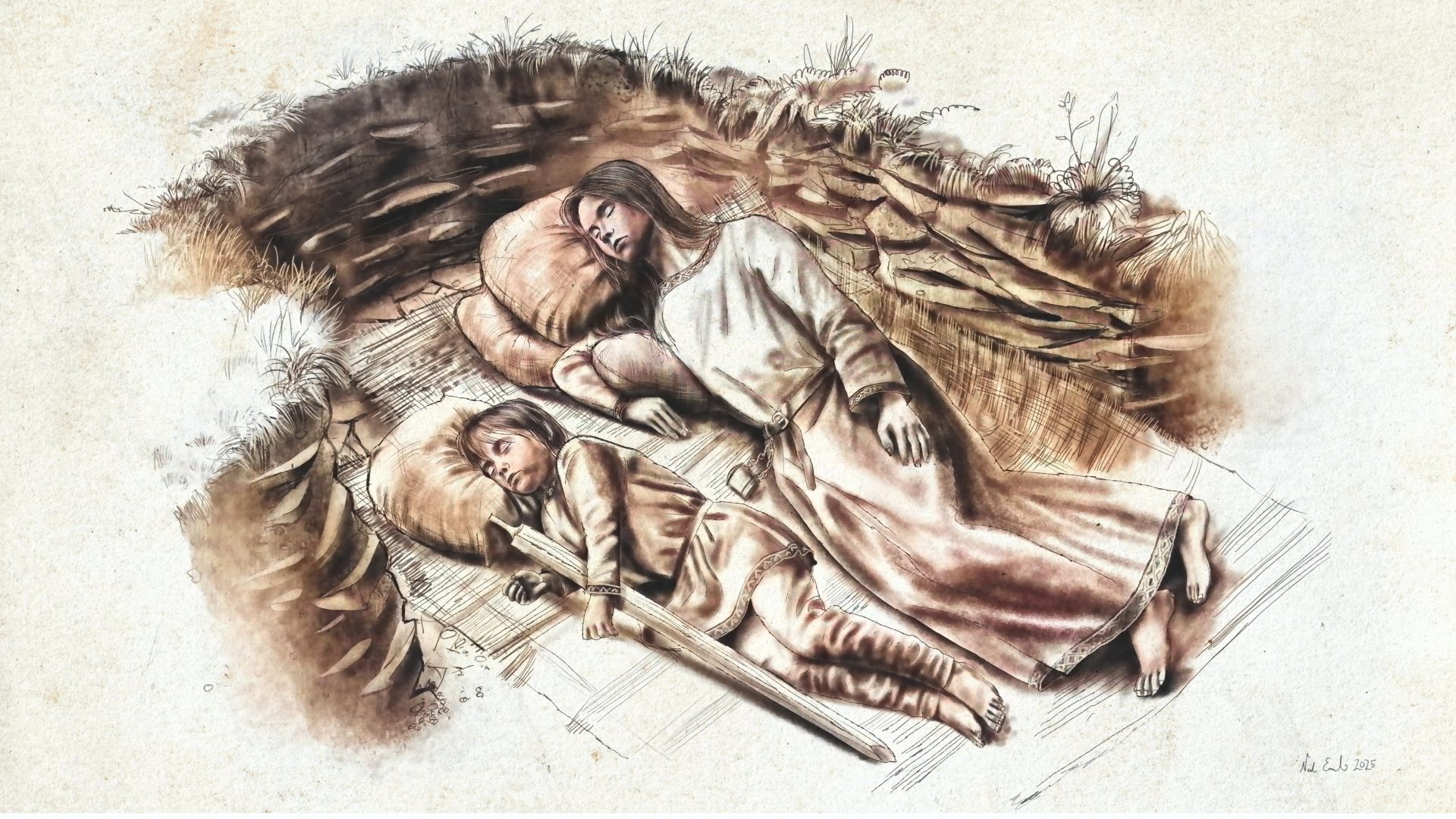
 An artistic reconstruction of the Anglo-Saxon double burial. (Image credit: © Neil Max Emmanuel / Time Team) Share this article 0 Join the conversation Follow us Add us as a preferred source on Google Newsletter Sign up for the Live Science daily newsletter now
 Get the world’s most fascinating discoveries delivered straight to your inbox.
Become a Member in Seconds
Unlock instant access to exclusive member features.
Contact me with news and offers from other Future brands Receive email from us on behalf of our trusted partners or sponsors By submitting your information you agree to the Terms & Conditions and Privacy Policy and are aged 16 or over.You are now subscribed
Your newsletter sign-up was successful
Want to add more newsletters?
Join the club
Get full access to premium articles, exclusive features and a growing list of member rewards.
Explore An account already exists for this email address, please log in. Subscribe to our newsletterTwo Anglo-Saxon children interred together 1,400 years ago were brother and sister, an analysis of the skeletons' DNA reveals — a confirmed familial link that is rare in Anglo-Saxon burials.
The siblings may have died at the same time from a fast-acting disease, according to a statement from the British archaeology show Time Team.
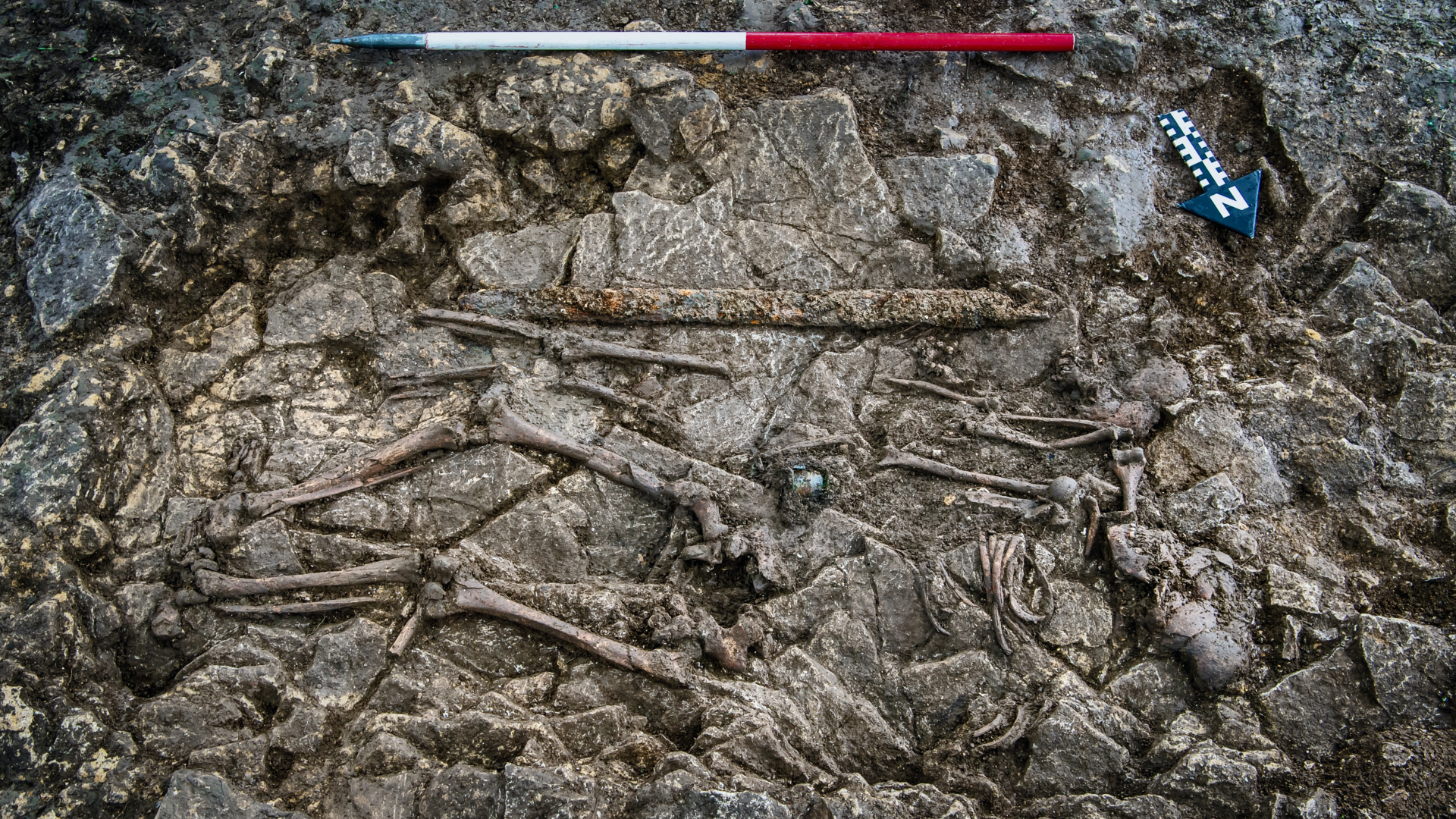
Archaeologists initially discovered the rare double burial in an Anglo-Saxon cemetery in Cherington, a village in southwest England, in September 2024. In the grave, the excavators found the skeleton of a 7- or 8-year-old boy holding an iron sword and the skeleton of a teenage girl buried with a necklace and a workbox — a cylindrical metal object that may have held thread and cloth — dated to the second half of the seventh century.
Time Team featured the excavation of the double burial in an episode released in January, but a DNA analysis of the skeletons was recently completed by scientists at the Francis Crick Institute in London. The results were announced on the April 14 episode of the Time Team podcast.
The DNA confirmed "we do have a boy and a young girl," Jacqueline McKinley, the osteoarchaeologist with Wessex Archaeology who excavated the burial, said in the podcast. "But I know what their relationship is now — they were brother and sister."
The siblings appear to have been buried in the same grave at the same time. The older sister was turned toward her little brother and was found at a slightly higher level, suggesting she had been propped up on pillows that have since disintegrated. It is "a very telling position," McKinley said. "To me, that is a signal of what her role was before he died. She was somebody who would look after him, look over him."
Because the siblings died at the same time, McKinley suspects a rapid-acting infectious disease may have been to blame. "I think she probably did catch something from him, and that's why they died at the same time," she said. It's not clear, however, how the siblings died.
Sign up for the Live Science daily newsletter nowContact me with news and offers from other Future brandsReceive email from us on behalf of our trusted partners or sponsorsFurther DNA analysis may be able to clarify if a pathogen was responsible for the siblings' deaths. But McKinley pointed out that the bacteria that cause some life-threatening conditions, such as sepsis or meningitis, would not leave behind their DNA, limiting confirmation of the siblings' cause of death.
RELATED STORIES- Eerie 'sand burials' of elite Anglo-Saxons and their 'sacrificed' horse discovered near UK nuclear power plant
- Anglo-Saxon children discovered buried with warrior gear in UK — perhaps as a nod to 'the men these children might have become'
- Detectorists find Anglo-Saxon treasure hoard that may have been part of a 'ritual killing'
McKinley is currently working on an Anglo-Saxon cemetery nearby in Wiltshire, which also contained double burials. At that site, however, the DNA analysis done so far has not shown any first- or second-degree relationships, such as siblings, parents and children, grandchildren and grandchildren, or uncles and nieces, she said. Rather, the relationships between people buried in double graves are helping confirm historical information that Anglo-Saxon households included adoption, fostering and extended family networks.
The discovery of siblings in an Anglo-Saxon grave "opens up a whole new vista," Helen Geake, a Time Team archaeologist and Anglo-Saxon specialist, said in the podcast. "Immediately, your thoughts go to the wider family and what an awful tragedy this must have been to lose two children at the same time."
 Kristina KillgroveStaff writer
Kristina Killgrove is a staff writer at Live Science with a focus on archaeology and paleoanthropology news. Her articles have also appeared in venues such as Forbes, Smithsonian, and Mental Floss. Kristina holds a Ph.D. in biological anthropology and an M.A. in classical archaeology from the University of North Carolina, as well as a B.A. in Latin from the University of Virginia, and she was formerly a university professor and researcher. She has received awards from the Society for American Archaeology and the American Anthropological Association for her science writing.
View MoreYou must confirm your public display name before commenting
Please logout and then login again, you will then be prompted to enter your display name.
Logout LATEST ARTICLES 1Colorado River may have pooled and spilled over to form the Grand Canyon, solving a long-standing mystery — but not everyone agrees
- 2'We all screamed when it happened': Bright-green fireball meteor caught exploding over famous Viking raid site in UK
- 3Northern lights may be visible from several US states Friday and Saturday as giant hole opens up in sun's atmosphere
- 4Hackers used AI to steal hundreds of millions of Mexican government and private citizen records in one of the largest cybersecurity breaches ever
- 5The first black hole ever discovered is spewing 'dancing jets' at half the speed of light


