

 Getty Images
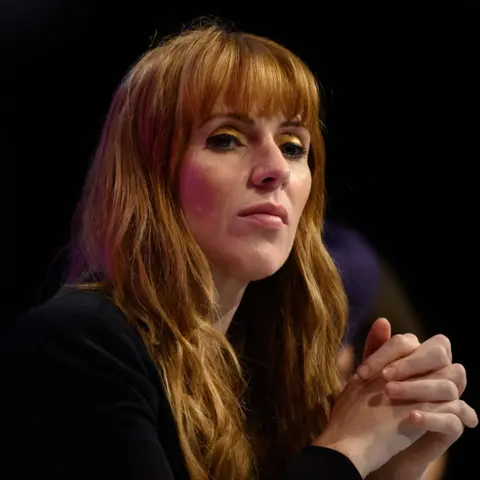
For the best part of a year, Angela Rayner's political ambitions have been stifled by an investigation into her tax affairs.
She resigned as deputy prime minister, housing secretary and deputy leader of the Labour Party in September last year, after admitting she did not pay enough tax on the purchase of a new home.
Marooned on the backbenches, Rayner could only watch on as Prime Minister Sir Keir Starmer was buffeted by a leadership crisis - and governed without her.
But the HMRC investigation that was seen as an obstacle to her return to top-flight politics has concluded, with Rayner saying the matter has been resolved.
As Sir Keir fights for his job, it opens up more options to a high-profile MP who is seen as a potential contender for the leadership of the Labour Party.
Her against-the-odds story, personality, and ability to connect with parts of the electorate that might be less accessible to others, gave her a special status in Sir Keir's cabinet and underscores why she would be a formidable opponent in any Labour leadership contest.
Labour leadership crisis: Follow live updates
At a glance: Starmer fights to stay on as prime minister
The potential challengers to the PM
How would a Labour leadership contest work?
Tough upbringing
Born Angela Bowen in Stockport, Greater Manchester, in 1980, Rayner grew up on one of the area's poorest council estates and from an early age, was caring for her mother, who had bipolar disorder and suffered from depression.
Both Rayner's parents were unemployed and speaking in 2017, she remembered having to grow up very quickly.
"My mum was a really vulnerable person. I remember, at 10, my mum being suicidal and me sleeping like a dog on the end of her bed, just to try and stay next to her so she didn't do any harm to herself," Rayner said.
She has also recalled going to her grandmother's flat on Sundays, so the family could take it in turns to have a bath there. Hot water was too expensive for them to use at home.
 Reuters
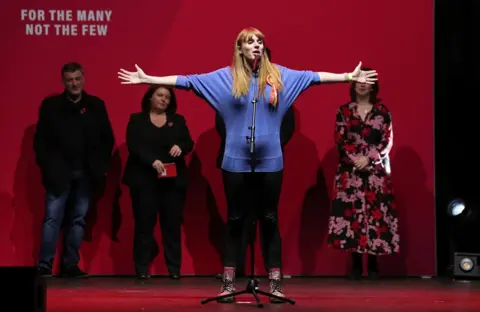
Rayner has often spoken about being told she would "never amount to anything", after she left school without any qualifications.
But after having her first child at 16, Rayner studied part-time at college, learning British sign language and gaining a vocational qualification in social care.
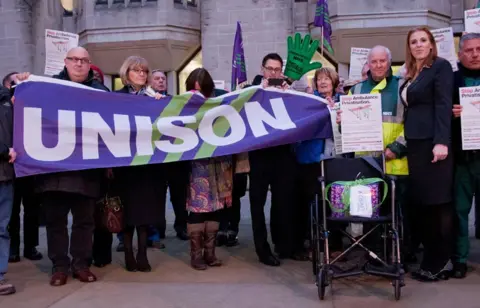
She spent a number of years as a care worker in Stockport, mainly looking after elderly people in their own homes, while also rising quickly through the ranks of the union, Unison.
She has described herself as "mouthy", someone who would "take no messing from management".
 Alamy
AlamyIn her 20s, she became a full-time union official and eventually, after battles over working conditions and zero-hour contracts, rose to the most senior elected role in Unison in north-west England.
It was at Unison she met Mark Rayner, a fellow union official whom she married in 2010 and divorced in 2023. The couple went on to have two sons, one of whom was born so prematurely he is registered blind and has special educational needs.
At the age of 37, the mum-of-three became a grandmother, sparking the nickname "Grangela".
She credits the trade union movement with encouraging her to enter politics and taking her from - in her own words - "the girl on a council estate" to "a woman who feels like she can conquer the world".
Those ambitions started to be realised in 2015, when she was elected as the MP for Ashton-under-Lyne - a seat not far from her hometown. She later said she had only stood to make the point that "people like me can't get elected" and had "accidentally" won the seat.
The Prescott role
A self-described "proper working-class" woman, Rayner rose quickly in Westminster, taking up the women and equalities, and education briefs in the shadow cabinet of former Labour leader, Jeremy Corbyn.
When Corbyn stood down in 2020, following Labour's worst general election result since 1935, Rayner did not run for the leadership, and backed her ally Rebecca Long-Bailey, who came second to Sir Keir.
Instead, Rayner stood for the deputy leadership and won election to that post comfortably - going on to be a central figure in Sir Keir's bid to remake the party.
But relations between Sir Keir and Rayner have sometimes been tense. After Labour lost control of eight English councils and lost the seat of Hartlepool in a parliamentary by-election in May 2021, the deputy leader was removed from her post as party chairwoman.
She pushed back and was appointed shadow first secretary of state among other titles.
By that point, Rayner had a strong support base and a powerful role likened to that of John Prescott, who was seen as a political bridge between the working class and the New Labour project during Tony Blair's premiership.
Rayner heavily leaned into that role and tried to use it to her party's advantage in the years before Labour's general election win in 2024.
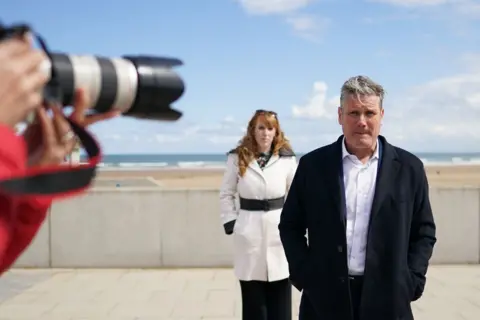 Getty ImagesIn May 2021, the deputy leader was removed from her post as party chairwoman
Outspoken and combative at times, Rayner repeatedly accused the Conservatives of being "out of touch", and hammered the party with lines such as "one rule for them and another rule for us" during the scandal over pandemic parties in Downing Street.
Sometimes Rayner admitted she had gone too far, once apologising for describing senior Conservatives as "a bunch of scum".
Her prominence and the venom of her political attacks had put a target on her back and attracted unwanted headlines.
In 2021, Rayner lashed out at "sexism and misogyny" in politics, after a newspaper reported that she crossed and uncrossed her legs during prime minister's questions to distract Boris Johnson.
And in 2024, she was investigated by the police over the tax paid on the sale of her council house, again following a slew of reports by unfriendly newspapers, cheered on by the Conservatives. She was not found to have committed a criminal offence.
 Getty Images
Her tendency to brush through political controversies gave her an air of untouchability, with some dubbing her "Teflon Ang".
Her stock had risen further still as deputy prime minister, leading on one of Labour's key pledges to build 1.5 million homes by 2030, and helping Sir Keir quell a rebellion by Labour MPs over welfare cuts.
But the political optics of a housing secretary admitting she had not paid enough when buying her £800,000 flat in Hove were not easy on the eye.
Rayner faced charges of hypocrisy and calls for her to stand down, and she did so after admitting arrangements on her family home in Greater Manchester meant she should have paid a higher rate.
She resigned from government after the prime minister's ethics adviser Sir Laurie Magnus declared that she had breached the ministerial code.
HMRC launched an investigation, and almost 10 months later, as a leadership crisis engulfed her party, a conclusion was reached.
Rayner announced she had settled £40,000 in unpaid stamp duty, and had been "exonerated" of the accusation she had "deliberately sought to avoid tax".
In an interview with the Guardian, the prime minister's former deputy did not rule out running in any Labour leadership race but said she would not "trigger" a contest.
Pressed over whether the prime minister should step aside, Rayner said: "Keir will have to reflect on that."
Losing such a key figure in his cabinet was a huge blow for Sir Keir and he has often suggested Rayner could return to his top team.
But with his leadership spinning out of control, and Health Secretary Wes Streeting thought to be plotting a bid to oust Sir Keir after resigning, Rayner has a range of choices.
Having overcome a difficult upbringing and personal adversity to climb the heights of the Labour Party and become only its second ever deputy prime minister, Rayner has once again become a key power player in British politics.
Angela RaynerLabour Party


